Governance
How to start a professional association: steps, costs and timeline
How to start a professional association in the US: testing the idea, choosing 501(c)(6) or 501(c)(3) status, forming a nonprofit corporation, the EIN, bylaws, applying to the IRS, yearly filings, setting dues, finding first members, and what it costs.
 Boopesh MahendranCo-founder, One Roof8 min read
Tap the picture to see it at full size.
In this article⌄
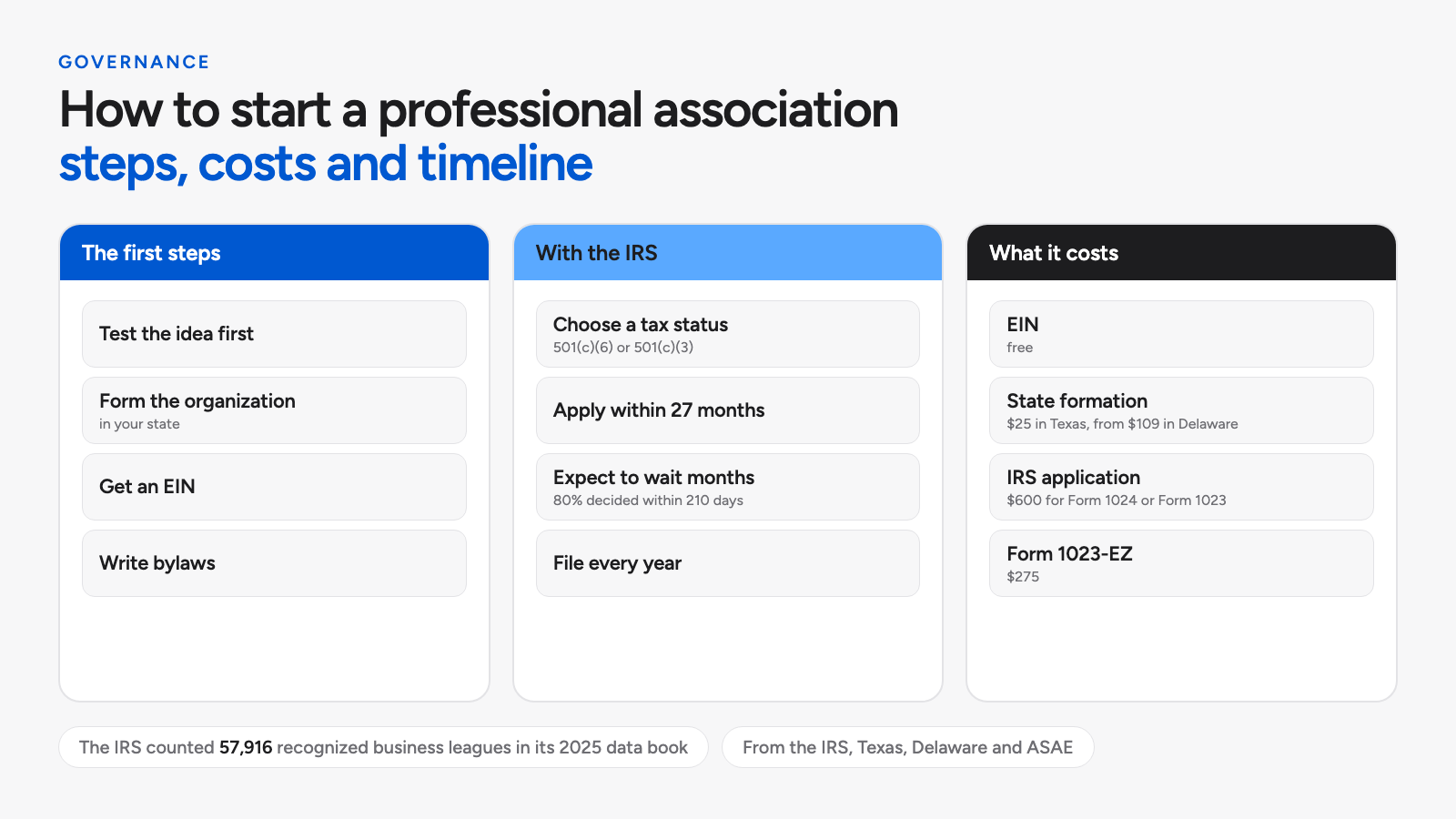
In its 2025 fiscal year, the IRS approved 1,392 applications from business leagues, the tax category that includes trade and professional associations. Its data book for that year counted 57,916 recognized business leagues in all.
Some began with a single social media page. The Association of Transgender Professionals began as a Facebook page in 2012. The National Cannabis Industry Association, founded in 2010, grew from 118 member businesses in 2013 to more than 800 members by 2015.
This guide covers the steps in order: testing the idea, choosing a tax status, forming the organization, the EIN, bylaws, applying to the IRS, yearly filings, dues, first members and staff, with what each step costs. It is about US associations, so check your own plans with a lawyer or accountant.
Test the idea first
Start by finding out whether enough people want to join. Several founders started with a free group, website or survey:
- The Graphene Council. Terrance Barkan built a LinkedIn group of more than 6,000 members in under three years, then began converting them to paid members. As Associations Now summarized his approach, he would build a large enough community, use it to develop content, then create a formal membership offer. He set it up as a for-profit company he owns, and runs it like an association.
- The Drone Pilots Association. Its founder built a simple WordPress website and announced the free association on Twitter. It had 600 members within 24 hours, and 1,000 within three days.
- The Influencer Marketing Association, launched in September 2019, made a survey of influencers its first project, to collect data on the field.
Then write the purpose in one or two sentences: who the members are, and what the association will do for their profession. You will use it in your bylaws and your IRS application.
Choose a tax status
Associations usually choose between two sections of the tax code. ASAE, the association for association staff, says its members are mainly “trade associations and individual membership organizations or professional societies organized under Section 501(c)(6) of the tax code and philanthropic organizations organized under Section 501(c)(3).”
501(c)(6), business leagues. The IRS says that “Trade associations and professional associations are business leagues.” A business league’s activities must be “devoted to improving business conditions of one or more lines of business as distinguished from performing particular services for individual persons.” It may lobby on issues related to its purpose. If it does, it may need to tell members what share of their dues went to lobbying, or pay a tax on that spending instead.
501(c)(3), charitable and educational organizations. Donations to these are tax-deductible, which helps with gifts and grants. The organization must be “organized and operated exclusively” for purposes such as charity or education. Lobbying is limited to an insubstantial part of its work, and it must stay out of political campaigns for or against candidates.
A 501(c)(6) suits an association whose main work is advancing its profession, including speaking up for it with lawmakers. A 501(c)(3) suits one whose main work is education or charity, funded partly by tax-deductible gifts.
Form the organization in your state
Next, form a nonprofit corporation by filing with your state. Two examples:
- Texas charges $25 for a nonprofit certificate of formation. The form asks for a registered agent, the person or company that receives legal papers for the organization, and “A minimum of three directors is required.” In place of an annual report, the Secretary of State may request an informational report at most once every four years.
- Delaware charges $109 to incorporate an exempt corporation, its category for nonprofit corporations. That covers a one-page certificate, plus $9 for each extra page. Each annual report costs $25, due by March 1.
Tax exemption is a separate step, with the IRS and with your state. The Texas Secretary of State explains that to become exempt, a nonprofit “must meet certain requirements and apply with both the Internal Revenue Service and the Texas Comptroller of Public Accounts.” Check your own state’s rules for state taxes as well.
Some groups start as an unincorporated association first. Texas defines one as “three or more members joined by mutual consent for a common, nonprofit purpose.” The Association of Transgender Professionals, which began as a Facebook page in 2012, formed one in January 2013.
Get an EIN
An employer identification number (EIN) is the association’s federal tax number. You need one for the IRS application. The IRS issues EINs online “in minutes for free.” The online session expires after 15 minutes of inactivity, so have the details ready before you start.
Write bylaws and a conflict of interest policy
Bylaws are the association’s own rules for how it runs. The U.S. Chamber of Commerce, in its plan for starting a chamber, lists what bylaws typically cover, including:
- The purpose.
- Membership categories, qualifications and privileges.
- The board of directors, and the officers’ qualifications, duties and terms.
- How directors are nominated and elected, and how vacancies are filled.
- How to change the bylaws, and how to dissolve the organization.
- Audits, and indemnification: protecting directors and officers against certain legal costs.
A conflict of interest policy is optional for exemption, and the IRS explains why it helps: “by adopting a policy, you will be choosing to put in place procedures that will help you avoid the possibility that those in positions of authority may receive an inappropriate benefit.” The yearly Form 990 also asks whether the organization had a written conflict of interest policy, and whether its leaders had to disclose possible conflicts each year.
Our guide to the association board of directors covers the board’s duties, the policies it needs, and antitrust rules for trade associations.
Apply to the IRS
The forms and fees for 2026, from the IRS user fee schedule:
| Status | Form | Fee |
|---|---|---|
| 501(c)(6) | Form 1024 | $600 |
| 501(c)(3) | Form 1023 | $600 |
| 501(c)(3), smaller organizations | Form 1023-EZ | $275 |
All three forms are filed online at Pay.gov, the federal payment site, and the fee is paid when you file. Form 1023-EZ is for organizations with projected gross receipts (all money received, before expenses) of $50,000 or less a year for the current year and the next two, past receipts of $50,000 or less, and assets of $250,000 or less.
Applying is optional for a business league. The IRS says most 501(c) organizations other than 501(c)(3)s “may self-declare their tax exempt status by operating within the requirements of the applicable code section and filing the required annual returns or notices.” They may still apply for a determination letter, the IRS letter confirming their exempt status. The IRS lists benefits such as “Public recognition of tax-exempt status,” “Possible exemption from certain state taxes” and “Nonprofit mailing privileges.” A 501(c)(3) generally must apply.
On timing:
- Apply within 27 months. If you file within 27 months after the month you formed, and the IRS approves, your exemption generally takes effect from the date you formed.
- Expect to wait months. As of October 2026, the IRS reports that it decides 80% of Form 1024 applications within 210 days, 80% of Form 1023 applications within 191 days, and 80% of Form 1023-EZ applications within 22 days.
- Keep filing while you wait. If a yearly return is due while your application is pending, the IRS says you still file it and note that the application is pending.
File every year
Unless an exception applies, yearly filings start when the association forms. In the IRS’s words, “your filing obligations began as soon as you were formed.” Most exempt organizations file an annual return, Form 990 or a shorter version. Those that normally have gross receipts of $50,000 or less can file Form 990-N, a short electronic notice.
“Organizations that do not file for three consecutive years automatically lose their tax-exempt status,” the IRS warns. To get it back, the organization must apply again, “even if the organization was not originally required to file an application for exemption.” So give one officer the task, with a reminder in the calendar, along with any state report, such as Delaware’s by March 1.
Set dues
For new chambers of commerce, which “depend on member dues as a primary source of income until other programs are developed,” the U.S. Chamber of Commerce suggests a simple method: add up the expected expenses, and divide by the number of members you expect to join in the first year. With fewer possible members, dues need to be higher.
Some associations start free and charge later:
- FaB Milwaukee, a food and beverage industry group, had brought employers together for more than a year when it introduced paid memberships. Company dues varied by size, and professional memberships for people outside member companies cost $100 a year.
- The National Cannabis Industry Association’s top tier cost $500 a year in 2015, and members at that level could run for a seat on the board.
Our guides to membership tiers and collecting dues online cover pricing and payment.
Find your first members
In the examples above, the first members came through the founders’ networks and online groups. A first event or project then gives people a reason to join:
- A launch event. Five international arbitration practitioners started ArabArb in 2022, and hosted a launch event during New York Arbitration Week.
- Useful data. The Influencer Marketing Association’s first project was a survey of influencers.
- A first conference. The National Cannabis Industry Association held its first national conference in June 2014, four years after it was founded.
Our guides to membership recruitment and launching an online community cover the next stage.
Decide who runs it
A new association can start with volunteers alone. ASAE notes that “Some associations are run entirely by volunteers at first.” As it grows, it can hire a staff executive as an employee, or an association management company, a firm that provides staff and services to several associations.
The Texas Dermatology Professionals Association shows how the steps can spread over years. According to its history:
- 2016: three physician assistants formed the Texas Society of Dermatology Physician Assistants and incorporated it in Texas.
- October 2023: it reincorporated under a new name, to include nurse practitioners.
- November 2023: it hired a management and conference planning company.
- April 29, 2024: the IRS recognized it as a 501(c)(6).
- May 2024: it held its first annual conference.
- 2025: it took its current name.
What it costs
The main official fees, from the IRS and the two states above:
| Step | Cost |
|---|---|
| EIN | Free |
| State formation | $25 in Texas, from $109 in Delaware |
| IRS application | $600 for Form 1024 or Form 1023, $275 for Form 1023-EZ |
| Yearly state report | $25 in Delaware; Texas asks for a report at most once every four years |
Budget as well for legal and accounting advice, a registered agent if you use a company, and the tools to run membership, events and communication.
Where One Roof helps
- Discussions give founding members a place to talk from the first day, in a space your association runs.
- Dues can be paid in One Roof, through your own Stripe account, with a yearly or monthly price for each member type.
- Events handle registration for a launch event or a first conference, with member and non-member prices.
- Member directory lets members find each other, searchable by expertise.
Questions about starting a professional association
How much does it cost to start a professional association?
In Texas, the official fees come to $625: a free EIN, $25 to form a nonprofit corporation and $600 for the IRS application on Form 1024. In Delaware, formation starts at $109. Legal and accounting advice, a registered agent and software come on top.
How long does it take to start a professional association?
An EIN takes minutes online, and state filing times vary. IRS recognition takes longer: the IRS decides 80% of Form 1024 applications within 210 days. Apply within 27 months of forming, and your exemption generally dates back to the day you formed.
Should a professional association be a 501(c)(6) or a 501(c)(3)?
Professional associations are generally 501(c)(6) business leagues, which may lobby on issues related to their purpose. A 501(c)(3) suits an organization focused on education or charity, since donations to it are tax-deductible.
How many people do you need to start an association?
It depends on the state. A Texas nonprofit corporation needs at least three directors, and Texas defines an unincorporated nonprofit association as three or more members.
Does a professional association have to apply for tax-exempt status?
Applying is optional for a business league. It may still apply for an IRS determination letter, which brings public recognition of its exempt status and can help with state tax exemptions. A 501(c)(3) generally must apply, on Form 1023 or Form 1023-EZ. Almost every exempt organization, business leagues included, files a yearly return or notice, and missing three years in a row ends the exemption automatically.