Membership dues
How to collect membership dues online: auto-renewal, fees and failed payments
How to collect membership dues online: annual or monthly plans, what card and bank fees cost, who can pay the fee, auto-renewal rules, and what to do when a payment fails.
 Boopesh MahendranCo-founder, One Roof8 min read
Tap the picture to see it at full size.
In this article⌄
- What the research shows
- Step 1: Choose annual, monthly or installments
- Step 2: Know what each payment costs
- Step 3: Decide who pays the fee
- Step 4: Set up auto-renewal the way the law expects
- Step 5: Plan for failed payments
- Step 6: Keep card details off your systems
- Step 7: Tell members the part they cannot deduct
- Mistakes to avoid
- Where One Roof helps
- Questions about collecting dues online
Most associations already take dues online. The decisions that matter come after the payment form: whether dues renew on their own, what each payment costs, who pays that cost, and what happens when a card is declined at renewal. This guide covers each, with the rules that apply in the US.
What the research shows
- Automatic renewal is common, not universal. In Marketing General Incorporated’s 2024 benchmarking report, “38% of associations offer automatic annual credit card renewal.”
- Renewal by bank debit goes with higher renewal rates. The same report found associations with renewal rates of 80% or higher “significantly more inclined” to offer automatic renewal by bank debit (EFT) or help for members facing hardship. That is a link, not proof that one causes the other.
Step 1: Choose annual, monthly or installments
- Annual is simplest: one payment, one renewal date, one reminder.
- Monthly makes a high fee easier to pay, but a card can fail twelve times a year instead of once.
- Installments spread an annual fee over a few payments. In the same MGI report, 23% of associations offered monthly or quarterly installments to recruit members.
Whichever you choose, set one renewal date per member, and show the total for the year next to any monthly price.
Step 2: Know what each payment costs
Stripe’s standard US pricing is typical:
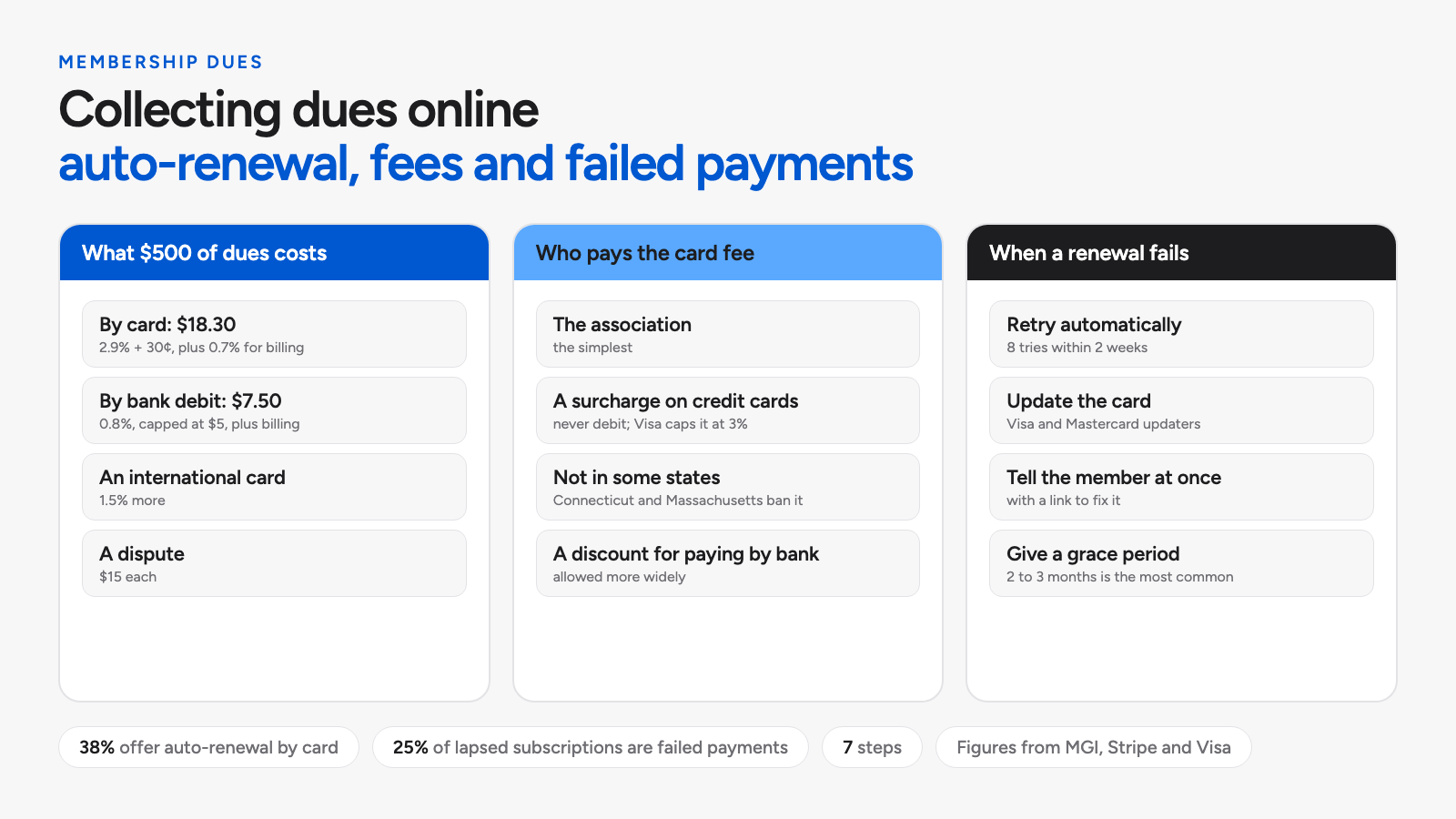
- Cards: 2.9% + 30¢ for a domestic card, plus 1.5% for an international card, and 1% more if currency conversion is needed.
- Bank debit (ACH): 0.8%, capped at $5.
- Recurring billing: Stripe Billing adds 0.7% of what it bills.
- Disputes: $15 each.
On $500 of annual dues, that works out at:
- By card: $14.80 in card fees plus $3.50 for billing, so $18.30.
- By bank debit: $4.00 plus $3.50, so $7.50.
The bigger the dues, the more a bank debit saves.
Step 3: Decide who pays the fee
There are three choices: absorb it, add a surcharge to card payments, or give a discount for paying by bank.
Surcharges have rules. Under Visa’s merchant guidance, a surcharge must be:
- on credit cards only, never debit or prepaid cards
- no more than your processing cost, or 3%, whichever is lower
- announced to your processor at least 30 days before you start
- shown before the member pays, and on every receipt
Mastercard caps surcharges at your cost of accepting the card, up to 4%. It does not allow them on debit cards either.
Some states ban them. Connecticut and Massachusetts prohibit card surcharges. New York requires the price shown to include the surcharge, or a separate card price next to the cash price.
A discount is simpler. Connecticut’s law, which bans surcharges, still allows “a cash discount”. On $500 of dues, a bank debit costs $10.80 less than a card, so a discount of up to that amount costs you nothing.
Step 4: Set up auto-renewal the way the law expects
- Get clear consent. California’s automatic renewal law requires “express affirmative consent”. Members who signed up online must be able to cancel online.
- Send the notices it asks for. On a yearly plan, members must be told 15 to 45 days before each renewal. A price change needs notice 7 to 30 days ahead. These rules apply to memberships started, changed or extended since July 1, 2025.
- Know who it covers. The California law protects a “consumer”, meaning an individual buying “for personal, family, or household purposes”. Dues an employer pays may fall outside it; a member paying their own may not.
- Watch the federal rule. The FTC’s click-to-cancel rule (its amended Negative Option Rule) was struck down by a federal appeals court in July 2025. The FTC started again in March 2026.
- Check other states. Other states, and DC, have automatic renewal laws of their own. Washington, DC’s, the law firm Venable noted, “affects all companies, nonprofit and for-profit”.
- Remind members before you charge. The American College of Cardiology emails members “30 days before debiting your card”. A month’s notice also heads off disputes from members who forgot.
Step 5: Plan for failed payments
Cards expire, get replaced and hit limits. Some figures:
- A big share of lost subscribers. Stripe found that “Twenty-five percent of lapsed subscriptions are purely due to payment failures.”
- Most recoveries are quick. Recurly reports that “90% of recovered transactions occur within the first 10 days of a failed payment.”
What helps:
- Retry automatically. Stripe’s recommended default is “8 tries within 2 weeks”.
- Update cards automatically. Visa and Mastercard run updater services that pass new card numbers and expiry dates to the merchant. Stripe applies them to saved cards.
- Tell the member at once, with a link to update their card.
- Give a grace period before access ends. In the MGI report, 48% of associations give two to three months, and 19% give none.
Step 6: Keep card details off your systems
Use a payment page hosted by your processor. Then you qualify for the card industry’s simplest self-assessment, SAQ A, which is for merchants that “outsource all payment processing and do not store, process or transmit cardholder data”. You still confirm it every year. Stripe calls PCI compliance “a shared responsibility”.
Step 7: Tell members the part they cannot deduct
If your association lobbies, you may have to tell members how much of their dues they cannot deduct as a business expense.
- Who it applies to. The IRS rule covers certain tax-exempt organizations, including trade and professional associations (501(c)(6)). There are exceptions for small amounts.
- What the figure is. The share of dues spent on lobbying or political activity.
- If you do not tell members, the association pays a “proxy tax” instead.
Put the figure on the dues invoice or receipt.
Mistakes to avoid
- Auto-renewal turned on without asking. It invites disputes, and in some states breaks the law.
- No reminder before an annual charge. The member sees $500 on their card and calls their bank.
- A failed payment that nobody follows up. The member lapses without knowing.
- A surcharge on debit cards, or in a state that bans them.
- Monthly plans with no annual total shown. Members feel misled when they add it up.
Where One Roof helps
One Roof can collect membership dues as part of the member community:
- Dues go into your association’s own Stripe account. Stripe’s standard fees apply, and One Roof takes nothing on top.
- Plans can be yearly or monthly, and renew automatically.
- Members pay on Stripe’s own checkout page, so card details never touch One Roof.
- In Stripe’s billing portal, members update their card, see their invoices, and turn off auto-renewal, which then takes effect at the end of the term they paid for.
- When a renewal fails, the member is told at once and keeps their access for a 14-day grace period, then becomes a free member.
- Renewal reminder emails skip members whose dues renew on their own.
- If your membership system already takes dues, switch dues off, and join links go there instead.
Questions about collecting dues online
How do associations collect membership dues online?
Through a payment processor such as Stripe, on a page the processor hosts. Members pay by card or bank debit, once or on a schedule, and the money goes to the association’s account.
Should membership dues renew automatically?
Offering automatic renewal is common: 38% of associations offer it by card. Ask for clear consent, remind members a month before each annual charge, and make cancelling easy.
How much does it cost to accept dues by card?
At Stripe’s standard US rates, 2.9% plus 30 cents per card payment, plus 0.7% for recurring billing. On $500 of dues that is about $18.30 by card, or $7.50 by bank debit.
Can an association charge members a fee for paying by card?
Sometimes. Only on credit cards, never debit cards, and capped at your processing cost or 3%, whichever is lower, under Visa’s rules. Some states ban it. A discount for paying by bank is allowed more widely.
What happens when a recurring dues payment fails?
The processor retries over the following days and tries to update the card. Tell the member at once, and allow a grace period before their access ends.
Are membership dues tax deductible?
Dues to a trade or professional association can be a business expense for a business or a self-employed member, but not the part the association spends on lobbying. Most trade and professional associations (501(c)(6)) that lobby must tell members what that part is, or pay a proxy tax on it.

