Member retention
Membership renewal emails: templates, timing and what to say
Membership renewal emails for associations: when to send them, what every renewal email needs, subject lines, five templates, grace periods, automatic renewal notices, the CAN-SPAM rules, sending fewer and better reminders, and what to measure.
 Boopesh MahendranCo-founder, One Roof7 min read
Tap the picture to see it at full size.
In this article⌄
Most associations renew members by email. In Marketing General’s 2024 benchmarking report, 98% of associations used email for renewals, and 85% named email among the channels that bring in the most renewals, far ahead of phone calls (25%) and mail (22%). The median renewal rate was 85%, and 75% for first-year members.
Some lapses are easy to prevent. 29% of associations named forgetting to renew among the top three reasons members lapse. A clear, well-timed email helps with that one.
This guide covers when to send renewal emails, what each needs, subject lines, five templates, grace periods, automatic renewal, the email rules, and what to measure.
When to send them
In the same report:
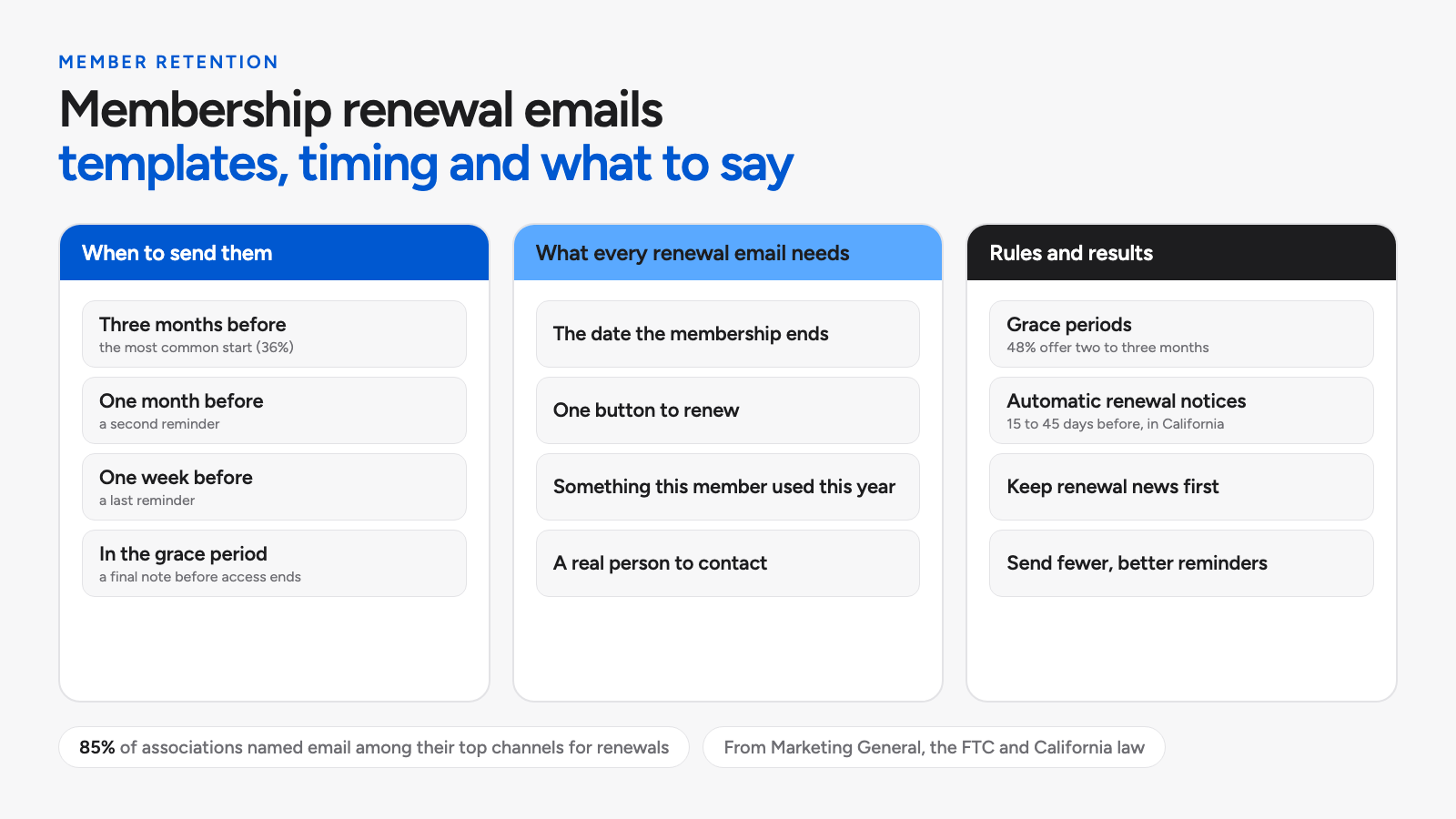
- Starting: three months before the membership ends was most common (36%), followed by two months (20%).
- Stopping: three months after it ends was most common (26%). 22% of associations keep contacting lapsed members indefinitely.
- How many: associations that use each channel contact a member up to six times by email, three times by mail and three times by phone, on average.
- Phone as well as email: 54% also phoned members, and associations with renewal rates of 80% or more were significantly more likely to call.
A simple series to start from:
- Three months before: the first reminder.
- One month before: a second reminder.
- One week before: a last reminder.
- In the grace period: a final note before access ends.
Our guide to member retention covers renewal practices beyond email.
What every renewal email needs
- The date the membership ends, near the top.
- The price, and what is included.
- One button to renew, going straight to payment, already signed in if possible.
- Something this member used this year, such as events they attended or credit they earned.
- How to update a card, for those on automatic renewal.
- A real person to contact, with a name and email address.
Naming what the member is working toward matters too, such as the credential they are keeping current. In a bank experiment in Peru by Dean Karlan and colleagues, reminders that mentioned the specific thing a person was saving for increased savings by an estimated 16% compared with no reminder. Reminders that did not mention it had no effect.
Subject lines
Put the important words first. In 2014, Nielsen Norman Group advised keeping subject lines to about 40 characters, because readers “often read only the first few words of a subject line.” Some examples:
- “Your membership ends March 31”
- “Renew by Friday to keep your member rate”
- “Your [year] membership: renew in one click”
The research differs on using names. Nielsen Norman Group advises leaving the recipient’s name out of the subject line. A field experiment published in Marketing Science found that adding the recipient’s name raised opens from 9.05% to 10.80%. Test both with your members.
Five templates
Adapt these to your association’s voice. Text in brackets is for you to fill in.
1. First reminder (three months before)
Subject: Your membership ends [date]
Hi [first name],
Your [association] membership ends on [date]. Renew now to keep [two benefits they use], without a break.
This year you [attended two webinars / earned 12 credits / posted 8 answers in the community].
[Renew for $X]
Questions? Reply to this email, or contact [name] at [email].
2. Second reminder (one month before)
Subject: One month left on your membership
Hi [first name],
Your membership ends on [date]. Renewing takes a minute, and keeps your member rate for [upcoming event].
[Renew for $X]
Questions? Contact [name] at [email].
3. Last reminder (one week before)
Subject: Your membership ends next [day]
Hi [first name],
A quick reminder that your membership ends on [date]. Renew today to keep access to [the community, member prices and your credit record].
[Renew for $X]
Questions? Contact [name] at [email].
4. Grace period
Subject: Your membership has ended, renew to keep access
Hi [first name],
Your membership ended on [date]. You still have access until [end of grace period], so you can renew without missing anything.
[Renew for $X]
If you are moving on, we would welcome a reply telling us why. Questions? Contact [name] at [email].
5. Automatic renewal notice
Subject: Your membership renews on [date]
Hi [first name],
Your membership will renew automatically on [date] for another year, and we will charge $X to your card ending [1234].
Your membership will continue automatically. To update your card or cancel automatic renewal, [manage your membership].
Questions? Contact [name] at [email].
Grace periods
A grace period gives members time to renew after the end date without losing access. In the 2024 report, 48% of associations offered two to three months, and 19% offered none. Associations with renewal rates of 80% or more were more likely to offer two to three months.
IEEE’s renewal toolkit shows a full cycle. For its 2025 membership year, renewal opened on September 3, 2024, memberships ended on December 31, and a grace period ran to February 28, 2025, with a “Last Chance to Renew” message during it.
Automatic renewal
38% of associations offered automatic annual renewal by card. Some send a notice before charging:
- The American College of Physicians sends an email 30 days before payment, with a chance to opt out.
- The American Hospital Association’s personal membership groups send a reminder 30 days before, show any new price in it, and let members cancel up to five days before renewal.
Some states set rules for these notices. California’s automatic renewal law requires businesses to send a notice 15 to 45 days before renewal for plans of a year or longer. Among other things, it must say the plan will renew, for how long, the cost, and how to cancel, with a cancellation link if sent by email. Ask your counsel how these rules apply to your dues. Our guide to collecting dues online covers automatic renewal in more detail.
Keep renewal news first
Under US email law, messages about a membership can count as “transactional or relationship” messages. The Federal Trade Commission’s guide to CAN-SPAM includes messages that notify the recipient “about a change in the terms or features of a membership” or “a change in their standing” with it.
The FTC says the law views these categories narrowly. In a message that mixes renewal news with promotion, if the subject line suggests a promotion, or the renewal information is not mainly at the beginning, the message counts as commercial. So put the renewal details first, and send offers for events or products separately.
Send fewer, better reminders
A reminder brings more action, at a cost. In a charity study by Mette Trier Damgaard and Christina Gravert, a second email a week after the first raised donations, but it also raised unsubscribes from the mailing list. Telling people in advance that they would receive fewer emails reduced unsubscribes.
So make each reminder count, and stop sending once a member has renewed.
A note on what others do can help too. In UK tax letter trials, telling people that most others pay on time raised payment rates. If most of your members renew, say so with your own figure, such as “8 in 10 members renew each year.”
What to measure
- Renewal rate, overall and for first-year members.
- Which email in the series produced each renewal.
- Opens, clicks and unsubscribes for each email.
- Renewals during the grace period.
- Members who switch to automatic renewal.
Where One Roof helps
- Renewal reminders: a ready-made set of reminders before renewal. You can edit the subject and opening line of each, preview it, send yourself a test, and see how many were sent and clicked.
- Dues: if you take dues in One Roof, members renew through your own Stripe account, with a yearly or monthly price for each member type.
- Members at risk: paying members who have gone quiet are listed with their renewal date, so staff can reach them in time.
Questions about membership renewal emails
When should you send membership renewal reminders?
The most common choice is to start three months before the membership ends (36% of associations) and to stop three months after it ends (26%). A series of a first reminder, a second one month before, a last one week before and a grace period note covers most needs.
What should a membership renewal email include?
The end date, the price, one button to renew, something the member used this year, how to update a card, and a person to contact.
How many renewal emails should you send?
Associations that email members about renewal contact each member up to six times on average, in Marketing General’s 2024 report. Make each one useful, and stop as soon as a member renews.
Is a membership renewal email a marketing email?
It can be a transactional or relationship message, if its main purpose fits one of the FTC’s categories, such as a change in the member’s standing. It counts as marketing if the subject line suggests a promotion or the renewal details are not at the beginning. If in doubt, include an unsubscribe link.
Should you offer a grace period?
Most associations do. 48% offer two to three months, and associations with higher renewal rates are more likely to.

