Member retention
Why association members lapse, and what the renewal figures show
Association member retention explained: renewal rate benchmarks by type, why members lapse, the first-year problem and the renewal practices tied to higher rates.
 Boopesh MahendranCo-founder, One Roof9 min read
Tap the picture to see it at full size.
In this article⌄
Association member retention is the share of last year’s members who are still members this year. The median association keeps a little over 80% of its members, and between 72% and 75% of its first-year members. This article covers how to calculate the rate, what a good rate looks like, why members lapse, and what associations with higher rates do differently.
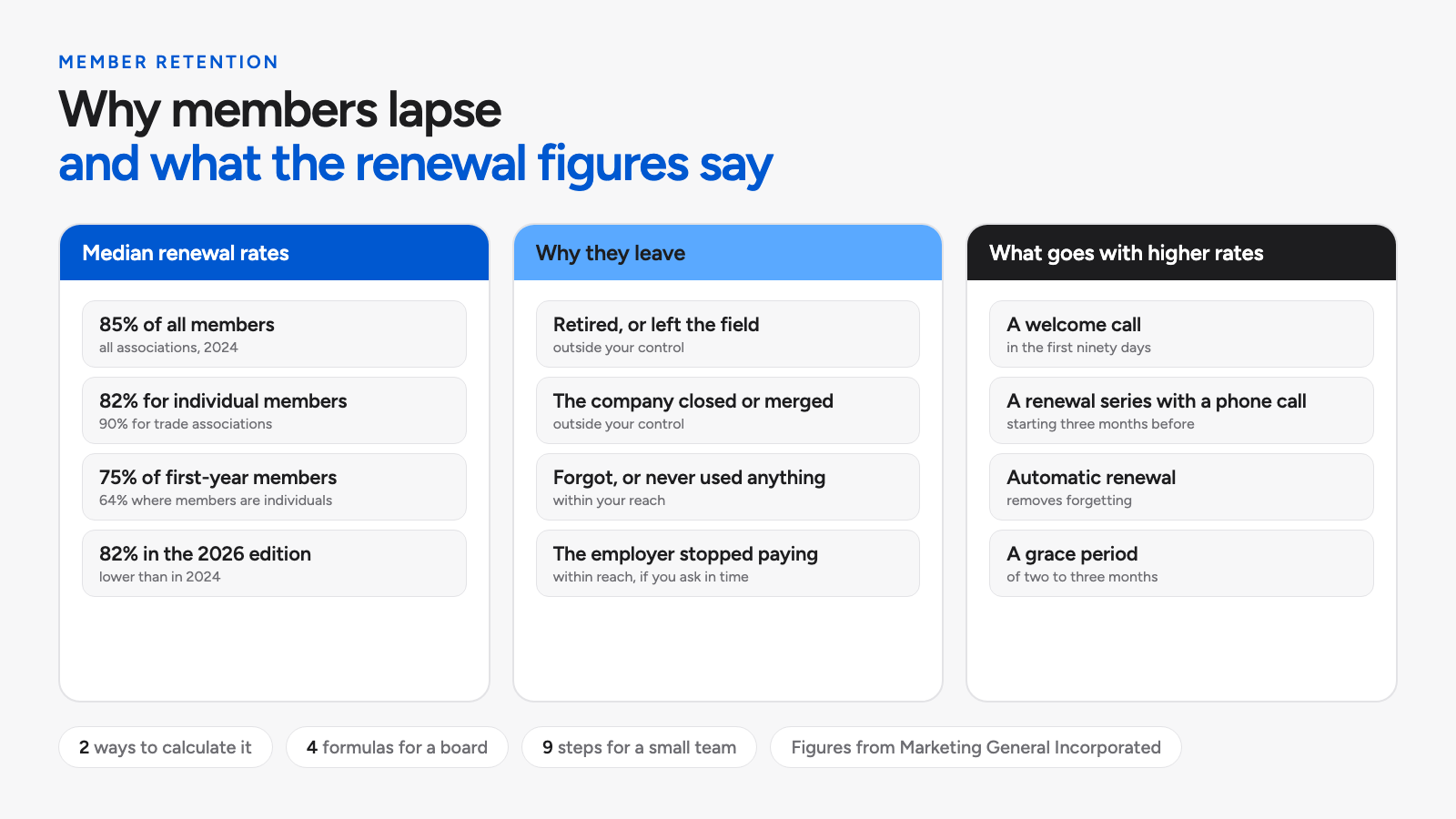
The numbers in brief
| Median | |
|---|---|
| Overall renewal rate, all associations | 85% |
| Individual-member associations | 82% |
| Trade associations | 90% |
| First-year members, all associations | 75% |
| First-year members, individual-member associations | 64% |
| First-year members, trade associations | 85% |
These figures come from Marketing General Incorporated’s 2024 Membership Marketing Benchmarking Report, a survey of nearly 700 associations. Rates have dropped a little since. In 2026 the overall median was 82%, according to Tony Rossell, who oversees the report, and first-year renewal was 72%, according to a published summary.
How to calculate your membership retention rate
There are two common methods:
- From the whole membership. Take your members today, leave out everyone who joined in the last twelve months, and divide by the number you had a year ago. This is the formula in Rossell’s Essential Math for Membership Marketers. With 10,500 members today, 1,500 of them new, and 10,000 a year ago, the rate is 90%.
- From the members who came due. Divide the members who renewed by the members whose membership was up for renewal in the period.
They give different answers when you have multi-year memberships, members who lapse and rejoin, or renewals bunched into one quarter. Either is fine. Pick one, write it down, and use it every year.
The share you lose each year is your lapse rate: a 90% renewal rate means a 10% lapse rate. Rossell’s article shows two useful things it tells you:
- How long members stay. Divide 1 by the lapse rate. If you lose 10% a year, the average member stays ten years. If you lose 20%, five.
- How big you can grow. Divide the new members you recruit each year by the lapse rate. Recruit 1,500 a year and lose 10%, and membership levels off at 15,000. Lose 15%, and it levels off at 10,000.
The second explains why many associations stop growing even though recruitment holds steady.
What is a good membership retention rate for an association?
It depends on who your members are. Nine in ten trade associations keep at least 80% of their members each year. Only six in ten individual-member associations do. A company renews as a line in its budget. An individual often pays personally and decides again every year.
First-year members are the most likely to leave. Nearly four in ten individual-member associations lose more than 40% of their new members after the first year. Smaller associations do better here: those with up to 1,000 individual members keep significantly more of their first-year members than larger ones.
Your own history is a better guide than any median. Elizabeth Weaver Engel of Spark Consulting gives an example: an association that usually renews 65% of members should aim for 67% next year, not 80%. And a society that has renewed 91% for ten years has a problem at 87%, even though 87% is above the median.
Why members do not renew
Most articles list the same reasons members lapse: lack of engagement, lack of value, forgetting to renew. These are usually presented as what lapsed members said. They actually come from surveys of association staff.
What staff think
The MGI survey asks executives what they “believe are the top reasons members do not renew.” In 2024, choosing up to three:
- Lack of engagement with the organisation: 47%, and 64% among trade associations
- Lack of perceived value: 32%
- Forgot to renew: 29%
- Left the field, industry or profession: 27%
- Employer does not pay dues: 24%, and 32% among individual-member associations
Another staff survey, the iMIS 2025 Membership Performance Benchmark Report, puts budget first (55%), ahead of engagement (47%). So even staff disagree on whether money or engagement matters most.
What members say
Surveys of members themselves are rarer, both of the recent ones were run by software vendors, and they disagree. Momentive Software’s 2026 research found fewer members intending to renew (48%, down from 56%). Higher Logic’s 2025 survey found more planning to stay at least five years (83%, up from 74%).
One finding is worth noting: when Momentive asked members which benefits matter most for renewal, the top answer was “Providing ways that members can collaborate, share, and create community”.
The only reliable way to learn why your own members left is to ask them.
Lapses you can prevent and lapses you cannot
Before setting a target, split last year’s lapses into two groups.
Outside your control:
- Retired
- Left the profession or industry
- Company closed or merged
- Moved somewhere you have no chapter
Within your reach:
- Forgot, or the reminder went to an old address
- Never used anything in the first year
- Did not see enough value for the price
- Employer stopped paying, and no one offered another way to pay
The first group can be large. In 2024, 42% of trade associations named a company closing or merging as a reason members did not rejoin.
An employer that stops paying is in the second group for a reason. Some members will pay for themselves if you ask before their membership lapses and offer instalments or a lower rate.
The first year
New members pay before they know whether the membership is useful, and the first renewal notice often comes before they have found out. Three kinds of new member are most likely to leave: those who joined for a conference discount, those whose employer paid, and those who joined for one thing, such as a certification.
ASAE’s onboarding guidance notes that “engagement within the first 90 days is a critical indicator of first year renewal.” Within three months a new member should have:
- Spoken to a person. According to MGI, associations that keep more than 80% of first-year members are significantly more likely to make welcome phone calls.
- Used one benefit, such as a resource, an event or an answer to a question.
- Met another member, at a chapter meeting, through a mentor or in the community.
- Been told what is next for them, such as a nearby event or the credit they still need.
A word of caution, which applies to the renewal findings below too. These surveys show what associations with high renewal rates do. They do not show that doing it caused the high rates. For example, trade associations renew more members and are also far more likely to make welcome calls (48% of them, against 11% of individual-member associations).
Members who go quiet
After the first year, look out for members who:
- have not signed in for three months, or six
- have never taken part
- are short of credit as their recertification cycle ends
- have no connections with other members
Contact the ones whose renewal is within ninety days first.
Renewal practices
These figures are all from the 2024 MGI report.
- When to start. Three months before the membership ends is the most common start. The most common time to stop is three months after it ends, and 22% never stop.
- Phone as well as email. Almost all associations renew by email, and about half also phone members. Associations with renewal rates of 80% or more are significantly more likely to phone. A call also tells you why a member is not renewing.
- One date or anniversaries. About half renew everyone on one date, and half on the anniversary of joining. Associations with higher renewal rates more often use one date.
- Automatic renewal. 38% offer it. It stops members lapsing simply because they forgot. Tell members before you charge them and make cancelling easy. Some US states, including California, require both.
- Instalments and hardship rates. Associations whose renewals are falling are more likely to offer these. That is probably because they added them in response, not because the options made renewals fall.
- A grace period. Two to three months is the most common, and is more common among associations with higher renewal rates. About one in five gives none. Decide what members keep during it, for example access to the community but not member prices.
To win back members who have already lapsed, ask them briefly why they left, keep their record so that rejoining restores everything, and tell them what has changed since. A message from another member can help: in the iMIS survey, 56% of organisations said it worked for them.
None of this will keep members who no longer find the membership worth paying for. As Rossell puts it, an association “cannot renew its way into growth” unless it fixes “a major flaw in its value proposition or renewal system.”
Where One Roof helps
One Roof is a community platform for associations, with a members at risk list. It shows paying members who have gone quiet, with the reason for each: never active, quiet for three months or more, short of credit as a cycle ends, no connections, a recent post suggesting they are unhappy, or a renewal coming up. Staff can filter to renewals within 30 or 90 days, log each contact, and see how many contacted members became active again. It also includes a welcome series and a renewal reminder.
Renewal dates come from your membership system, which stays the record of who has paid. To report the result to your board, see measuring what the community is worth.
Questions about member retention
What is a good membership retention rate for an association?
The 2024 median was about 82% for individual-member associations and 90% for trade associations. Above 80% is often called healthy, but your own last five years are a better guide.
What is the average first-year renewal rate?
75% across all associations in 2024, 64% for individual-member associations and 85% for trade associations. Later summaries put it at 72% to 74%.
Why do members not renew?
Staff most often name lack of engagement, budget, lack of value and forgetting, though surveys disagree on the order. Some lapses, such as retirement or a company closing, cannot be prevented.
How do you calculate membership retention rate?
Take today’s members, subtract those who joined in the last twelve months, and divide by last year’s total. Or divide the members who renewed by those who came due. Use the same method every year.
How long should a membership grace period be?
Two to three months is most common, used by about half of associations, and more common among those renewing 80% or more.
When should renewal reminders start?
Three months before the membership ends is the most common start, and three months after it ends the most common time to stop.

