Engagement
Association social media strategy: platforms, what to post, and where your community fits
An association social media strategy: which platforms your members use, what social media does well for associations, what to post, member ambassadors, where your own community fits, handling comments, a social media policy, disclosing sponsored posts, and what to measure.
 Boopesh MahendranCo-founder, One Roof7 min read
Tap the picture to see it at full size.
In this article⌄
Social media is part of how associations reach members every week. In Naylor’s 2025 benchmarking report, associations contacted members about 30 times a month across digital, print, social media and video. LinkedIn ranked fourth among the tools associations valued most, rated very or extremely valuable by 87%. Naylor sells marketing services to associations.
This guide covers where your members are, what social media does well, what to post, member ambassadors, where your own community fits, comments, a social media policy, sponsored posts, and what to measure.
Where your members are
Pew Research Center’s 2026 survey of 5,511 US adults found these shares using each platform:
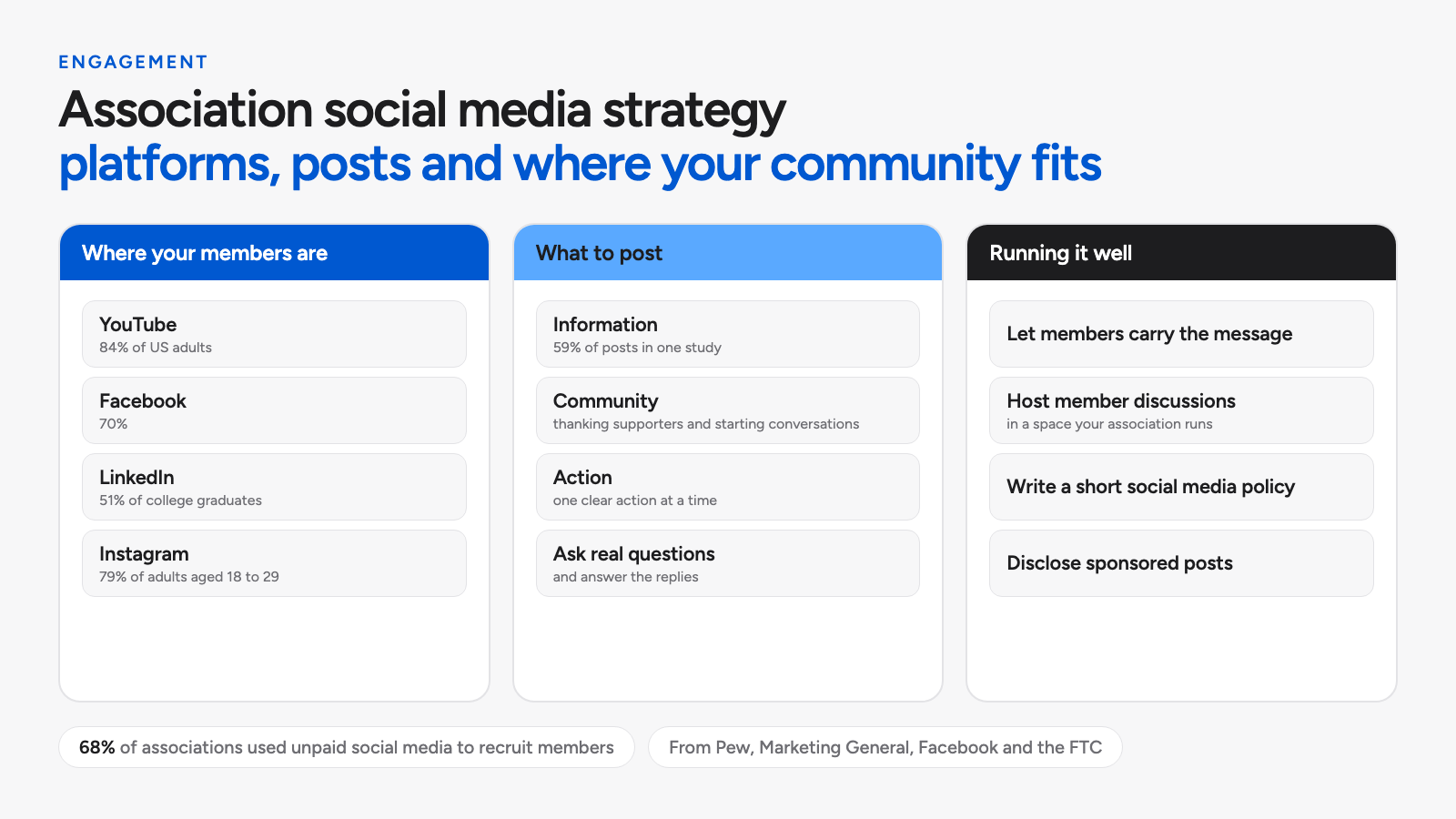
- YouTube: 84%.
- Facebook: 70%.
- Instagram: 51%.
- TikTok: 37%.
- LinkedIn: 31%.
- X: 18%.
The mix depends on who your members are:
- LinkedIn suits professional associations. It is used by 51% of college graduates and 45% of adults with household incomes of $100,000 or more.
- Facebook reaches most age groups, from 59% of adults aged 65 and over to 78% of those aged 30 to 49.
- Instagram and TikTok reach younger members best. 79% of adults aged 18 to 29 use Instagram, against 21% of those aged 65 and over.
Choose two or three platforms you can keep up with well.
What social media does well
Reaching future members. In Marketing General’s 2024 benchmarking report, 68% of associations used unpaid social media to recruit members, and 16% of all associations surveyed named it among their three most effective channels. Paid digital advertising was used by 40%, and associations whose membership grew said it was one of their most effective ways to recruit.
Welcoming members. In the same report, 35% of associations invited new members to follow them on social media.
Running a campaign. For its first Healthcare Simulation Week, an online awareness week, the Society for Simulation in Healthcare asked members to act as social media ambassadors. Its hashtag made more than 14,000 impressions on Twitter, and its Facebook video views more than doubled.
Supporting advocacy. The American Society of Gene and Cell Therapy created a hashtag to use whenever it posts about its advocacy on LinkedIn, Facebook and other platforms. “We know members are on social media and so are elected officials,” said its director of policy and advocacy, Margarita Valdez Martínez.
What to post
A study of the 100 largest US nonprofits, by Kristen Lovejoy and Gregory Saxton, sorted a month of 2009 tweets from the 73 that used Twitter into three kinds:
- Information about the organization and its work: 59% of posts.
- Community, such as thanking supporters and starting conversations: 26%.
- Action, such as asking people to donate, attend or sign up: 16%.
In that study, most posts were information. Associations can give more space to the other two: thank volunteers and sponsors by name, feature a member each week, and ask for one clear action at a time.
Conversation matters to the platforms too. When Facebook changed its News Feed in 2018, it said that “Page posts that generate conversation between people will show higher in News Feed,” and that it would continue to demote “engagement-bait” designed to goad people into commenting. So ask real questions, and answer the replies.
LinkedIn says that companies posting weekly see twice the engagement, and that images typically double the comment rate. These are LinkedIn’s own figures, so treat them as a guide.
Let members carry the message
Members can reach people beyond the association’s own followers. Some examples:
- The National Association for Community College Entrepreneurship asked members to like and retweet its Twitter posts during National Entrepreneurship Week. That brought nearly 800 likes and more than 100,000 impressions, across seven countries and 10 states.
- The American Academy of Ophthalmology chose seven physicians to post from its 2017 annual meeting for those attending online. They were asked to post at least twice a day, and told that authenticity mattered most.
Give ambassadors a hashtag, a few sample posts, and a clear ask.
Where your own community fits
Social platforms are rented space. Each sets its own rules and can change them. In 2018, LinkedIn removed features from its groups, including the ability to send group posts to members by email. “This is what you get when you–and your community members–are the product and you build your home on borrowed land,” the community consultant Maggie McGary wrote on her blog, as quoted in Associations Now.
Reach changes too. When Facebook made its 2018 change, it warned that “Pages may see their reach, video watch time and referral traffic decrease.”
Some associations use both. The National Association for Community College Entrepreneurship used public posts to raise awareness, a private Facebook group where members swapped lesson plans, and a members-only web page to keep the resources they shared. The Michigan Veterinary Medical Association had tried formal online communities, but members said they already had too many from other associations. It moved them to a private, members-only Facebook page, and “It really took off,” said its chief executive, John Tramontana.
A good split is to use social media to reach people and invite them in, and to host member discussions, member-only resources and member data in a space your association runs.
Decide how you will handle comments
Decide how you will handle difficult comments before you need to. In 2025, the National Association of Social Workers stopped posting on X after it removed guardrails against misinformation. Citing “an increase in incivility” on Facebook and Instagram, it also closed comments on most of its posts there. Write down what you will hide, what you will answer, and who decides.
Write a short social media policy
Volunteers and chapter leaders post too, so set a few rules in writing. Some associations publish theirs:
- Who speaks for the association. The New York State Bar Association’s policy says members must not imply “that you are acting on behalf of the NYSBA or that you have an official NYSBA opinion unless authorized to do so.”
- Who may create official accounts. The American Society of Safety Professionals requires official authorization for any account that uses its name or logo.
- Personal opinions marked as personal. ASSP asks volunteers to identify “Anecdotes and personal opinions” as such, so readers can tell them apart from the society’s view.
- How comments are handled. The Association of Legal Administrators says its staff correct inaccurate posts on its pages, and delete posts only when they break its policies.
Trade associations have one more rule to add. Members are often competitors, and antitrust law applies online too. The Insights Association’s antitrust policy covers “forums, webinars, group emails, chats,” and prohibits “any discussions of pricing.” Our guide to the association board of directors covers antitrust in more detail.
Disclose sponsored posts
When a sponsor pays for a post, or a member or employee promotes a product they have a connection to, say so. The Federal Trade Commission’s Endorsement Guides say a connection that “might materially affect the weight or credibility of the endorsement” must be “disclosed clearly and conspicuously” when the audience would not expect it. The FTC adds that a platform’s own disclosure tool may not be enough on its own.
Label sponsored posts in the text of the post, and give ambassadors simple disclosure rules.
What to measure
- Clicks from social media to your join page and event registrations.
- New members who say they found you on social media.
- Shares by members, and comments that start a conversation.
- Followers who could become members, by platform.
Our guide to membership recruitment covers the other channels associations use to recruit.
Where One Roof helps
- Discussions give members a place your association runs, with spaces open to all members or limited to paying members.
- Email digests and announcements reach members directly: digests on the schedule each member chooses, and announcements to all members or the followers of one space.
- Sponsorship places are always labeled as sponsored, with views and clicks counted.
Questions about association social media
Which social media platform is best for associations?
For professional associations, usually LinkedIn: 51% of US college graduates use it. Facebook is used fairly evenly across age groups, and Instagram and TikTok reach younger members.
How often should an association post on social media?
Regularly enough that followers expect you, such as a few times a week. LinkedIn says companies that post weekly see twice the engagement.
Does social media help recruit members?
It helps many associations reach new people. 68% use unpaid social media to recruit, and 16% of associations rate it among their three most effective channels.
Should we run our member community on Facebook or LinkedIn?
Some associations do, with success. Others prefer a space they run, since platforms set their own rules and can change features, as LinkedIn did with its groups in 2018.
Do sponsored social media posts need a disclosure?
Yes. Under the FTC’s Endorsement Guides, a material connection such as payment must be disclosed clearly and conspicuously when the audience would not expect it.