Governance
Association board of directors: roles, responsibilities and orientation
What an association board of directors does: the three legal duties, the line between board and staff, terms and term limits, orienting new board members, the policies the IRS asks about, antitrust rules for trade associations, better meetings, and board self-assessment.
 Boopesh MahendranCo-founder, One Roof7 min read
Tap the picture to see it at full size.
In this article⌄
The board of directors is legally responsible for the association. “The ultimate legal responsibility for the actions (and inactions) of the association rests with the board,” Jeffrey Tenenbaum, an association lawyer, wrote on ASAE’s site. Yet many new board members are never told what that means. “We hear from plenty of board members who express frustration at having spent six months on the board before they understood what they were supposed to do,” Lowell Aplebaum, a consultant to associations, told Associations Now in 2024.
This guide covers the board’s legal duties, the line between board and staff, terms, orientation, the policies every board needs, antitrust rules, meetings, and assessing the board.
Most of the survey figures below come from BoardSource’s Leading with Intent report, published in 2021 from a 2019 survey of 820 chief executives and board chairs. Most figures are the chief executives’ answers. It covered charities, not trade or professional associations, but it is the most recent full report from the largest regular survey of how boards work.
The three legal duties
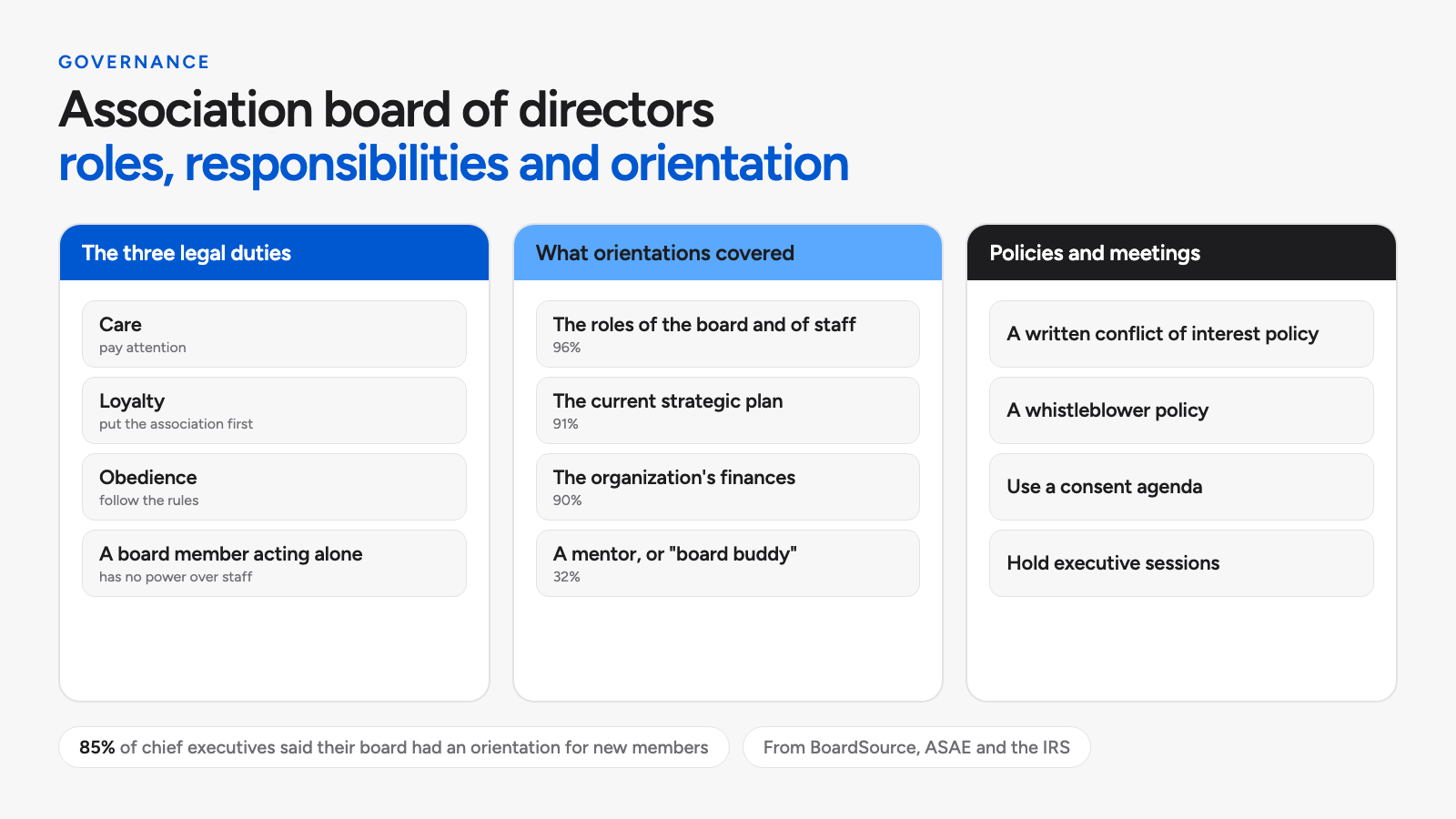
State laws across the US expect board members of nonprofits, associations included, to meet three duties. The New York Attorney General’s guide for board members calls them “the duties of care, loyalty and obedience”:
- Care: pay attention. Board members must know the organization’s finances and activities, and take part regularly in running it, the guide says. In practice, read the papers before each meeting, ask questions, and vote with your own judgment.
- Loyalty: put the association first. Board members must act in the association’s interest, not their own or their employer’s, and disclose any conflict of interest. Tenenbaum gives an example: a board member who also sits on the board of a competing association may have to resign from one of them.
- Obedience: follow the rules. The board must make sure the association follows the law, its mission and its own bylaws and policies.
The exact rules vary by state, so new board members should hear about them from the association’s lawyer or in their orientation.
What the board does, and what staff do
The board decides what the association should do, and the staff decide how. ASAE’s own bylaws put it this way: “The Board establishes policy and monitors implementation of policy by ASAE’s staff under the direction of the President & CEO.” They add: “The President & CEO has exclusive authority over the staff of ASAE.”
BoardSource, a nonprofit that trains boards, lists ten basic responsibilities of a board, including:
- Determine the mission and purpose.
- Select, support and evaluate the chief executive.
- Ensure effective planning.
- Ensure adequate financial resources, and provide proper financial oversight.
- Build a competent board.
- Ensure legal and ethical integrity.
A board member acting alone has no power over staff. “An individual board member has no individual management authority simply by virtue of being a member of the board,” Tenenbaum writes. BoardSource tells board members to “refrain from making special requests of the staff.”
Size and terms
There is no right size for a board. In a 2013 study of associations for the ASAE Foundation, boards of 16 to 20 members were more likely to have strategic discussions at their meetings than larger or smaller boards, though the authors note this does not prove size is the cause. ASAE’s own bylaws provide for 19 voting board members, plus one the chair may appoint.
Terms are more settled. In BoardSource’s survey:
- 73% of boards had three-year terms, and 18% had two-year terms.
- About half had both set terms and a limit on the number of terms a member can serve.
- Where there was a limit, two consecutive terms was the most common.
ASAE’s elected directors, for example, serve staggered three-year terms, so only some seats change each year, and no director may serve more than two terms in a row unless they are also an officer, such as the chair.
Orient every new board member
In BoardSource’s survey, 85% of chief executives said their board had an orientation for new members. What the orientations covered:
- The roles of the board and of staff: 96%.
- The current strategic plan: 91%.
- The organization’s finances: 90%.
- The conflict of interest policy: 89%.
- How to read the financial reports: 57%.
- A mentor, or “board buddy,” from among current board members: 32%.
Some ways associations do it:
- A session every year. The National Foundation for Infectious Diseases holds an onboarding session each year for new and returning board members, and surveys board members afterwards.
- A required course. In 2019, NIGP, the association for government purchasing staff, introduced a governance course that every new board member must take, spread over three days.
- A packet of documents. The United States Bowling Congress’s sample orientation checklist includes the bylaws, the policy manual, the conflict of interest and confidentiality agreements, and a follow-up call with a board mentor after the first meeting. It is written for USBC’s local associations.
David Falchek, a consultant quoted in the same Associations Now article, adds a year of board minutes, the latest financial statements and audit, and an overview of the association’s programs. He also suggests pairing each new member with a current one as a mentor.
The policies every board needs
Form 990 is the annual return that larger US tax-exempt organizations file with the IRS: those with gross receipts (total income before expenses) of $200,000 or more, or assets of $500,000 or more. Smaller ones file a shorter version. Its governance section asks whether the organization has certain policies. Federal tax law generally does not require them, and some states require some of them. But the IRS “considers such policies and procedures to generally improve tax compliance.” The form asks:
- A written conflict of interest policy, and whether board members must disclose possible conflicts every year. A conflict arises when someone in authority “can benefit financially from a decision she or he could make,” the instructions explain.
- A whistleblower policy, which protects staff and volunteers who report wrongdoing.
- A document retention and destruction policy, which says how long records are kept.
- Whether every board member got a copy of the Form 990 before it was filed. Telling them a copy is available on request does not count.
In BoardSource’s survey, 96% of boards had a written conflict of interest policy, 85% had a whistleblower policy, and 77% had a document retention policy.
Add a confidentiality policy too. ASAE’s ethics toolkit says “confidentiality is included in the board’s fiduciary responsibility,” meaning the duties a board member owes the association, and suggests making the policy part of every new board member’s orientation.
Antitrust: when board members are competitors
Antitrust laws stop competitors from agreeing among themselves on prices or other terms. A trade association’s board is often made up of competitors, so it has to be careful. The Federal Trade Commission warns that “it is illegal to use a trade association to control or suggest prices of members.”
ASAE’s model antitrust policy tells members not to discuss “prices, fees or rates,” discounts, salaries or profit margins, and to leave any meeting where improper subjects come up. An antitrust lawyer writing for ASAE recommends that associations:
- Read a short antitrust statement at the start of board meetings.
- Send out an agenda in advance, and stick to it.
- Have the association’s lawyer review agendas and minutes when sensitive subjects come up.
Run better meetings
- Send papers early. BoardSource recommends sending meeting materials two to three weeks ahead. In its survey, 92% of chief executives said board members got them at least three days before the meeting, but fewer than 3% sent them two weeks or more ahead.
- Use a consent agenda. This groups routine items, such as approving the last meeting’s minutes, into a single vote, so the meeting can spend its time on decisions. Any board member can ask for an item to be taken out and discussed. BoardSource says financial statements should not go on it. 58% of boards in its survey used one.
- Hold executive sessions. An executive session is a closed part of the meeting, usually without staff and sometimes without the chief executive, for example to discuss the chief executive’s performance. 26% of chief executives said their board had one on every meeting agenda.
Assess the board
Many boards do not review their own performance regularly. In BoardSource’s survey, 32% of chief executives said their board had done a formal written self-assessment in the past year, and 33% said it never had. Chief executives whose boards had assessed themselves in the past two years rated their boards higher in every area of board performance than those whose boards never had. BoardSource recommends an assessment at least every two years.
Associations show the same pattern. In the ASAE Foundation’s 2013 study of more than 1,500 associations, the best-performing boards were twice as likely to assess themselves, and almost twice as likely to invest in mentoring and training for board members.
Common mistakes
- No orientation, so new members spend months working out their role.
- Board members managing staff, instead of setting policy through the chief executive.
- Papers sent the night before, so members cannot prepare.
- Reports read aloud at meetings, instead of put on a consent agenda.
- Never reviewing the board’s own performance.
Our guide to association strategic planning covers the board’s part in setting the association’s direction.
Where One Roof helps
- Chapters and committees give the board its own private space in the community, with its discussions and members list, seen only by the board’s members.
- Terms that end on time: each role can have a term. The group’s leaders and staff are told before it ends, and when it does, the role is removed and the former member loses access to the board’s private space.
- Resource library: the board handbook, policies and past minutes sit in the board’s space, seen only by those who can see the space, and found by search.
Questions about association boards
What are the three duties of a board member?
Care, loyalty and obedience. Pay attention to the association’s finances and activities, put its interests ahead of your own, and make sure it follows the law and its own rules.
What is the difference between the board and staff?
The board sets policy and direction, and hires and evaluates the chief executive. The staff, led by the chief executive, run the association day to day.
How long should board terms be?
Three years is the most common. In BoardSource’s survey, 73% of boards had three-year terms, and most with a limit allowed two in a row.
What should a board orientation include?
The roles of the board and staff, the strategic plan, the finances and how to read them, the bylaws, the conflict of interest policy, and ideally a mentor from the current board.
What policies does an association board need?
At least a conflict of interest policy, a whistleblower policy, a document retention policy and a confidentiality policy. The IRS asks about the first three on Form 990.

