Strategy
Association strategic planning: how to build a plan your board and staff will use
How to build an association strategic plan: how many years it should cover, who to involve, asking members first, choosing a few priorities, measurable goals, tying the plan to the budget and staff work, reporting progress, and common mistakes.
 Boopesh MahendranCo-founder, One Roof7 min read
Tap the picture to see it at full size.
In this article⌄
- Does planning make a difference?
- How many years the plan should cover
- Who should be involved
- Ask members first
- Start with the facts
- Choose a few priorities
- Make each goal measurable
- Tie it to the budget and to staff work
- Report progress
- Common mistakes
- Where One Roof helps
- Questions about association strategic planning
Writing a strategic plan is a familiar ritual for associations. Using it is harder. “No association leader wants a strategic plan that just sits on the proverbial shelf,” Mark Athitakis wrote in Associations Now in 2026. Yet many plans end up there.
This guide covers how long a plan should run, who to involve, how to choose priorities, and how to tie the plan to the budget and report progress.
Does planning make a difference?
On average, yes, though it is no guarantee. A 2019 meta-analysis in Public Administration Review combined 31 studies and found that strategic planning had a “positive, moderate, and significant impact” on how well organizations performed. The effect was strongest when planning was formal, and when success was measured by whether an organization achieved its goals.
How many years the plan should cover
ASAE’s Association Governance Institute says the time horizon is “normally 3-5 years.” Some recent plans:
- ASAE: a new framework for “the next three to five years,” approved in August 2026.
- The National Association of REALTORS (NAR): a plan for 2026 to 2028.
- The American Speech-Language-Hearing Association (ASHA): a plan for 2026 to 2028.
- The Promotional Products Association International (PPAI): a five-year plan for 2026 to 2030.
Some go shorter or longer. When its five-year plan expired, the Center for Public Safety Excellence wrote a two-year plan instead. The American Society of Landscape Architects set a ten-year vision in 2020, broken into three multiyear stages.
Three years suits most associations: long enough to finish something, short enough to stay current. Whatever the length, review progress every year.
Who should be involved
The board sets the direction, and staff work out how to get there. They need to plan together. Glenn Tecker, of the consulting firm Tecker International, told Associations Now that his firm turns down associations whose board and senior staff will not plan jointly: “We know whatever they come up with will never be implemented.”
Many boards struggle with strategy. In BoardSource’s 2021 survey of charities, with 820 responses from chief executives and board chairs:
- Chief executives gave their boards a B- for setting strategic direction.
- 59% of chief executives said their board spent too little time thinking strategically.
- Chief executives rated their board’s impact on overall performance at 4.32 out of 5 when the board was a partner in leading the strategy. When the board was not involved, the rating was 3.14.
The survey covered charities, not associations, but it is a useful guide.
An outside facilitator can help people speak freely. The Toy Association used consultants to interview its members. “When you get a stranger to do it, people will talk about what they really don’t like,” said Steve Pasierb, then its chief executive, in 2017.
Ask members first
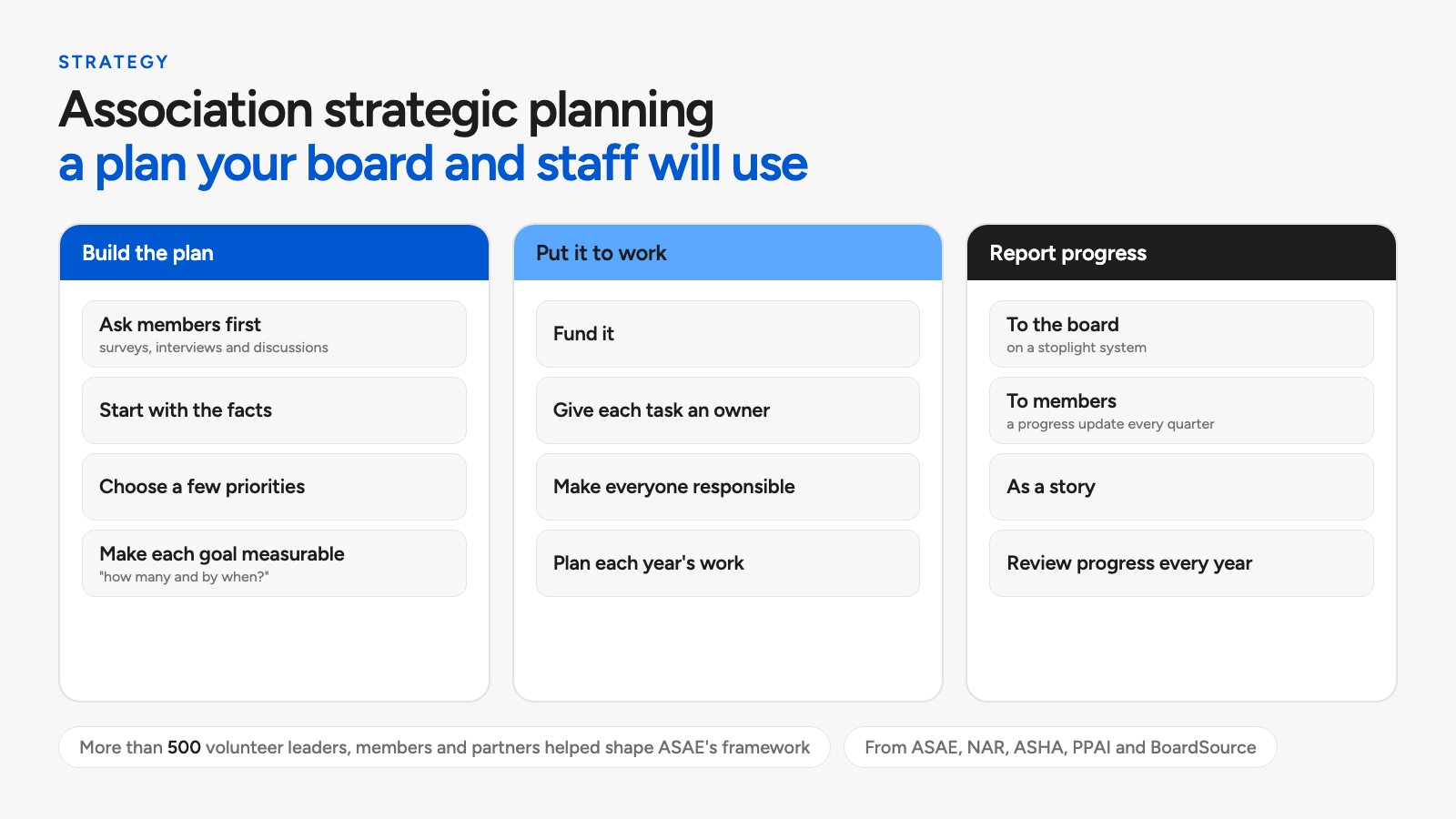
Find out what members value before you decide anything. Some ways associations have done it:
- A survey. NAR says that for its current plan, “we surveyed more than 150,000 members to understand their needs and wants.” It also held member focus groups and forums.
- Wide involvement. ASAE says “more than 500 volunteer leaders, members, and partners helped shape the framework.”
- Interviews. Over three months, the consultancy Chief Outsiders met one-on-one with stakeholders of the American Society of Landscape Architects, and asked four questions: “What excites you? What makes you nervous? What’s missing? And what don’t you understand?”
- Building the plan around the answers. In 2020, the Indiana State Bar Association ran a member survey that found members valued “education, advocacy, and connecting with other professionals,” and built its plan around those.
Our guide to member survey questions covers what to ask.
Involving many people is not enough on its own. In the 2019 meta-analysis, formal planning was more strongly linked to good results than planning that involved a wide range of people. The authors say how people are involved matters, not only how many.
Start with the facts
Look hard at where the association stands before you decide where it should go. “Real strategy starts with diagnosis,” Jon Bassford, CAE, wrote on ASAE’s site in 2026. For him, that means an honest look at how leaders make decisions, and whether the association’s operations and culture can carry out a plan. He warns that the usual steps, such as a SWOT analysis of strengths, weaknesses, opportunities and threats that the association runs itself, often lack objectivity.
While preparing its plan for 2025 to 2028, the board of the Tennessee Society of CPAs reviewed “membership statistics, the vision and mission statements, marketplace challenges, and areas of emphasis and deemphasis.” For most associations, a useful starting set is:
- Membership: joins, renewals and who is leaving.
- Revenue: where it comes from, and what is growing or shrinking.
- Programs: which ones members use, and which ones cost more than they return.
- The field: changes in the profession or industry members work in.
- Member input: what members told you in surveys, interviews and discussions.
Choose a few priorities
A plan with many priorities has none. ASAE’s governance guidance warns that plans often become “a ‘laundry list’ of activities without clear prioritization.” The plans above keep their top priorities to a handful:
- ASAE: three “strategic pillars,” such as “Optimize the Member Experience.”
- PPAI: three strategic pillars, such as “Member Success.”
- ASHA: three strategic objectives, such as “Members and affiliates are actively engaged with ASHA,” set alongside four broader themes.
When the American Medical Association set a new strategy in 2012, an internal audit had found “more than 100 different projects in varying stages of completion, many unrelated to one another and modest in scale.” Choosing priorities also means choosing what to stop. ASAE’s guidance suggests considering whether to “sunset outdated programs, to allow resources for new initiatives.”
Make each goal measurable
Each priority needs goals you can check. Steve Pasierb of the Toy Association said each goal should answer “how many and by when?” At the time, its board checked those numbers at every meeting.
For example, instead of “improve member engagement,” write “raise the share of members who attend an event or post in the community from 30% to 40% by the end of 2027.”
Tie it to the budget and to staff work
A plan with no money or people behind it will not happen. Some ways associations connect them:
- Fund it. When ASAE’s board approved the new framework, it also approved funding for two initiatives that directly support the framework.
- Give each task an owner. After its board approved the plan, the Indiana State Bar Association gave most of its staff specific tasks from the plan. Staff met weekly, and later monthly, to keep it on track.
- Make everyone responsible. NAR’s plan says: “Every employee of NAR is accountable for the successful execution of this Strategic Plan.”
- Plan each year’s work. PPAI turned its five-year plan into “an internal roadmap of annual objectives.”
Tony Gambill, writing in Forbes and quoted by Associations Now, suggests asking: “Who owns each strategic priority? … Who approves changes or reallocations?”
Report progress
A plan stays alive when people see it moving:
- To the board. In 2016, the Canadian Organization of Medical Physicists reported to its board on a stoplight system: “Green means we’re on-track, yellow means we need some more information … and red means we got to do something here.”
- To members. NAR has committed to a progress update every quarter, and has posted two so far. Each shows, for every goal, what was done, how members were involved, and what comes next. The Tennessee Society of CPAs publishes a “Year in Review” of progress on its strategic goals in its journal’s May/June issue each year.
- As a story. The American Society of Landscape Architects presented its ten-year vision as “a narrative from the future,” rather than a list of bullet points.
Common mistakes
- Planning because it is expected. Bassford warns that “strategic planning is one of those things associations do because it’s expected.”
- Too many priorities. Three is a good limit.
- No owners. Each goal needs a named person responsible for it.
- No money. A priority with no budget is a wish.
- The board approves it and moves on. Review progress at every board meeting, and the whole plan every year.
- Members never hear about it. Tell them what the plan is, and what has changed because of it.
Where One Roof helps
One Roof does not write your plan. It helps you hear from members while you make it, and show them progress once it is under way:
- Polls ask members a quick question, such as which of four possible priorities matters most to them, with the answers split by member type, region and industry.
- Chapters and committees give a planning task force its own private space, with its discussions and members list.
- Announcements share progress updates with all members, or with the followers of one space.
- Reporting gives the board a one-page quarterly report on the community: whether members use it, whether it helps keep them, and whether it pays for itself.
Questions about association strategic planning
How long should an association strategic plan be?
Most cover three to five years. Three years is common, as in the current plans of NAR and ASHA. Review progress every year.
How many priorities should a strategic plan have?
Few. The new plans of ASAE and PPAI each have three pillars, and ASHA’s has three strategic objectives.
Who should be involved in strategic planning?
The board and senior staff together, with input from members. Many associations also use an outside facilitator.
How do you get member input for a strategic plan?
Surveys, interviews, focus groups and quick polls. NAR surveyed members for its current plan, and the American Society of Landscape Architects held one-on-one interviews with its stakeholders.
How often should the board review the strategic plan?
Review progress at every board meeting, and the plan as a whole every year.

