Member surveys
Member survey questions for associations, with a template to copy
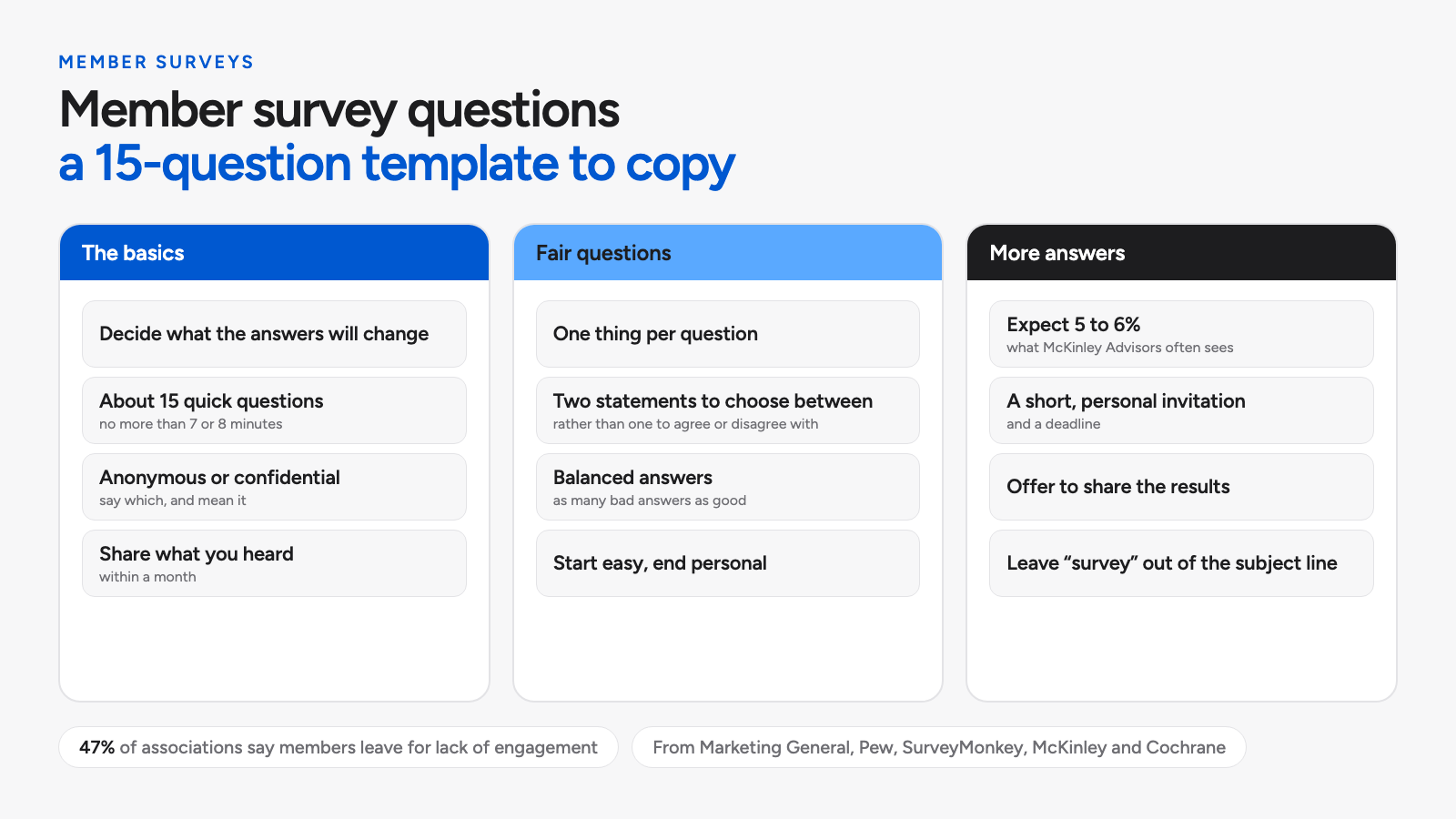
How to run an association member survey: what to decide first, how long it should be, how to write fair questions, a 15-question template to copy, anonymous or confidential, getting more answers, and what to do with the results.
 Boopesh MahendranCo-founder, One Roof7 min read
Tap the picture to see it at full size.
In this article⌄
A member survey tells you why people joined, what they use, and what would make them renew. This guide covers what to decide before you write, how long to make it, how to write fair questions, a template to copy, and what to do with the answers.
Why survey your members
In Marketing General’s 2024 benchmarking report, associations named the top reasons members do not renew:
- Lack of engagement with the association: 47%.
- Lack of value from membership: 32%.
- Forgot to renew: 29%.
Research pays off. Among the associations in the report that research their members, 53% say it helped them explain what membership is worth, and 41% say it led to new products and services.
Decide what you will do with the answers
Before writing a question, write down the decisions the answers will help you make. For example:
- Which benefits to keep, change or drop.
- Which events to run next year.
- How often to email members.
- How to keep more first-year members.
Then cut every question that would not change one of those decisions. “Nice to know” questions make the survey longer and the results harder to use.
Keep it short
Each question you add means fewer people finish. SurveyMonkey found that a 10-question survey takes about 5 minutes, and that more people give up once a survey takes longer than 7 or 8 minutes. Qualtrics, another survey company, says many more people give up after 12 minutes on a computer, or 9 on a phone.
Aim for about 15 quick questions, then take the survey yourself with a timer. Many members will answer on a phone, where people give up sooner.
Write fair questions
The way a question is asked changes the answer. Pew Research Center’s guide to writing survey questions covers most of these rules:
- Ask one thing at a time. “How satisfied are you with our events and webinars?” is two questions. Someone who likes one and not the other cannot answer it.
- Offer two statements to choose between, rather than one to agree or disagree with. Some people agree with almost any statement put to them. Question 6 in the template shows how.
- Balance the answers. If the answers run from bad to good, give as many bad answers as good: very poor, poor, fair, good, very good. Answers that run from “not at all” to “extremely” are fine too.
- Think about the order. An earlier question can change the answer to a later one.
- Decide whether to give a list of answers or leave the question open. A list changes what people say. In one Pew survey about what mattered most to people’s vote, 58% picked “the economy” from a list. Asked with no list, only 35% said it.
- Start easy, end personal. Begin with simple questions, and leave questions about the member themselves to the end.
A 15-question template
Copy these, then cut or change them to fit the decisions you wrote down.
Value
- What is the main reason you are a member? Choose one: meeting others in my field, learning and continuing education, earning or keeping a certification, news about my field, career or job opportunities, advocacy for my profession, something else (please say).
- How well does your membership meet that need? Not at all well, slightly well, moderately well, very well, extremely well.
- How likely are you to recommend [association] to a friend or colleague? 0 (not at all likely) to 10 (extremely likely).
Benefits
- Which of these have you used in the last 12 months? Choose all that apply, from your list of benefits.
- Which one of these is most valuable to you? Choose one, from the same list.
Community and events
- Which comes closer to your view? “Membership has helped me build relationships in my field” or “Membership has not done much to help me build relationships in my field.”
- How many of our events did you attend in the last 12 months, in person or online? None, 1, 2 or 3, 4 or more.
- What mainly stopped you from coming to more of our events? Choose one: the price, travel, the time or date, the topics did not interest me, I did not know about them, nothing stopped me, something else.
Communication
- How often would you like email from us? Weekly, every two weeks, monthly, less often than monthly.
Renewal
- How likely are you to renew when your membership is next due? Very likely, somewhat likely, somewhat unlikely, very unlikely, not sure.
- Who pays for your membership? I do, my employer does, we share it, someone else (such as a scholarship), not sure.
In your own words
- What is one thing we could do that would make your membership more valuable to you?
- Is there anything else you would like to tell us?
About you
- Which best describes your role? Your own list, plus “other (please say)”.
- How long have you been a member? Less than a year, 1 to 2 years, 3 to 5 years, 6 to 10 years, more than 10 years.
A few notes on the template:
- Question 3 is the Net Promoter Score question, in the wording Bain uses. Members who answer 9 or 10 are promoters, 7 and 8 count as neither, and 0 to 6 are detractors. The score is the percentage of promoters minus the percentage of detractors: if 50% answer 9 or 10 and 20% answer 0 to 6, the score is 30. Scores vary by sector, so compare against your own past scores.
- Question 4 lets members choose several answers. Pew finds that asking “Have you used this?” about each benefit in turn gives more accurate answers. Do that if your list is short.
- Question 6 uses two statements instead of agree or disagree.
- Question 11 matters because 24% of associations in the Marketing General report name “employer does not pay” as a reason members leave.
- Questions 14 and 15 let you compare groups: first-year members against long-standing ones, for example. If the survey is confidential and your member records already show each member’s role and join date, leave these two out and take the details from your records.
Anonymous or confidential
Say clearly which one it is, and mean it:
- Anonymous: nobody can trace an answer back to a member, not even staff. That means not keeping email addresses, device (IP) addresses or links made for one member alongside the answers.
- Confidential: you know who answered, but results are only reported in groups, never one member at a time.
Confidential lets you match answers to member records and follow up with members who are thinking of leaving. If you plan to follow up, say so in the invitation. If you know who answered, the answers are personal data under UK and EU data protection law (GDPR), as the ICO, the UK’s data protection regulator, explains. Handle them like the rest of your member records.
Get more answers
Expect a low response. McKinley Advisors, a firm that runs surveys for associations, says it often sees only 5 to 6% of members answer.
A Cochrane review, which pulls together the results of many studies, looked at 88 trials of online surveys. These things raised the share of people who answered:
- A short invitation email.
- A shorter survey.
- Personal invitations, addressed to the member by name.
- A deadline.
- Offering to share the results.
- A small cash incentive, which nearly doubled the odds that someone answered.
In three trials, emails with “survey” in the subject line got fewer answers than emails with no subject line at all. Leave the word out. Close the survey on the date you promised.
Between surveys, ask one question at a time
A yearly survey cannot tell you what members think of a change you made last month. A single question in the community can tell you within days. Gallup warns, though, that people tire of being asked too often, and that frequent surveys are wasted if nothing follows from them. Ask only what you will act on.
Share what you heard
Within a month of closing the survey, tell members:
- How many answered.
- The three or four things you heard most.
- What you will change, what you will not, and why.
When members can see what came of their answers, they are more willing to answer the next one.
Where One Roof helps
One Roof’s polls are for the quick questions between surveys:
- Ask one question, with two to ten answers, in the community members already use.
- See how the answers differ by member type, region and industry, taken from members’ profiles, so you do not have to ask.
- Polls are anonymous unless the person who sets one up says otherwise. Members are told which it is before they vote.
- In an anonymous poll, groups of fewer than five voters are combined, so no one’s answer can be picked out.
- Staff can download the results as a spreadsheet (CSV).
A poll is one question. For a longer survey like the template above, use a survey tool, and share the results in the community.
To act on what members tell you about leaving, see our guide to association member retention.
Questions about member surveys
How many questions should a member survey have?
About 15 quick ones, so that it takes no more than 7 or 8 minutes. Longer surveys lose more people before the end.
What is a good response rate for an association member survey?
McKinley Advisors says it often sees 5 to 6% of members answer its association member surveys. A shorter survey, a personal invitation, a deadline and an offer to share the results all raise it.
How often should associations survey members?
There is no single rule. In Marketing General’s 2024 report, of the associations that research their members, 38% do it once a year, 29% more often and 22% every two years. Quick single-question polls can fill the gaps.
Should a member survey be anonymous?
It can be anonymous or confidential. Anonymous means nobody can link answers to a member. Confidential means you know who answered but report only in groups. Say which one it is before members start.
What is the Net Promoter Score question?
“How likely are you to recommend us to a friend or colleague?”, answered from 0 to 10. The score is the percentage who answer 9 or 10, minus the percentage who answer 0 to 6.

