Membership growth
Membership recruitment for associations: how to find and win new members
Membership recruitment strategies for associations: why prospects do not join, the channels and offers associations rate most effective, recruiting at events and through members, students and young professionals, free levels, employer-paid dues and a short join form.
 Boopesh MahendranCo-founder, One Roof7 min read
Tap the picture to see it at full size.
In this article⌄
- Where associations stand
- Why people do not join
- The channels associations use, and which work
- Recruit at your own events
- Ask your members to bring colleagues
- Make the first year easier to say yes to
- Students and young professionals
- A free membership level
- Help members get their employer to pay
- Make joining short
- What to measure
- Where One Roof helps
- Questions about membership recruitment
In a typical association, 85% of members renew each year. So 15 in every 100 need replacing just to stay the same size.
This guide covers why people do not join, which ways of recruiting work best, and how to make joining easy.
Where associations stand
In Marketing General’s 2024 benchmarking report:
- 47% of associations grew in the past year, 31% stayed the same, and 21% declined.
- 51% brought in more new members than the year before.
In its 2025 report, 45% of associations grew in the past year.
Why people do not join
In the 2024 report, each association named up to three main reasons prospects do not join. Among the answers:
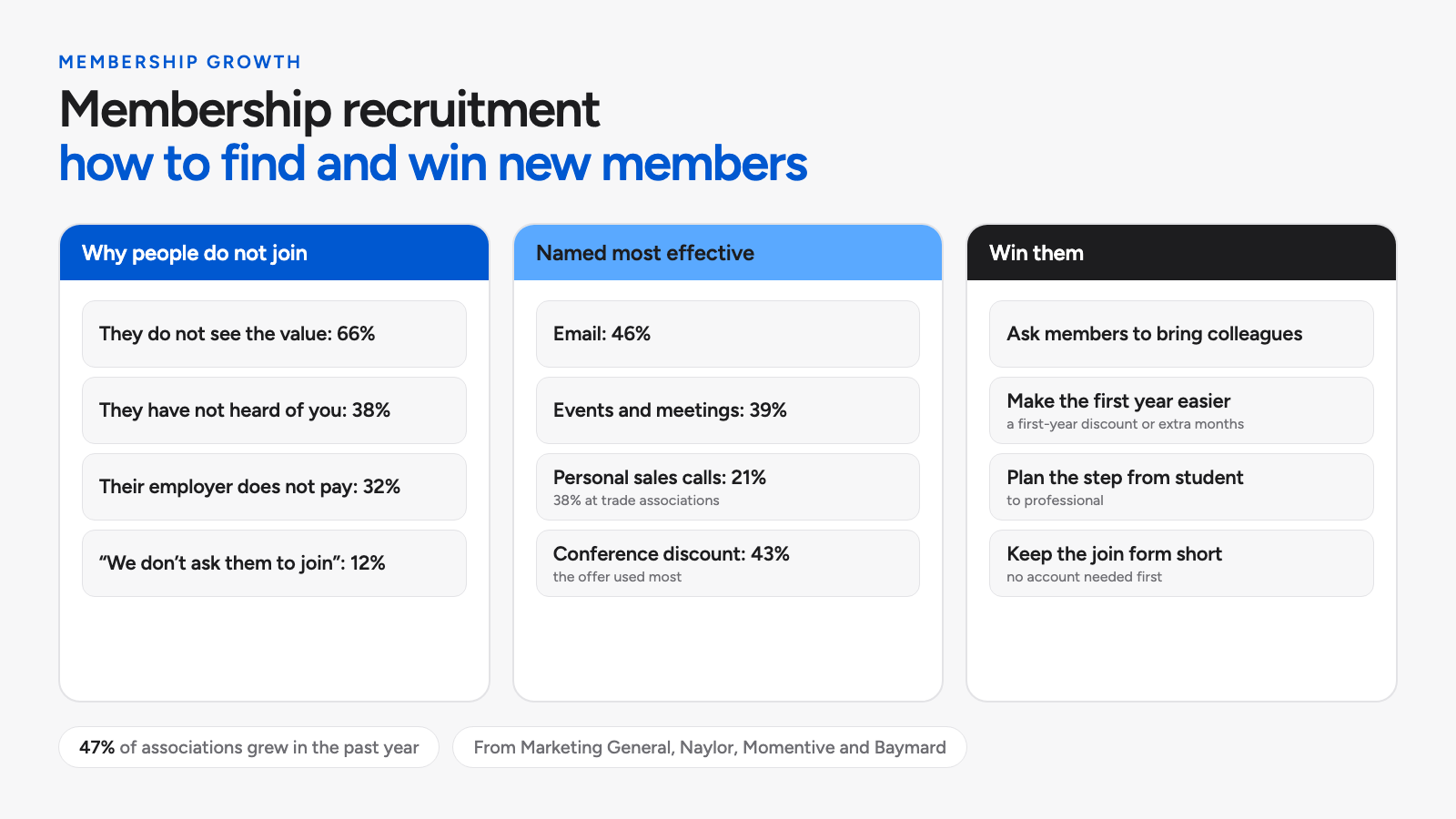
- They do not see the value: 66%.
- They have not heard of you: 38%.
- Their employer does not pay: 32%.
- They belong to a competing association: 26%.
- The dues are too high: 22%.
- “We don’t ask them to join”: 12%.
So most of the work is making sure the right people know you exist, showing them what membership gives them, and asking them to join.
The channels associations use, and which work
In the same report, associations said which channels they use to recruit. Each also named up to three it finds most effective. Below, the second figure is the share of all associations that named the channel:
- Email: used by 85%, named by 46%.
- Events and meetings: used by 67%, named by 39%.
- Personal sales calls: used by 32%, named by 21%. At trade associations, 52% use them and 38% name them.
- Organic social media: used by 68%, named by 16%.
- Paid digital advertising: used by 40%, named by 15%. Associations that had grown over both the past year and the past five years named it among their most effective.
- Member-get-a-member: used by 19%, named by 8%.
Recruit at your own events
People who come to your events already value what you do. A conference discount is the offer associations use most (46%), and the one they most often rate as working best (43%).
There is a catch: 20% of associations say a top reason members do not renew is that they joined only for the conference discount.
Some associations include a year’s membership in the non-member registration fee. For example, the Municipal Management Association of Southern California charges non-members $775 at the early rate, against $625 for members, and the $775 includes a year’s membership. But Associations Now warns that these attendees often become “passive members” who do not renew.
So look after members who join at an event: introduce them to other members, invite them to the next event, and show them what else membership gives them. Our guide to new member onboarding covers the first year.
Ask your members to bring colleagues
Members know who else in their field should join. A member-get-a-member program asks them to invite those people, and usually rewards them when someone joins:
- IEEE gives members $15 for each professional member they recruit, up to $90 a year.
- The Financial Planning Association offers $25 off a member’s renewal for each colleague they invite who joins as a CFP professional or allied professional member, and $10 for some other member types.
- AIChE gives a $20 gift card for each new professional member, plus prize drawings.
- ACOEM offers a discount to both: up to $165 off for the new member, and up to $125 off for the member who referred them.
Only 19% of associations run a member-get-a-member program, and 8% name it among their most effective channels. If you run one, make the ask easy: give members a ready-made email or link to send, and remind them when they are happiest, such as after an event.
Make the first year easier to say yes to
In the 2024 report, these were the offers associations used to win new members, and how many rated each most effective:
- A discount on the first year’s dues: used by 22%, rated most effective by 19%.
- Extra months free: used by 23%, rated most effective by 17%.
- Paying in installments: used by 23%.
- A free trial: used by 8%.
Whatever you offer, the first renewal is the test. In the same report, the median renewal rate for first-year members was 75%, against 85% for all members.
Students and young professionals
Younger members are a growing share. At associations whose members are individuals, Gen Z made up 11% of members in the 2024 report, up from 6% in the 2022 report. But Naylor’s 2024 benchmarking report found that engaging young professionals is one of associations’ top challenges.
Many associations make the first step free or cheap:
- ASCE lets students join free, and graduating student members get their first year of professional membership free.
- The American Bar Association is free for students, with an upgrade to premium for $25 a year.
- AIChE sponsors undergraduate membership at no cost. New graduates pay $25 in the year they graduate, rising to $50, $100 and $150 over the next three years.
The hard part is the move to full dues. In the 2024 report, 7% of associations said a top reason members do not renew is that student members do not move on to full membership. Among associations whose members are individuals, it was 14%. Plan the step from student to professional: a reduced rate for the first years after graduation, and a reason to stay, such as a mentor or a first committee role.
A free membership level
Some associations offer a free level, with paid levels above it. The American Society of Administrative Professionals, for example, offers a free level that includes its online community, alongside paid levels at $205 and $695.
A free level brings more people in, but it only pays if enough of them move up. Tom Petrocelli of CMSWire, quoted by Associations Now, put it plainly: freemium “requires a high enough conversion rate to justify the costs of the free users who stay free.” Decide in advance what the free level does not include, and show free members what they are missing.
Help members get their employer to pay
In the 2024 report, 32% of associations said prospects do not join because their employer will not pay. Among associations whose members are individuals, it was 42%. And more members now pay their own dues: in Momentive’s 2025 survey, 62% of members paid their own dues, up from 55% the year before.
Give prospects a short letter they can send their manager, with what membership costs and what the employer gets from it. For employers that pay for several people, see our guide to organizational membership.
Make joining short
78% of associations have a join button on their website, and 51% offer more than one way to join. After that, the join form decides how many people finish. We found little published research on association join forms, but online shops show what loses people. In Baymard Institute’s research:
- 17% of US online shoppers had left a checkout in the past three months because it was too long or complicated.
- 18% had left because they were asked to create an account.
- The average US checkout has about 23 form elements, such as fields to fill in and boxes to tick. Baymard found 12 to 14 can be enough.
For your join form:
- Show the price, and what it includes, before the form.
- Ask only what you need to start the membership. Collect the rest later.
- Let people pay online, at once, without creating an account first.
- Send a welcome email the same day.
What to measure
- New members each month, against the same month last year.
- Where each new member came from: an event, a referral, an ad, the website.
- The share of people who start the join form and finish it.
- The first-year renewal rate, by where members came from.
Where One Roof helps
One Roof helps turn people who already come to you into members:
- Events can be open to visitors, with a member price and a non-member price.
- When a free member opens a paid space, they see how many members and posts it has, but not the posts, and are offered an upgrade.
- Insights show free members who tried to open a paid space, and how many looked at upgrading.
- With membership dues switched on, members join and upgrade at Stripe’s checkout.
- Employer accounts link members to their employer by email domain, and show seats used against seats paid for.
For keeping the members you win, see our guide to member retention.
Questions about membership recruitment
What is the most effective way to recruit association members?
Associations most often name email and their own events among their most effective channels. Trade associations also name personal sales calls.
Why do people not join associations?
The most common reason associations give is that prospects do not see the value. Others are that people have not heard of the association, or their employer will not pay.
What is a member-get-a-member program?
A program that asks members to invite colleagues to join, usually with a reward such as a dues discount or a gift card for each new member.
How do associations recruit young professionals?
Many offer free or low-cost student membership, and a reduced rate for the first years after graduation. The hard part is keeping them when they move to full dues.
Should an association offer a free membership level?
It can bring more people in, but it only pays if enough free members move to a paid level. Decide what the free level leaves out, and show free members what they are missing.

