Membership models
Organizational membership for associations: pricing, seats and renewals
How to offer organizational, corporate or group membership: why employers pay, three pricing models with real prices, seat rules, what happens when someone leaves, the US tax points, and winning the renewal.
 Boopesh MahendranCo-founder, One Roof6 min read
Tap the picture to see it at full size.
In this article⌄
In an organizational membership, an employer pays for several of its staff at once. It goes by other names too: corporate, institutional, group or enterprise membership. This guide covers why it is worth offering, three ways to price it, the seat rules to settle first, the US tax points, and how to win the renewal.
Why offer it
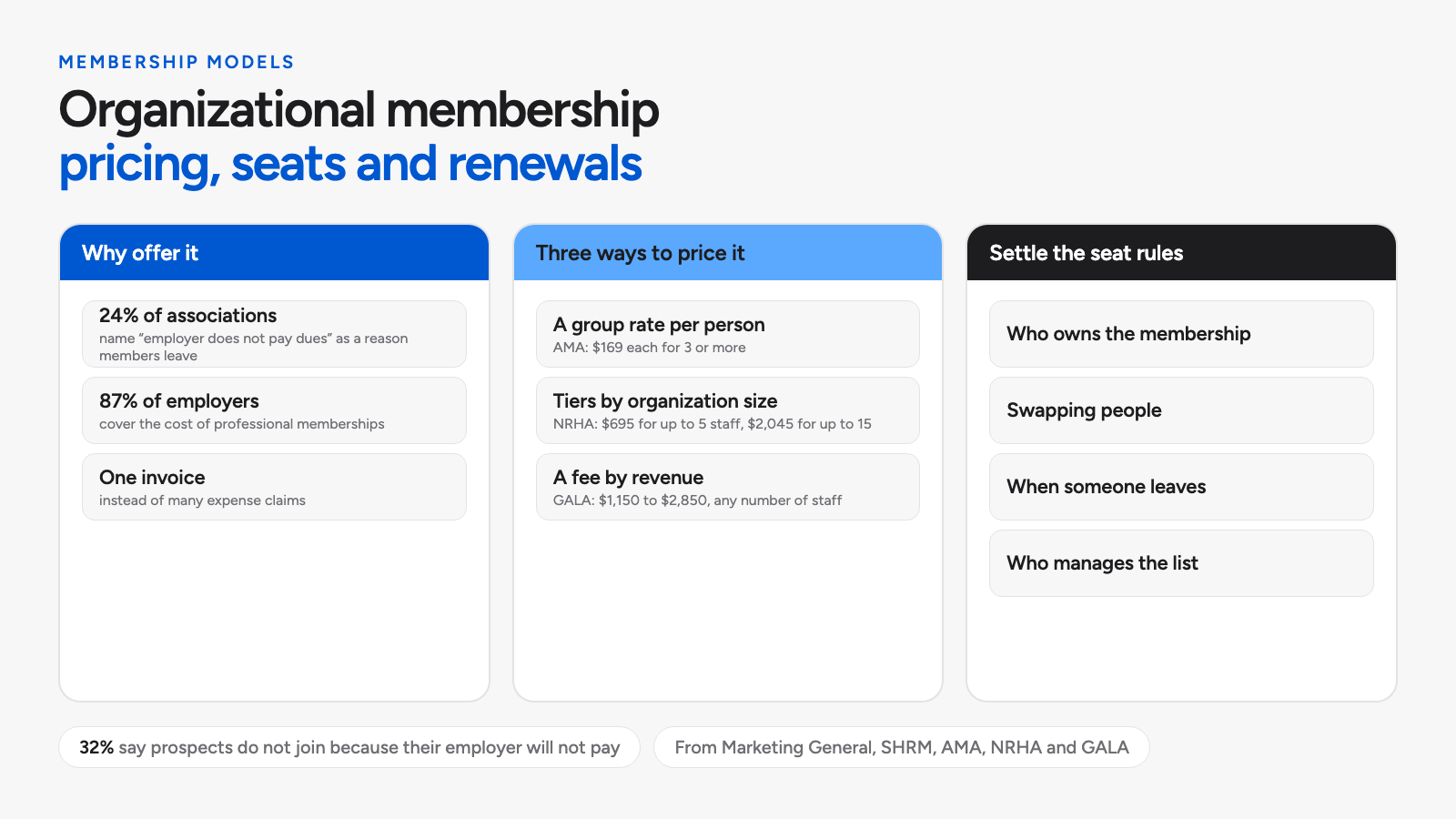
In Marketing General’s 2024 benchmarking report, associations named “employer does not pay dues” as a reason members leave:
- 24% of all associations.
- 32% of associations whose members are individuals.
- 7% of trade associations, where the member is often the company itself.
The same reason keeps people from joining: 32% of associations say prospects do not join because their employer will not pay.
Most employers will pay. In SHRM’s 2023 Employee Benefits Survey, 87% of employers said they cover the cost of professional memberships. An organizational membership turns many expense claims into one invoice.
Three ways to price it
A group rate per person
Each person still has their own membership, at a lower price because they join together.
- The American Marketing Association charges $169 a year each for groups of three or more, $30 less than the usual rate.
- NAFSA charges $449 each for 2 to 5 people, $429 for 6 to 10 and $409 for 11 or more, against $499 for one person.
This is the simplest to run: the employer pays only for the people it names. The catch is that it gives the employer little reason to add anyone else.
Tiers by organization size
The price depends on how many people the organization employs. Some tiers cover a set number of members, called seats. Others cover the whole staff.
- The National Rural Health Association charges $695 for organizations with 25 or fewer employees, covering up to 5 staff. Organizations with over 100 employees pay $2,045, for up to 15 staff.
- ASAE, the association for people who work at associations, prices its organization membership by staff size, from $495 for 1 or 2 staff to $10,945 for 400 or more, and covers the whole staff.
The price grows with the employer. A seat limit stops one fee covering many people who would otherwise pay for themselves.
A fee by revenue, with no limit on people
The price depends on the company’s yearly revenue, and anyone who works there can take part.
- GALA, the language industry association, charges $1,150 a year for companies with revenue under $1 million, up to $2,850 for over $10 million, for any number of staff.
This suits trade associations, where the company is the member, and it brings the most people into the community. Check the revenue where you can:
- A public company reports its revenue in its yearly filings with the SEC.
- A nonprofit, such as a hospital or university, must make its yearly Form 990 tax return, which shows revenue, available to the public.
- A private company keeps its tax returns confidential. Ask for proof, such as a letter from its accountant, or take its word.
Settle the seat rules first
Write these rules down before you sell your first organizational membership, and put them in the agreement the employer signs:
- Who owns the membership. NAFSA’s rule is that the institution “owns” the membership, while the person is the member.
- Swapping people. ATD lets an employer move a membership to another employee at any time, at no extra cost.
- Adding people during the year. When an employer adds someone mid-year, ATD charges only for the months left until the group’s shared renewal date.
- When someone leaves. WorldatWork’s policy is that people who leave an employer that paid for them keep their membership until its end date.
- Who manages the list. Name one person at the employer who tells you who is in and who is out.
When someone leaves the employer
A member who changes jobs is easy to lose. Before their covered membership ends:
- Ask whether their new employer would buy an organizational membership.
- If not, offer them an individual membership, starting the day the current one ends.
- Keep their history: events, continuing education credit and posts stay with the person, not the employer.
The US tax points
Employers often ask about tax, and the answer helps the sale:
- The employer can usually deduct the dues. Businesses cannot deduct club dues, but IRS Publication 535 says professional and trade associations are not clubs for this rule, unless a main purpose is to entertain members.
- Most employees who pay their own dues cannot deduct them. Since 2018, employees have not been able to deduct work expenses they pay for themselves, with a few exceptions, and a 2025 law made that permanent. So the same dues cost less when the employer pays: the employer can deduct them, and the employee cannot.
- The lobbying share cannot be deducted. Many trade and professional associations are taxed as 501(c)(6) organizations. If yours is one and spends money on lobbying, it must tell members what share of their dues goes to lobbying and political spending. Otherwise it pays a proxy tax itself. Put that share on the invoice.
Winning the renewal
An organizational membership renews when the employer’s contact decides the money was well spent. Give them what they need to decide:
- How many seats were used, out of how many paid for.
- Who took part, and what they did: events attended, credit earned, questions answered.
- Who has stopped taking part, while there is time to bring them back.
Send this report two months before the renewal date, not with the invoice. An employer paying for seats nobody uses will notice at renewal. Notice first, and help them fill those seats.
What to measure
- Seats used against seats paid for, for each employer.
- The share of each employer’s covered staff active in the last 90 days.
- The share of employer accounts that renew each year.
- How many people who left an employer then joined as individual members.
Where One Roof helps
One Roof’s employer accounts keep each organizational membership in one place:
- Add the employer with its email domain, number of seats, renewal date and main contact.
- Members are linked to it automatically, by email domain or the employer named on their profile. The links are checked every day, and staff can add or remove anyone by hand.
- See seats used against seats paid for, with a notice when the employer has more paying members than seats.
- See which of the employer’s members have been quiet for 90 days, and which accounts renew in the next 60 days.
- Every change to an account is recorded, with who made it.
For keeping individual members, see our guide to member retention.
Questions about organizational membership
What is an organizational membership?
A membership an employer buys for several of its staff at once. Depending on how it works, it may be called a corporate, institutional, group or enterprise membership.
How should an association price organizational membership?
Three models are common: a group rate per person, tiers by organization size, or a fee by revenue with no limit on people. If each person is the member, a group rate is simplest. If the company is the member, as in most trade associations, price by size or revenue.
What is the difference between group and corporate membership?
Both are kinds of organizational membership. In a group membership, each named person is a member, at a discount. In a corporate membership, the organization itself is the member, and its staff use a set number of seats or take part without limit.
Can an employer deduct association dues paid for employees?
In the US, usually yes, as a business expense. Dues to professional and trade associations are not treated as club dues, which businesses cannot deduct. The share of dues spent on lobbying and political spending cannot be deducted.
What happens when an employee covered by an organizational membership leaves?
It depends on your rules. Some associations let the person stay a member until the membership’s end date. Others let the employer pass the seat to a colleague straight away. Either way, offer the person an individual membership before their covered one ends.

