Member onboarding
New member onboarding for associations: a plan for the first year
A first-year onboarding plan for association members: what to send and when, the 3-3-6 email schedule, welcome calls, mistakes to avoid and how to measure it.
 Boopesh MahendranCo-founder, One Roof7 min read
Tap the picture to see it at full size.
In this article⌄
New member onboarding is how an association helps someone who has just joined get value from their membership before their first renewal. This guide covers why the first year matters, a plan for it, the 3-3-6 email schedule, and how to tell whether it is working.
Why the first year matters
First-year members are the most likely to leave. In Marketing General Incorporated’s 2024 benchmarking report, a survey of nearly 700 associations:
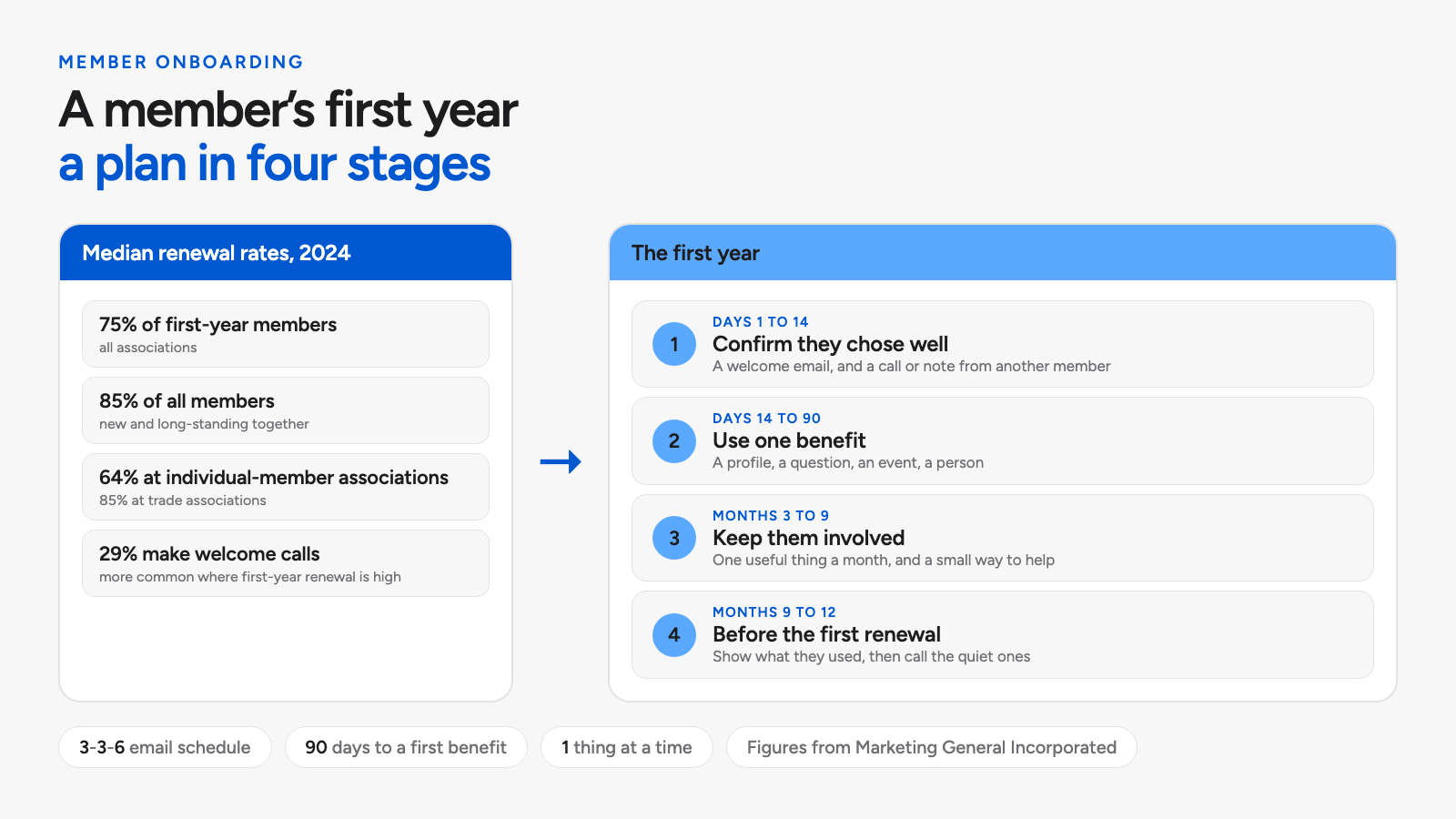
- The median first-year renewal rate was 75%, against 85% for all members.
- It was 64% at individual-member associations and 85% at trade associations.
- About a quarter of associations renewed fewer than 60% of their first-year members.
When the same survey asked staff why members do not renew, two of the answers matter most for new members:
- Lack of engagement was the top reason, given by 47%.
- Joined only for a conference or meeting discount was given by 20%, and by 25% at individual-member associations.
A member who never used anything has no reason to pay again. Onboarding is how you get them to use something.
What associations do now
The same report asked how associations welcome new members:
- Welcome emails: 81%
- An emailed welcome kit: 42%
- A welcome call from staff, the board or a chapter: 29%
- An invitation to the online community: 28%
- A new member webinar: 20%
- A new member survey: 12%
Welcome calls stand out. Associations that phone new members tend to keep more of them: the call was significantly more common among those renewing over 80% of first-year members. That does not prove the call is the reason, but it is cheap to try. Trade associations make them far more often: 48%, against 11% of individual-member associations.
A plan for the first year
Associations Now describes onboarding in four stages across the first year. Here is what to do in each.
Days 1 to 14: confirm they chose well
- Send a welcome email on the day they join. Thank them, say how to sign in, suggest one thing to do first, and tell them where to get help.
- Ask why they joined. One question, by email or on a welcome call. The answer tells you what to show them next.
- Arrange a welcome from a member, not only from staff. Elizabeth Weaver Engel of Spark Consulting recommends that “someone who’s not on staff” calls or emails each new member.
Days 14 to 90: get them to use one benefit
An Associations Now article on onboarding calls engagement in the first 90 days “a critical indicator of first year renewal”. By day 90, each new member should have done at least one of these:
- Completed their profile and followed the subjects they work on
- Asked or answered a question in the community
- Registered for an event
- Met another member, at a chapter meeting or through a mentor
A short online orientation can help. It was the tactic associations most wanted to try in the 2022 New Member Engagement Study. Most of those already running one (70%) hold it live, with time for questions.
Months 3 to 9: keep them involved
- Send a monthly note with one thing worth their time: a discussion, an event, a resource.
- Offer a small way to help, such as answering a question or joining a short project. Start small. A committee seat can come later.
- Hold back the rest. The same article suggests keeping new members off other association mailings for their first one to three months, so the welcome messages are not lost.
Months 9 to 12: before the first renewal
Renewal notices usually start about three months before a membership ends. Before the first one goes out:
- Show them what they used: the events they attended, the questions answered, the credit they earned.
- Call the ones who never did anything. Ask what they hoped for when they joined. Some can still be kept.
The 3-3-6 email schedule
The 3-3-6 schedule is a common way to pace onboarding emails. The 2022 New Member Engagement Study describes it:
- Three emails in the first week
- Weekly for the rest of the first month
- Monthly for the next six months
That makes about seven months of emails. In the same study, associations with longer onboarding programmes tended to report higher renewal rates, and many said renewals rose after they adopted 3-3-6. This is what associations reported about themselves, not a controlled test. But it agrees with the rest of the evidence: onboarding should not stop after the first week.
Mistakes to avoid
- Sending everything at once. Spark Consulting’s advice is to “try introducing one thing at a time.”
- Asking for money too soon. Engel advises against asking new members for more money straight away. Save the conference and course offers for later.
- Relying on a welcome kit. In the 2018 New Member Engagement Study, 65% of associations sent welcome kits, but only 24% found them effective.
- Stopping after week one. A year is a long gap between the welcome and the first renewal notice.
How to measure it
- First-year renewal rate, by the month members joined, so you can see whether changes help.
- The share of new members who did one thing in their first 90 days.
- Who never did anything, as a list your staff can call, not just a number.
- Whether each email worked: did members do what it asked, such as sign in or post?
Where One Roof helps
One Roof is a community platform for associations. It includes a welcome series for new members:
- On joining: a welcome email.
- After three days: a reminder to finish their profile and follow a few subjects, skipped if they already have.
- After a week: an invitation to ask or answer a question, skipped if they have already posted.
Staff can edit each email’s subject and opening line, and see how many members did what it asked. No member gets more than one automatic email every three days. The series is off until you switch it on.
After the first weeks:
- New members who never took part appear on the members at risk list, so staff can call them before they lapse.
- Renewal reminders can go 60, 30 and 7 days before the renewal date.
Questions about member onboarding
What is member onboarding?
It is how an association helps a new member get value from their membership before their first renewal: a welcome, a first thing to do, and regular contact through the first year.
How long should member onboarding last?
Most of the first year. A common schedule, called 3-3-6, sends emails for about seven months, and associations with longer programmes tend to report higher first-year renewal.
What should a welcome email include?
Thanks, how to sign in, one thing to do first, where to get help, and a question about why they joined.
What is the 3-3-6 rule?
A schedule for onboarding emails: three in the first week, weekly for the rest of the first month, then monthly for six months.
What is a good first-year renewal rate?
The median in 2024 was 75% across all associations, 64% at individual-member associations and 85% at trade associations. Your own trend matters more than the median.
Why do new members not renew?
Staff most often say lack of engagement. Others joined only for a conference discount, or their employer stopped paying. Many never used a benefit in their first year.

