Membership models
Association membership tiers: how to structure membership levels and price them
How to structure association membership tiers: dues set by who members are or by what they choose, real examples and prices, what happened when associations added tiers, how many levels to offer, risks, free levels, and what to measure.
 Boopesh MahendranCo-founder, One Roof7 min read
Tap the picture to see it at full size.
In this article⌄
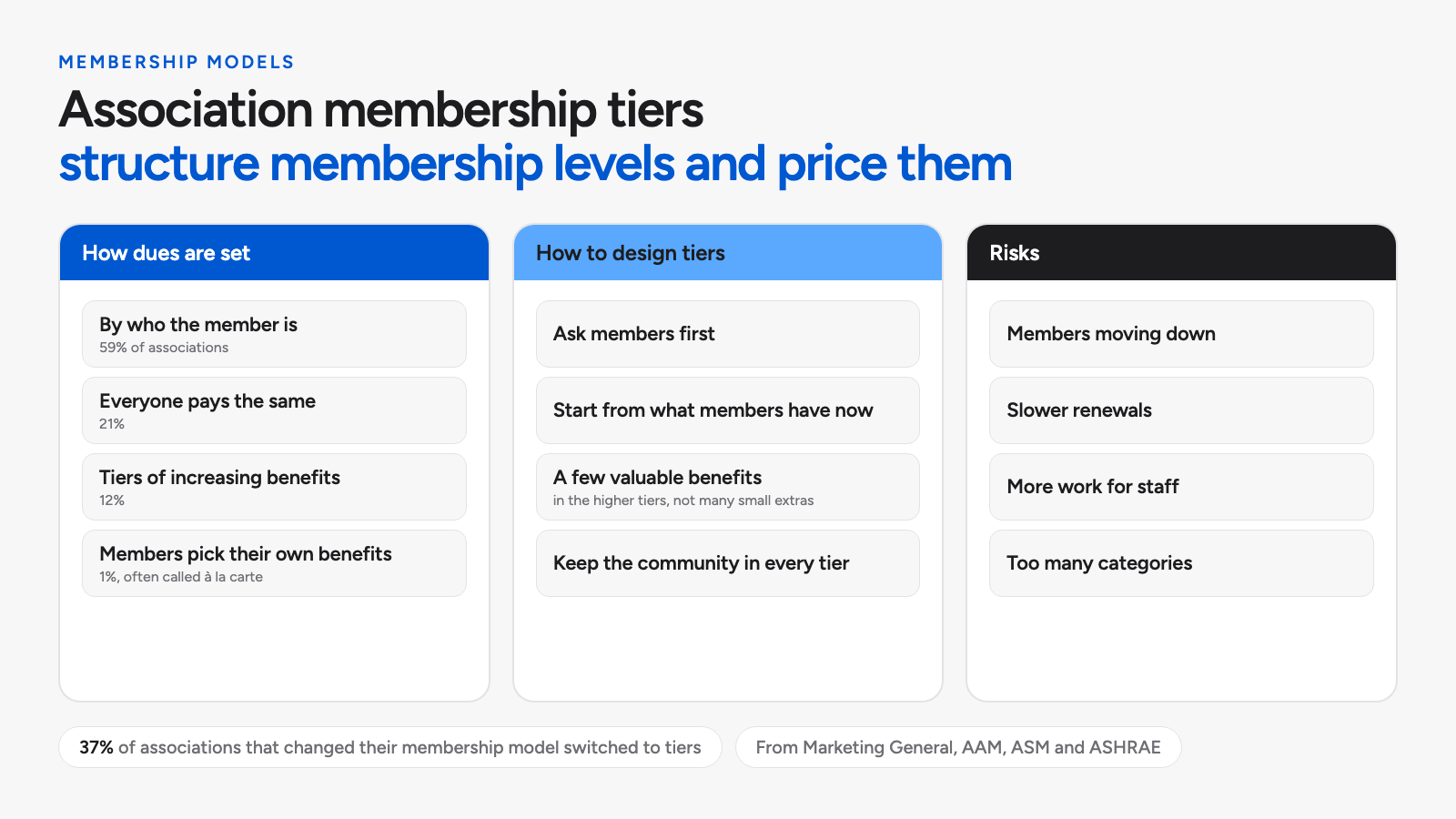
There are two ways to set different dues for different members. You can charge by who they are, such as their career stage or company size. Or you can let them choose a level of benefits, often called tiers. Most associations do the first. In Marketing General’s 2024 benchmarking report, which covered 696 associations (530 answered this question):
- 59% set dues by who the member is, such as their qualifications, experience, company size or region.
- 21% charged everyone the same.
- 12% offered tiers of increasing benefits.
- 1% let members pick their own benefits, often called à la carte.
Associations whose membership grew, in the past year and in the past five, more often used tiers than those whose membership fell. That does not prove the tiers caused the growth.
This guide covers both kinds of tiers, real examples and prices, what happened when associations added tiers, how many levels to offer, the risks, free levels, and what to measure.
Tiers by who the member is
Most associations already price this way, by career stage, age or country:
- The American Society of Civil Engineers (ASCE) charges $138.50 a year for professional members aged 28 or younger, and $277 for older members. Students join free.
- The American Society for Microbiology (ASM) prices students at $40, postdoctoral researchers at $70 and medical lab scientists at $80. In some lower- and middle-income countries, membership is generally free, and in others it is 75% off.
- ASHRAE, the heating and cooling engineers’ society, will change its model on July 1, 2027. Every full member will get the same benefits, but dues will depend on how wealthy their country is, using the World Bank’s income groups. New members aged 35 or younger will get lower dues for their first two years.
Tiers members choose
With benefit tiers, members decide how much they want. Some examples:
- AIGA, the professional association for design, sets most levels by career stage, such as $150 for emerging designers and $250 for professionals, according to its Minnesota chapter’s page. It also offers a $500 Leader level for members who choose to give more.
- ASM offers a Premium membership at $245 and a Contributing membership at $130.
- SHRM, the HR association, charges $299 a year for its Professional membership. Its Executive Network, for senior HR leaders, is by application, with research, retreats and a dedicated relationship manager.
- The American Alliance of Museums launched three levels for museums in 2012: The Basics, Enhanced Access, and Full Suite of Benefits. For The Basics, museums paid what they could. Today its levels are Essential, Plus and Premier, priced by staff size, and the pay-what-you-can level is being phased out.
A single professional price can work too. The American Marketing Association charges professionals and academics $229 a year, and SMPS, the society for marketing professionals in architecture, engineering and construction, charges $449.
What happened when associations added tiers
These results were reported by the associations themselves, to Associations Now:
- The American Alliance of Museums had “a 34 percent increase in museum members in the first year,” Janet Vaughan, then its senior director of member services, said in 2014. The rise reversed a 12-year decline. The launch came with a new name, logo and website too. More museums chose the top level than expected: 59%, against the 46% projected. Only 13% chose The Basics, against 23% projected.
- ATIXA, the association for school and college Title IX administrators, who handle complaints of sex discrimination, added a premium tier in 2015. Seven months in, 54 member organizations had joined at the premium level, against the 35 it hoped for. About 85% were existing members who upgraded, and its standard membership grew too.
- The Portable Sanitation Association International found its first tiers difficult to manage and less successful than hoped, because they were “loaded with too many low-value ‘goodies.’” After it reworked them, its executive director said it had its best year ever for recruiting new members, though that came alongside a wider turnaround.
How many levels to offer
Offering fewer levels may help. In a well-known study by Sheena Iyengar and Mark Lepper, published in 2000, nearly 30% of shoppers who stopped at a tasting table with 6 jams later bought one. Of those who stopped at a table with 24 jams, only 3% did, even though the larger display drew more people in.
But the effect is not reliable. A 2010 review of 50 experiments, with more than 5,000 participants, found that on average the number of options made “virtually zero” difference, though results varied widely between studies.
Where a level sits in the list matters too. Research by Itamar Simonson, published in 1989, found that an option tends to win more buyers when it becomes the middle, compromise choice. So with three levels, the middle one may draw more members than it would on its own. Make it the level you most want members to choose.
How to design tiers
- Ask members first. Find out which benefits they value, and which they would pay more for.
- Start from what members have now. Richard Gott of the MemberWise Network, quoted in a 2014 Associations Now roundup, suggested making today’s membership the basic level, so members who stay at the lowest level do not end up with less than they have now.
- Put a few valuable benefits in the higher tiers, not many small extras.
- Keep the community in every tier, so members at every level can still ask each other questions.
- Show what each level includes, side by side, in plain words.
Risks
- Members moving down. Some members may drop to the cheapest level.
- Slower renewals. The American Alliance of Museums found museums took longer to renew, because they now had to choose a level as well. It began calling museums the month after they lapsed.
- More work for staff. Tracking who gets which benefits is harder. The Portable Sanitation Association International found its tiers “more complex to administer.”
- Too many categories. In 2021, the American Library Association said its 11 membership types were “very complex and very confusing,” and set out to cut them to five.
A free level
A free level brings more people in, but it only pays if enough of them move up. One association in the 2024 Marketing General report described “declining membership because of low conversion rate from free members to dues paying members.” A related offer, a free trial, was used by only 8% of associations to recruit members.
Our guide to membership recruitment covers free levels in more detail, and our guide to raising membership dues covers changing prices.
What to measure
- The share of members at each level.
- How many move up or down at renewal.
- The renewal rate at each level.
- Average dues per member, before and after the change.
- How long members take to renew.
Where One Roof helps
- Dues can be paid in One Roof, with a yearly or monthly price for each member type.
- Spaces for paying members: a space can be limited to paying members. When a free member opens one, they see what it is about and how many members and discussions it has, but not the discussions themselves. If you have set an upgrade link, they are offered an upgrade.
- Reporting shows free members who tried to open a paid space, and how many looked at upgrading.
- Announcements can go to all members, paying members or free members.
Questions about association membership tiers
What are membership tiers?
Levels of membership at different prices. Members either pay according to who they are, such as their career stage, or choose a level of benefits.
How many membership tiers should an association have?
Few enough that each is easy to tell apart. Three is common. Research suggests an option tends to gain buyers when it becomes the middle choice, so make the middle level the one you most want members to choose.
Do tiered memberships help associations grow?
In Marketing General’s 2024 report, growing associations more often used tiers than shrinking ones, but that does not prove tiers caused the growth. The American Alliance of Museums reported a 34% rise in museum members in the first year after adding tiers in 2012, though it also changed its name and website at the time.
What should higher tiers include?
A few benefits members value highly, such as research, recognition or direct access to experts, rather than many small extras.
Should an association offer a free membership level?
Only if you have a plan to move free members up. Decide what the free level leaves out, and show free members what they are missing.

