Membership dues
How to raise membership dues without losing members
How to raise association membership dues: how often associations raise them and by how much, what inflation has done to flat dues, who must approve, how to tell members, and how to soften the increase for those who struggle to pay.
 Boopesh MahendranCo-founder, One Roof6 min read
Tap the picture to see it at full size.
In this article⌄
- How often associations raise dues
- Why flat dues lose value
- Small and regular beats large and rare
- Check who has to approve it
- Explain why, in plain words
- Tell members before they decide to renew
- Make it easier for those who struggle to pay
- Watch what happens after
- What to measure
- Where One Roof helps
- Questions about raising membership dues
Most associations have to raise their dues at some point. If you keep them the same for years, inflation cuts their value. If you raise them badly, members leave. This guide covers how often associations raise dues and by how much, who has to approve an increase, how to tell members, and how to make the increase easier for those who struggle to pay.
How often associations raise dues
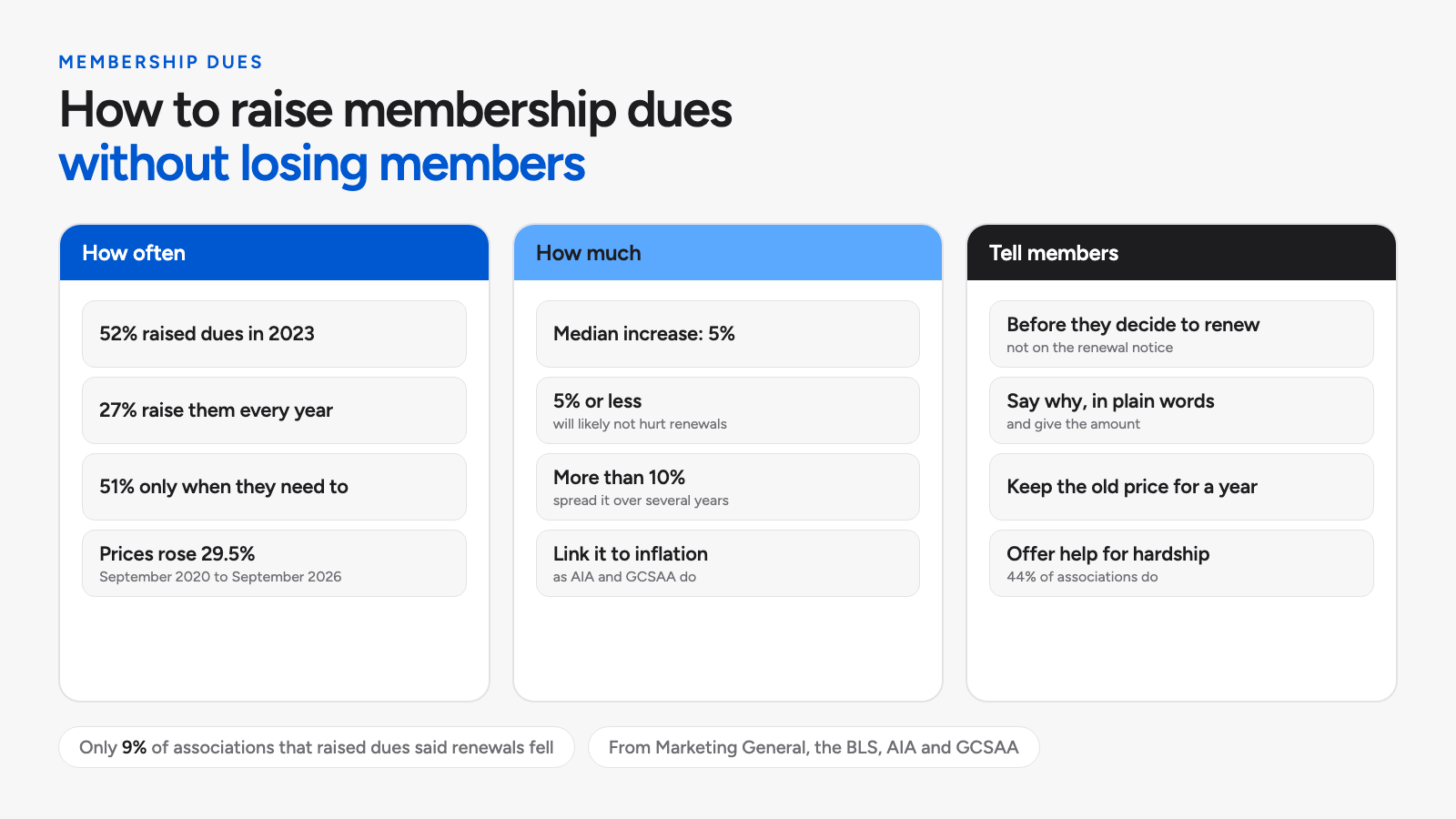
In Marketing General’s 2024 benchmarking report, 52% of associations raised their dues in 2023. Asked how often they raise dues:
- 27% raise dues every year.
- 6% raise them every other year.
- 51% raise them only when they need to.
- 6% never raise them.
- 10% gave another answer.
Associations with renewal rates of 80% or more were more likely to raise dues every year than those with lower renewal rates. In Marketing General’s 2025 report, 49% of associations had raised dues in the past year. Among trade associations, it was 59%.
Why flat dues lose value
Dues that stay the same lose value every year. US consumer prices rose 29.5% between September 2020 and September 2026, according to the consumer price index from the Bureau of Labor Statistics. Dues of $100 set in 2020 now buy what $77 bought then. In the 12 months to September 2026, prices rose 3.7%.
Your own costs rise too: staff, venues and software. The State Bar of Texas raised its dues by 10% from June 2025, its first increase since 1991. The reason: its budgeted spending was “increasing faster than its budgeted operating revenues due to inflation.”
Small and regular beats large and rare
Marketing General found that:
- The median dues increase was 5%.
- Only 14% of those that raised dues did so by more than 11%.
- In its 2022 survey data, only 9% of associations that raised dues saw their renewal rate fall, and 4% saw fewer new members join.
Its earlier advice: an increase of 5% or less is unlikely to hurt renewals, but increases of more than 10% have led to lower renewals.
Waiting makes it harder. One association went 17 years without an increase and then needed 43%, an increase too large to make in one year.
Some associations link dues to inflation, so members expect the increase:
- The American Institute of Architects (AIA) raised its 2025 national dues for architect members by $12, to $330, in line with core inflation of 3.9%. Core inflation leaves out food and energy prices.
- The Golf Course Superintendents Association of America (GCSAA) has raised dues every two years since 2007, tied to inflation. Members vote on each increase. As of 2014, every increase had won at least 88% of the vote.
Check who has to approve it
Your bylaws (or, for a state bar, the law) say who can change dues. In some associations the board decides. In others, members vote. Rules can also limit how much and how often:
- The State Bar of Texas may raise dues by up to 10% every six years, with approval from its board and the Supreme Court of Texas. A bigger or more frequent increase needs a vote of the members.
- GCSAA members approved a $65 increase for its two main membership classes, to $530, at the 2025 annual meeting. Of that, $40 followed inflation and $25 was extra. Before the vote, delegates discussed it in small groups and a town hall.
If members must vote, explain the increase well before the vote, and give them a chance to ask questions.
Explain why, in plain words
Members accept an increase more easily when they know what it pays for. Say the reason in a sentence or two, and give the amount, not just a percentage:
- The Colorado Medical Society said this was its first dues change in 20 years, that most members would pay $50 more, and that the increase was “essential for keeping pace with inflation.”
- The American Society for Biochemistry and Molecular Biology (ASBMB) said dues for regular members would be $175 in 2025, its first increase in five years.
- AIA linked its increase to more resources for members and its work on federal policy.
Remind members what they got this year too. Our guide to member benefit ideas covers how to show that value.
Tell members before they decide to renew
Marketing General advises against surprising members with the new amount on their renewal notice. Mention it beforehand, in your newsletter or on your website. If dues go up every year, members expect it, and a notice is less important.
In Marketing General’s 2022 data, as reported by Associations Now, 20% of associations did not announce their increase at all. The most common ways to announce it were:
- A letter or email: 45%.
- Their renewal reminders: 39%.
- Their newsletter: 21%.
- Their website: 19%.
Pick the amount with care, too: Marketing General notes that going from $95 to $99 draws less pushback than going from $95 to $100.
Make it easier for those who struggle to pay
- Keep the old price for a year. The Utilities Technology Council raised dues by 5% for 2018, and let member companies that had not budgeted for it keep paying the old amount that year. Its renewal rate had been in the low 90s before the increase. It was 97% in 2021 and 98% in 2022.
- Offer help for hardship. 44% of associations do. AIA waives dues for up to three years for members facing hardship.
- Let members pay in parts. A third of associations offer installments at renewal. Marketing General also found that associations whose renewals fell offered installments and hardship help more often, so watch your own figures.
- Add a lower-priced level. Of 65 associations that changed their membership model in the past year, 20% added reduced dues for early-career members or new graduates, rising over a few years, and 37% moved to levels with different benefits.
If your association is a 501(c)(6), (c)(5) or (c)(4) that spends on lobbying or political activity, it must tell members what share of their dues goes to that spending, or pay a proxy tax on it. Check that share when the amount changes.
Watch what happens after
In the 2024 report, the median renewal rate was 85%, and 75% for first-year members. Compare your own rate with last year’s.
Also watch why members leave. In the same report, 24% of associations counted “too expensive” among the top reasons members do not renew, and 32% of trade associations did. If more members give that reason after an increase, contact members who have not yet renewed. Our guide to member retention covers what to do.
What to measure
- The renewal rate in the year after the increase, against the year before.
- The share of lapsed members who say cost was the reason.
- The number of new members, against the same months last year.
- How many members asked for hardship help or installments.
Where One Roof helps
If you take dues through One Roof’s membership dues, a few things help with an increase:
- Set a yearly or monthly price for each member type, on your own Stripe account.
- When you change a plan’s price, new members pay the new price. Members already paying keep the price they joined at until they change plan.
- Send an announcement to paying members before renewals start.
- See which paying members have gone quiet, on the members at risk list, while there is still time to reach them.
For setting up online dues, auto-renewal and failed payments, see our guide to collecting membership dues online.
Questions about raising membership dues
How much should an association raise its dues?
Most increases are small: the median is 5%. Increases of 5% or less are unlikely to hurt renewals. Increases of more than 10% are more likely to, so spread a large increase over several years.
How often should an association raise its dues?
About a quarter of associations raise dues every year: 27% in Marketing General’s 2024 report. Small yearly increases are easier for members to accept than a large one after many years.
Do members leave after a dues increase?
Usually not many. In Marketing General’s 2022 survey data, only 9% of associations that raised dues said their renewal rate fell, and the median increase was 5%.
When should members be told about a dues increase?
Before their renewal decision, not for the first time on the renewal notice. A newsletter, an email or a page on your website works. If members must vote, explain it well before the vote.
Should membership dues be tied to inflation?
It works for some associations. AIA based its 2025 increase on the inflation rate. GCSAA has raised dues in line with inflation every two years since 2007, though its 2025 increase added $25 to the $40 that followed inflation. Linking dues to inflation makes increases regular and easy to explain.

