Member value
Member benefit ideas for associations: what members value, and how to show it
Member benefit ideas for associations, grouped by why members join: meeting others, learning and credit, information, careers, advocacy and savings. With research on what members value, checking which benefits are used, and showing members what their membership is worth.
 Boopesh MahendranCo-founder, One Roof6 min read
Tap the picture to see it at full size.
In this article⌄
- Start with why members join
- The problem is often showing the value
- Members value what you do for the field, too
- Benefit ideas, by why members join
- Check which benefits are used
- Show members what their membership is worth
- Should benefits come in levels?
- Partner programs and US tax
- What to measure
- Where One Roof helps
- Questions about member benefits
A member benefit is anything a member gets because they belong: events, learning, information, people to know, a voice in policy, or savings. This guide groups benefit ideas by the reasons people join. It also covers checking which benefits are used, and showing members what their membership is worth.
Start with why members join
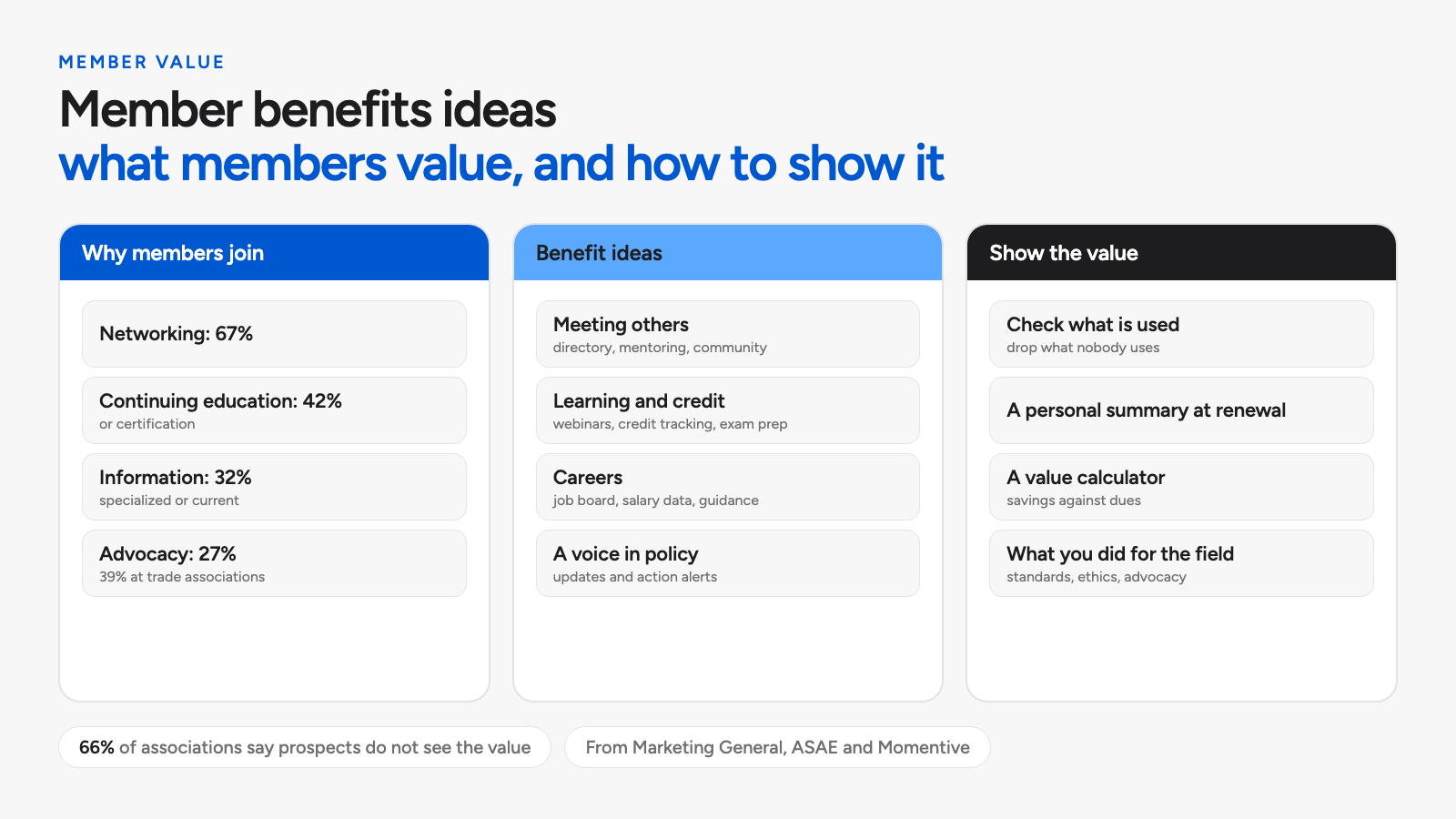
In Marketing General’s 2024 benchmarking report, associations named what they see as the top reasons members join. Each association could pick up to three:
- Networking: 67%.
- Continuing education or certification: 42%.
- Specialized or current information: 32%.
- Learning best practices: 29%.
- Supporting advocacy: 27%.
- Discounts: 21%.
- Career advancement: 19%.
The order shifts with the kind of association. At associations whose members are individuals, 54% named continuing education, against 32% at trade associations. Advocacy is the reverse: 39% at trade associations, against 23% at associations of individuals.
The problem is often showing the value
In the same report:
- 66% of associations say prospects do not join because they do not see the value.
- 58% call their value proposition compelling or very compelling.
- Associations with a weaker value proposition named what holds them back: finding it hard to explain the value (48%), and too few benefits (42%).
So before adding a benefit, check that members know about the ones you have.
Members value what you do for the field, too
Not every benefit is personal. ASAE’s study The Decision to Join found that networking, current information and professional development were the most valued single benefits. But taken as a group, benefits for the whole profession, such as standards, a code of ethics and advocacy, rated higher than personal ones.
Momentive’s 2025 survey, which asked 831 current members, also found members value work for the whole field. The benefits most often rated “very important” were professional standards or a code of ethics (55%), the latest news in the field (54%), representing members’ interests (54%) and advocacy (52%).
Tell members what the association did for their field this year, not only what it did for them.
Benefit ideas, by why members join
Meeting others in their field
- A member directory, searchable by expertise and location.
- A mentoring program that matches newer members with experienced ones.
- An online community for questions between events.
- Special interest groups for each specialty.
- Local chapter meetups.
- Introductions to other members in a new member’s first months.
Learning and credit
- Webinars, live and recorded.
- Continuing education credit, tracked for each member.
- Preparation for certification exams.
- A library of templates, guides and recorded sessions.
Information about their field
- Research and benchmark reports, such as a salary or compensation survey.
- A weekly news digest.
- Standards and best-practice guides.
- Answers from peers, searchable in the community.
Careers
Momentive’s 2025 report found 46% of members had used their association’s job board or career center. Members were most interested in salary and benefits data (74%), job boards (73%) and career path guidance (71%). Younger members care more: 57% of Gen Z members were very interested in career help, against 17% of Baby Boomers.
- A job board.
- Salary data for the profession.
- Career guidance and résumé reviews.
- Volunteer roles that build experience.
A voice in policy
- Updates on laws and regulations that affect the field.
- Action alerts, so members can contact lawmakers.
- The association speaking for members to government.
Savings
- Member prices for events, courses and publications.
- Discounts from partner companies, such as insurance or software.
Do not make discounts the main reason to join. In the Marketing General report, 24% of associations said members who joined only for the conference or meeting discount do not renew.
Check which benefits are used
An article on ASAE’s site suggests a benefits usage audit: measure how many members use each benefit, then drop or change the ones few members use. For each benefit, record:
- How many members used it this year.
- Who used it: new or long-standing members, and which member types.
- What it costs to run, in money and staff time.
When the National Strength and Conditioning Association tracked use, it retired three products and services. One was a directory the public used to find and hire a member trainer. When the association surveyed members, it found none who had received a referral through it.
To ask members directly which benefits they value, see the template in our guide to member survey questions.
Show members what their membership is worth
Members forget what they used. Remind them in one of these ways:
- A personal summary at renewal: the events they attended, the credit they earned, the resources they downloaded and the questions other members answered for them.
- A value calculator: the Restoration Industry Association’s calculator lets members tick the benefits they use and see the savings against their dues.
- One number: ASHRAE’s 2024 value sheet tells new full-dues members they receive $2,269 in free ASHRAE products.
Should benefits come in levels?
Some associations offer levels of membership, such as basic and premium, with more benefits at each level. In the Marketing General report, 12% of associations set dues this way. Of the 65 associations that changed their membership model in the past year, 37% chose levels.
Levels suit associations where members want very different things. Keep the basic level worth having, or members will see it as a trial version.
Partner programs and US tax
Royalty income, such as from an affinity credit card, is usually not subject to unrelated business income tax, the tax on income that has nothing to do with the association’s purpose. The IRS explains that this holds unless the association does more than a little work on the program, such as marketing it. For more on partner income and the tax rules, see our guide to non-dues revenue ideas.
What to measure
- The share of members who used at least one benefit this year.
- Use of each benefit, by member type and among first-year members.
- Renewal rates of members who used each benefit, against those who did not.
- Prospects who say they did not join because membership did not seem worth it.
Where One Roof helps
One Roof puts several of these benefits in your member community:
- A member directory, searchable by expertise.
- Mentoring, with suggested mentors, and meetings arranged with calendar invites and reminders.
- Events with member and non-member prices.
- Continuing education credit, tracked for each member.
- A resource library for templates and guides, with downloads counted.
- Recognition for members who help others, with points and ribbons.
For keeping the members those benefits bring in, see our guide to member retention.
Questions about member benefits
What are member benefits?
Anything a member gets because they belong: events, learning, information, people to know, career help, a voice in policy, or savings.
Why do members join associations?
Associations say networking is the main reason, then continuing education and certification, then information about the field. At trade associations, advocacy matters more.
What benefits do members value most?
Associations say networking, then continuing education. When Momentive asked members, the benefits most often called very important were standards or a code of ethics, the latest news, and representing their interests.
How do you know which member benefits to cut?
Measure how many members use each benefit and what it costs. Drop or change the ones few members use, and tell members what you are doing instead.
How do you show members the value of membership?
At renewal, send each member a summary of what they used this year. You can also offer a value calculator, or put one figure on what membership gives them.

