Non-dues revenue
Non-dues revenue ideas for associations, sorted by the work each takes
Twelve non-dues revenue ideas for associations, sorted by effort, with how to price and report community sponsorship and the US tax rule on advertising.
 Boopesh MahendranCo-founder, One Roof7 min read
Tap the picture to see it at full size.
In this article⌄
Non-dues revenue is money an association earns from anything other than membership fees. Here are twelve ways to earn it, starting with the ones that take the least work.
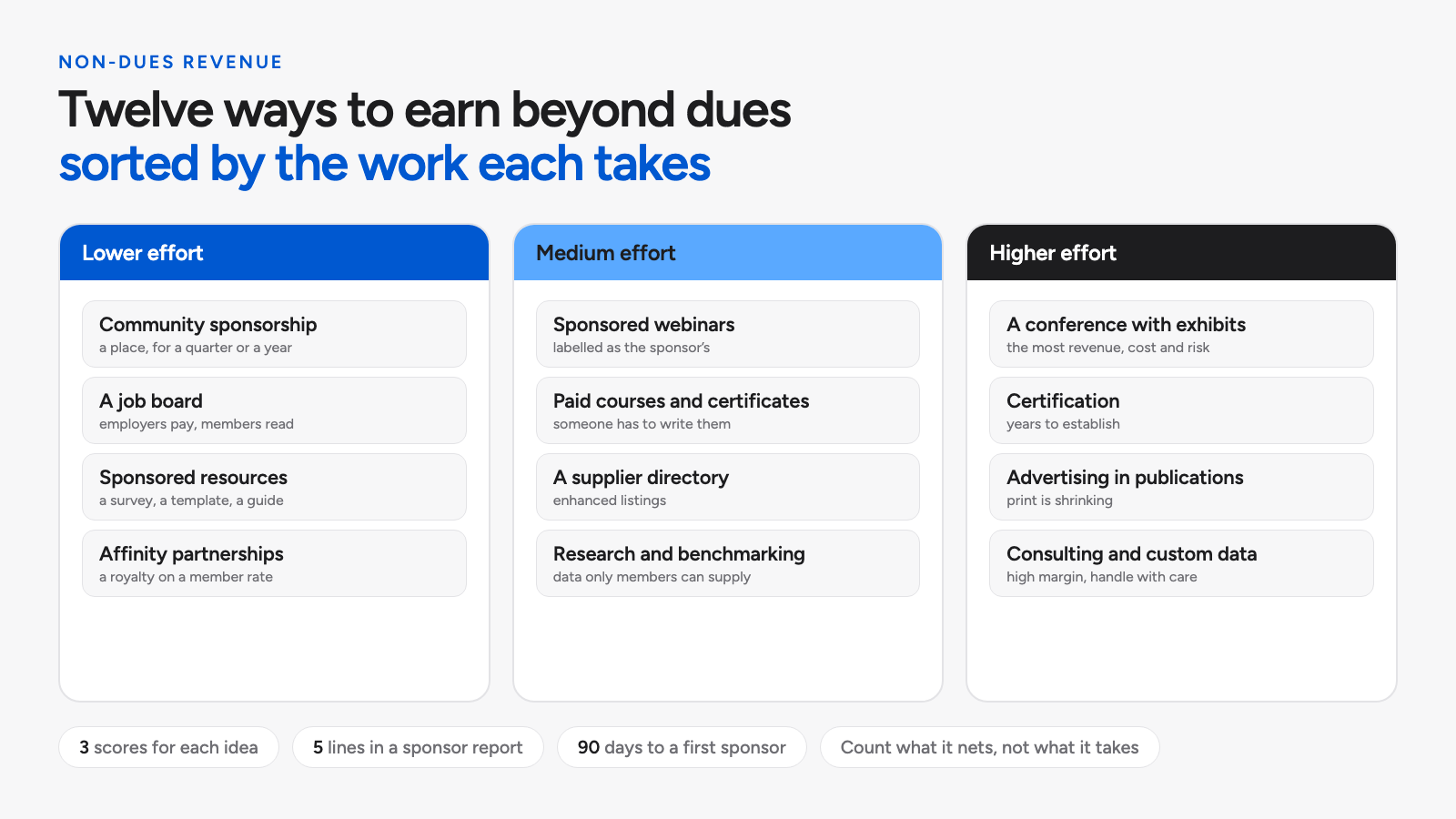
Twelve non-dues revenue ideas
Less work: sell what you already have
- Community sponsorship. A company pays to have its name beside the discussions on a subject, on your community’s home page or in its email digest. More on this below.
- A job board. Employers pay to post jobs. Members read them for free.
- Sponsored resources. A company pays to put its name on a guide or salary survey you would publish anyway. It does not get to write it.
- Affinity partnerships. A company offers members a discount, such as on insurance, and pays you a share. Choose carefully, because you are recommending it.
More work: something to make
- Sponsored webinars. A company pays to support a session, or to present one. If it presents, say so.
- Paid courses and certificates. Members pay for each course. Demand is there: in Momentive Software’s 2025 study, 72% of members said they must take professional education.
- A supplier directory. Suppliers pay for a better listing in a directory members use.
- Research reports. Data only your members can provide, sold to members and to companies that serve them.
Most work: a business of its own
- A conference with exhibitors. Often the biggest earner, and the most costly and risky.
- Certification. A credential members renew brings in fees for years, but takes years to build.
- Advertising in publications. Print is shrinking. MCI USA found print advertising revenue fell 25% from 2021 to 2024 across the associations it works with.
- Consulting. Selling your staff’s expertise to member companies. Be careful not to compete with your own members.
How to choose
Ask three questions about each idea:
- What is left after costs? A conference that takes $400,000 and costs $370,000 earns less than a job board that takes $40,000 and costs $5,000.
- Who will do the work? If the same two people must sell it, make it and deliver it, something else will stop.
- Would members mind? Be wary of anything that sells their attention or their details.
If you have a small team, add one new idea a year, not five.
Sponsorship in your online community
Your community brings together people in one profession, grouped by subject, who come back every week. That is the audience a supplier wants to reach.
What you can sell
- A subject space. For example, “The pay equity discussions are supported by” a company in that field. This is the most valuable place, because members chose the subject.
- The home page. Everyone who signs in sees it.
- The email digest. In Higher Logic’s 2025 figures for its customers’ communities, daily digests had a 56% open rate.
- An event page, for that event’s sponsor.
Sell a place for a set time, such as “the Compensation space for three months”. That is easier for a company to approve than a price per view.
What to charge
Few prices are published. One example comes from Kelly Whelan, writing for Higher Logic about her work at PRIM&R. She charged “between $1,000 and $1,500 for email ads, and $300-600 for web and community ads.” In the year before she left, these ads brought in over $60,000.
To set your own price:
- Look at what companies already pay you. If a conference table costs $4,000 for two days, three months beside the right discussions is worth something similar.
- Offer only a few places. A place shared by three sponsors is worth more to each than one shared by ten.
- Charge less in the first year, and ask your first sponsors for feedback.
- Raise the price once you can show a year of results.
Keep members’ trust
- Mark every sponsored place as sponsored.
- Never give sponsors members’ details.
- Show only one sponsor at a time on any page.
Send every sponsor a report
The person who bought the sponsorship has to explain to their manager what it achieved. Make that easy. At the end of each period, send:
- Views: how many times members saw it.
- Clicks: how many members clicked it.
- Click rate: clicks divided by views.
- Each place separately, and the previous period for comparison.
Do not count your own staff’s visits. Say who saw it, for example “members of the Compensation space”. Send it a month before renewal, before they ask.
This matters because sponsorship is shrinking as a share of association income. Naylor’s 2026 report found it fell from 29.7% to 25.3% of non-dues revenue. A sponsor who cannot see results is easy to lose.
Sponsorship or advertising: the US tax rule
For a US tax-exempt association, what a placement says can decide whether the income is taxed. This is a summary, not tax advice.
The IRS treats them differently. A sponsorship thanks a company with its name, logo, a neutral description and a link, and is usually not taxed. An advert praises or compares the product, gives a price or discount, or asks people to buy, and its income may be taxable.
Usually sponsorship:
- “Supported by [company]” with its logo
- A plain line about what the company does
- A link to its website
Usually advertising:
- “The most accurate pay equity software”
- “20% off for members this month”
- “Book a demo today”
Adverts are allowed. The income may simply be taxed, so decide which you are selling before you set prices.
The figures, briefly
- It is the top challenge. Naylor’s 2026 survey of 665 senior association staff found raising non-dues revenue their top challenge for the fourth year running.
- The famous “70%” is old. The common claim that most association income comes from outside dues traces to an ASAE note from 2016: dues were 30% of income at professional associations and 45.4% at trade associations. Newer figures are in ASAE’s paid report.
- There is no right percentage. We could not find a study behind the targets some guides give. Track your own share each year instead.
Where One Roof fits
One Roof is a community platform for associations with sponsorship built in. You can place a sponsor on the home page, beside a subject’s discussions, on an event page or in the digest. Each place is marked as sponsored and runs between set dates.
It counts views and clicks for each place, and gives you a report for each sponsor to read on screen or download. Sponsor income also appears in your board report.
Questions about non-dues revenue
What is non-dues revenue?
Money an association earns from anything other than membership fees, such as events, sponsorship, advertising, courses, certification and job postings.
What percentage of revenue should be non-dues?
There is no agreed figure. The often quoted one comes from a 2016 ASAE report. Compare your own share year by year instead.
What is the biggest source of non-dues revenue?
Often sponsorship. Naylor’s 2025 report calls sponsorship sales “the largest source of non-dues income for many associations.”
What is the difference between sponsorship and advertising?
Sponsorship thanks a company with its name and logo. Advertising promotes its product with claims, prices or a call to buy. In the US, advertising income may be taxed.
How can a small association start?
Sell places you already have to companies that already pay you. List the places, set a price, call five suppliers, and send each sponsor a report.
How do you price community sponsorship?
Start from what companies already pay you, offer only a few places, charge less in the first year, and raise the price once you have results to show.

