Engagement
How to engage young professionals and student members in your association
How to engage young professionals and student members: what they want, making the move from student to full member easy, step-up dues, young professional groups, a seat on the board, short volunteer roles, mentoring, early recognition, and what to measure.
 Boopesh MahendranCo-founder, One Roof7 min read
Tap the picture to see it at full size.
In this article⌄
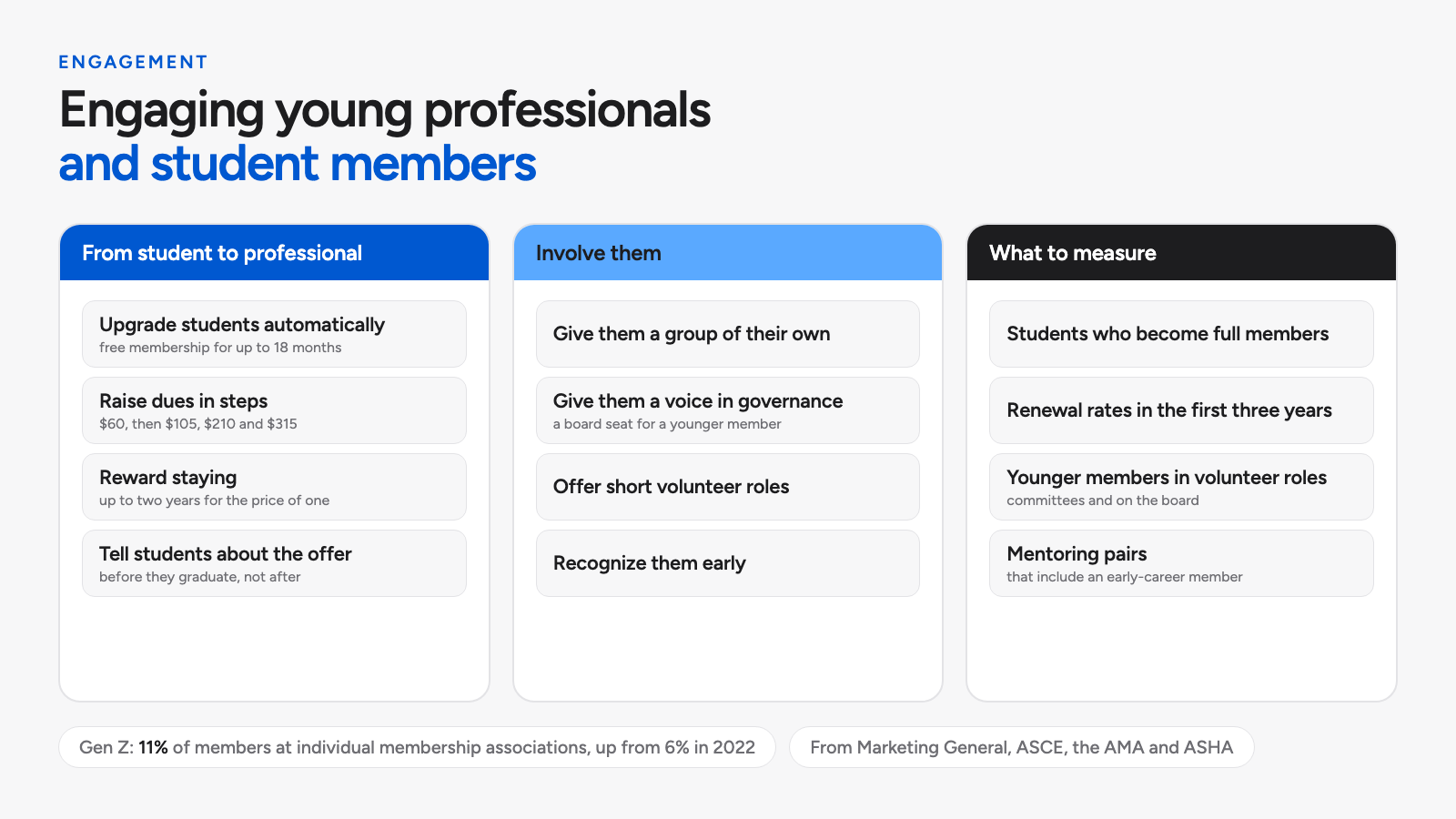
Younger members are a growing share of many associations. In Marketing General’s 2024 benchmarking report, Gen Z made up 11% of members at individual membership associations (those whose members are people, not companies), up from 9% in 2023 and 6% in 2022. Millennials have stayed at 21% since 2020.
For some associations, getting them to join is easier than keeping them. One association put it plainly in the report: “attracting new YPs is not a challenge but keeping them throughout their career is.” YPs are young professionals.
This guide covers what younger professionals want, the move from student to full member, young professional groups, governance, volunteering, mentoring, recognition, and what to measure.
What younger professionals want
Mostly, they want to grow in their careers:
- Development. In a 2016 Gallup study, 87% of millennials rated “professional or career growth and development opportunities” as important in a job, against 69% of non-millennials.
- Steady progress, not a title. In Deloitte’s 2026 survey of more than 22,000 Gen Zs and millennials, only 6% said reaching a leadership position was their main career goal. More of them preferred steady advancement (44% of Gen Zs and 45% of millennials) than rapid promotion (25% and 21%).
- Career help. In the 2024 Marketing General report, 27% of individual membership associations named advancing their careers among the top three reasons members join.
So lead with what helps them now: learning, people to ask, and a path to the next step.
Make the move from student to professional easy
The riskiest moment is graduation. In the 2024 Marketing General report, 14% of individual membership associations said one of the top three reasons members do not renew is that student members do not move up to full membership. One trade association noted “the low renewal rate for graduates due to high cost of education/loans.”
Associations that handle this well do three things:
- Upgrade students automatically. At ASCE, the civil engineers’ society, student members are upgraded on their graduation date and “receive free membership for up to 18 months.” After that, members aged 28 or younger pay $138.50 a year, half the $277 that older members pay.
- Raise dues in steps. Under the American Medical Association’s 2027 dues, a doctor pays $60 in their first year in practice, then $105, $210 and $315, before the regular $420. In the 2024 Marketing General report, 14% of associations that adopted a new membership model chose this kind of step-up dues for early-career members.
- Reward staying. The American Speech-Language-Hearing Association (ASHA) offers a New Professional Package that gives “up to two years of ASHA membership for the price of one.” Its student association is called NSSLHA. Graduates who were National NSSLHA members for the last two years of their master’s or doctoral program get $250 off their initial ASHA membership and certification fees.
Tell students about the offer before they graduate, not after.
Give them a group of their own
A young professionals group gives younger members peers at the same stage. In the 2024 Marketing General report, 56% of associations said participation in young professional programs went up, more than for most other services.
- ASHRAE, the heating and cooling engineers’ society, makes all members aged 35 and younger (except students) automatically part of Young Engineers in ASHRAE. More than 1,100 of them have attended its Leadership Weekend.
- ASCE has Younger Member Groups for members aged 35 or younger, and a national Committee on Younger Members.
Let the group run its own events and discussions, with a staff contact to help.
Give them a voice in governance
Some associations reserve a board seat for a younger member:
- The American Nuclear Society added a seat for a representative of its Young Members Group in 2020. The representative must be younger than 36 on June 1 of the election year.
- SWANA, the solid waste association, has a permanent board position representing members aged 35 or younger, for a two-year term.
A seat on the board tells younger members their view counts, and gives the board a younger member’s view of the association.
Offer short volunteer roles
Younger professionals, like most members, are short of time. The ASAE Foundation, which researches associations, found that time was the most common reason members gave for not volunteering, and that “short-term micro-volunteering opportunities and virtual volunteering” appeal to many.
Offer roles that take an hour or a few weeks: reviewing conference proposals, judging a student competition, or writing one article. One trade association in the Marketing General report said: “We try to get them plugged in as a volunteer the moment they express interest in something.”
Our guide to volunteer management covers short roles in more detail.
Help them with their careers
Mentoring is one of the most direct ways to help. In a 2025 Gallup survey of nearly 16,000 US workers, 48% of those who had taken part in mentoring in the past year reported high job satisfaction, against 29% of those who had not. The difference held across all age groups.
ASHA runs several mentoring programs, from six to twelve months, including one for PhD students, postdocs and early-career faculty. Our guide to association mentoring programs covers how to set one up.
Recognize them early
Do not wait for a lifetime achievement award:
- The American Institute of Architects gives a Young Architect Award to members first licensed less than ten years before the deadline, and to Associate members, who are not yet licensed, if they have passed the licensing exam.
- ASCE names ten young professionals aged 30 or younger as New Faces of Civil Engineering each year, alongside ten college students.
Our guide to association awards programs covers nominations and judging.
What to measure
- The share of students who become full members after graduating.
- Renewal rates in the first three years after the student upgrade.
- How many younger members join the young professionals group, and how many take part.
- Younger members in volunteer roles, committees and on the board.
- Mentoring pairs that include an early-career member.
Where One Roof helps
- Dues can be paid in One Roof, with a yearly or monthly price for each member type, so students, recent graduates and full members each pay their own rate.
- Mentoring suggests mentors with the reason for each, and arranges meetings with calendar invites and reminders.
- Chapters and committees give a young professionals group its own space in the community, with its own events and discussions, run by its own leaders.
- Volunteer openings list each role with the time it takes, and members see the ones that fit their expertise first.
- Recognition gives members points and ribbons, a kind of badge, for helping others, from their first post or the first answer marked as solving a question.
Questions about engaging young professionals
How do associations keep student members after graduation?
Upgrade them automatically, and make the first years cheaper. ASCE gives graduating students up to 18 months free, and the AMA raises dues in steps over a doctor’s first four years in practice.
What do young professionals want from an association?
Mostly, help with their careers: learning, mentoring and people to ask. In Deloitte’s 2026 survey, more Gen Zs and millennials preferred steady advancement than rapid promotion.
What is step-up dues pricing?
Dues that start low for new graduates and rise each year until they reach the full rate. Under the AMA’s 2027 dues, a doctor pays $60 in their first year in practice and $420 once the steps end.
Should a young professional have a seat on the board?
Some associations think so. The American Nuclear Society and SWANA each reserve a board seat for a younger member.
How old is a young professional?
Many associations use 35 or younger, as ASHRAE, ASCE and SWANA do.

