Recognition
Association awards programs: how to run member awards that mean something
How to run an association awards program: why recognition matters and when it backfires, choosing categories, nominations and eligibility, fair judging and conflicts of interest, widening who gets nominated, timelines, fees and sponsors, celebrating winners, US tax on prizes, and everyday recognition.
 Boopesh MahendranCo-founder, One Roof7 min read
Tap the picture to see it at full size.
In this article⌄
- Why recognition matters, and when it backfires
- Decide what each award is for
- Set the rules for nominations
- Judge fairly
- Widen who gets nominated
- Plan the timeline
- Fees and sponsors
- Celebrate the winners
- Know the tax rules on prizes
- Recognize people all year, not only at the gala
- What to measure
- Where One Roof helps
- Questions about association awards programs
An awards program is one of the oldest ways an association thanks its members, and one of the most visible. Done well, it shows what the field values and who is doing that work. Done badly, the same few names win every year.
This guide covers why recognition matters, setting up and judging awards, widening who gets nominated, timelines, fees, celebrating winners, US tax on prizes, and everyday recognition.
Why recognition matters, and when it backfires
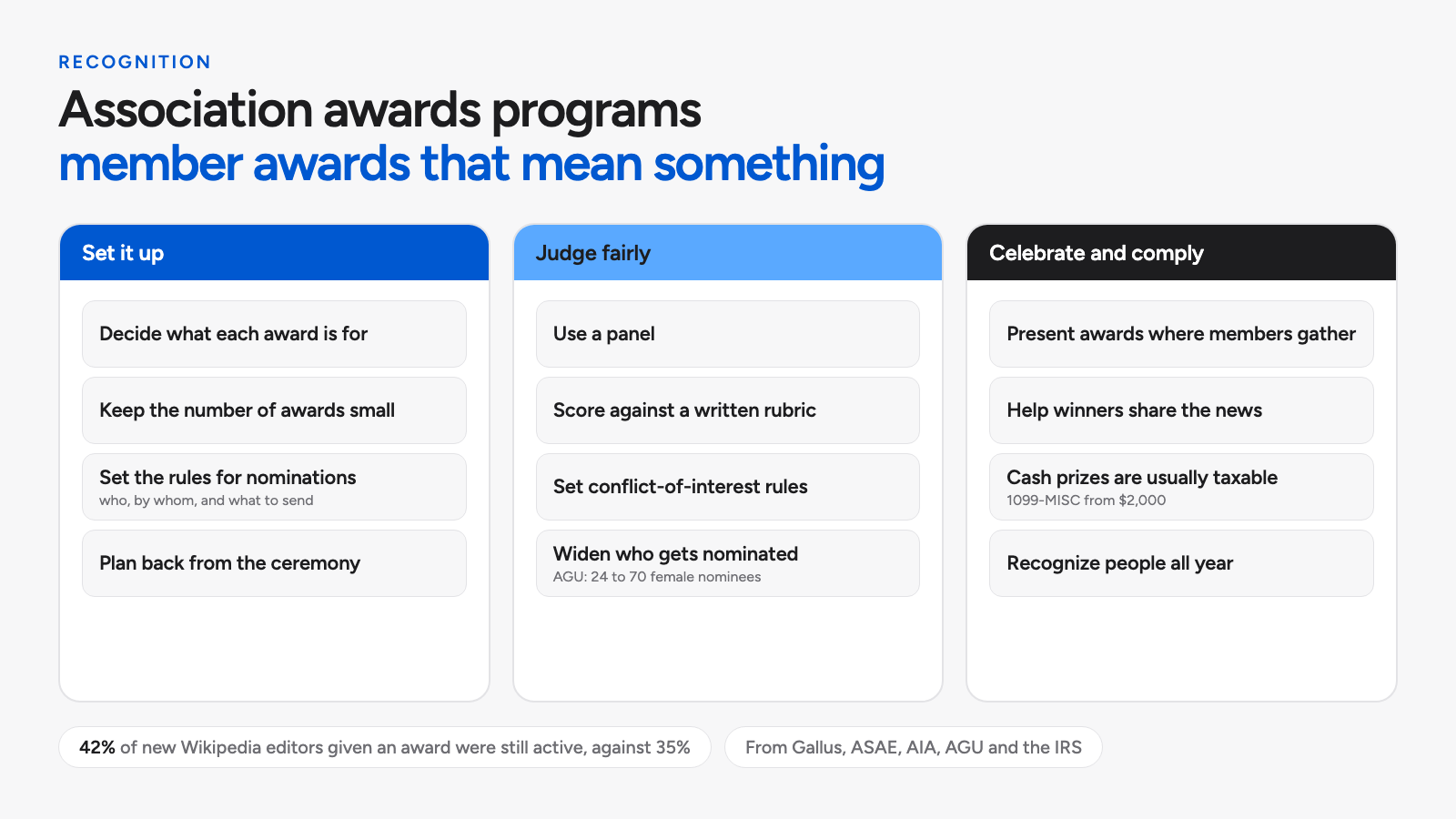
Recognition can keep people involved. In a field experiment published in the journal Management Science in 2017, Jana Gallus gave purely symbolic awards to new editors of the German-language Wikipedia. A month later, 42% of the editors who got an award were still active, against 35% of those who did not. The gap lasted about a year.
But awards can backfire. In a trial with 15,329 US students, awards promised in advance for perfect attendance did not raise attendance on average. Surprise awards for past perfect attendance made students attend less afterwards. The researchers suggest the awards told students two things: that perfect attendance was unusual and not expected of them, and that winners had already done more than they needed to.
The lesson for associations: be careful with awards for things you expect of everyone, such as showing up. They can signal that few people do them.
Few associations think prestige is a main reason people join. In Marketing General’s 2024 benchmarking report, 15% of associations named “receiving recognition or prestige” among the top three reasons members join, and 20% of trade associations did.
Decide what each award is for
Each award should say clearly what it recognizes. Common kinds:
- Lifetime achievement. The Massachusetts Medical Society’s Lifetime Achievement Award comes with a $5,000 honorarium.
- Early career. The Association of Proposal Management Professionals started a 40 Under 40 award in 2017.
- Work and projects. ASAE’s Power of Associations Awards recognize association programs in five categories, such as advocacy. Entries are judged on their impact, their reach, and how far they go beyond the association’s core mission.
- Volunteer service. For members who served on a committee, mentored others or led a chapter.
Keep the number of awards small. Each new award takes nominations, judges and time, and too many awards make each one mean less.
Set the rules for nominations
Decide who can be nominated, who can nominate, and what a nomination needs:
- Self-nomination. ASAE’s individual honors let members nominate a peer or apply themselves. The American Institute of Architects requires a nominator for its Gold Medal, but candidates may ask someone to nominate them.
- Eligibility. The Massachusetts Medical Society requires nominees to be members in good standing who live or practice medicine in Massachusetts.
- What to send. The same society asks for a CV of no more than five pages, a statement from the nominator, and two letters of support from members. AIA Minnesota asks for a single PDF of no more than 16 pages for its Gold Medal.
A shorter nomination is easier to make, so more people may make one.
Judge fairly
- Use a panel. ASAE’s Gold Circle Awards use “an independent panel of judges” for each category.
- Score against a written rubric. Gold Circle entries “are scored on a five-point scale within each area of review.” The American Geophysical Union (AGU) gives 60% of its second-round score to how well a nomination fits the award’s criteria.
- Set conflict-of-interest rules. Gold Circle judges may not judge a category that their own organization or their clients have entered. AIA’s national officers, staff and board members may not nominate, sponsor or campaign for a Gold Medal candidate, or serve as a reference.
- Say whether decisions are final. For Gold Circle, “There is no appeals process.”
Widen who gets nominated
If the same kinds of people are nominated every year, the same kinds will win. Two associations that set out to change this:
- AGU found that “six of the 13 medals in 2018 did not receive a single female nominee.” For 2019, it set up a committee to seek out nominations, trained selection committees on implicit bias, and began writing scoring rubrics. Female nominees for its medals and prizes rose from 24 in 2018 to 70 in 2019, its report shows. Women were 18 of the 35 people honored in 2019, up from 5 of 33. Today AGU hides nominees’ names from the committee in its first round of scoring.
- The American Chemical Society found that women made up 17% of nominees for its 2015 national awards, against 29% of its members. Working with the Association for Women in Science, it set up a task force to review its awards. In 2014, it was building more diverse selection committees and planning a guide for nominators.
Compare your nominees with your membership each year, and ask members directly to nominate people who have not been recognized before.
Plan the timeline
Large programs can take most of a year from the call for nominations to the ceremony. Some examples:
- AGU’s 2026 honors: nominations were open from January 5 to March 2, committees reviewed them in the spring and summer, recipients were announced in September, and the ceremony is in December.
- AIA’s 2027 Gold Medal: nominations were due August 6, 2026, and the winner will be announced in December 2026.
- ASAE’s Gold Circle Awards: entries for 2026 were due February 5, for work done in 2025.
Plan back from the ceremony, which is often at the annual meeting, and give nominators at least two months.
Fees and sponsors
Some programs charge an entry fee, especially competitions for work and projects. Some examples:
- Gold Circle charges $150 an entry if someone on your staff is an ASAE member, and $300 otherwise.
- AIA’s Gold Medal, which honors a person, has a $450 application fee. AIA Minnesota’s Gold Medal has no entry fee.
Sponsors can fund prizes and ceremonies:
- The American Chemical Society’s Award in Polymer Chemistry is sponsored by Procter & Gamble and pays the winner $5,000.
- CAI’s Greater Houston chapter sells sponsorships of its awards gala from $1,000 to $5,000.
Celebrate the winners
- Present awards where members gather. ASAE presents its individual honors at its annual meeting.
- Help winners share the news. Gold Circle winners get a press release template, and ASAE issues its own release listing every winner.
- Make the ceremony easy to attend. The Textbook and Academic Authors Association moved its awards from an evening dinner to a lunch. Later it moved them again, to an afternoon ceremony and reception held 15 minutes after the last conference session.
- Show what winners did. The Entrepreneurs’ Organization added panels to its student awards dinner: one of past participants and winners, and one of that year’s finalists.
Know the tax rules on prizes
In the US, a cash prize is usually taxable income for the winner. IRS Publication 525 says prizes of goods or services are taxed too, at their fair market value. A prize for achievement in a field such as science, education or civic work can be left out of the winner’s income only if all three of these are true:
- The winner did nothing to enter.
- The winner does not have to provide substantial services in the future.
- The payer sends the prize straight to a government body or charity the winner names, and the winner does not use it first.
For payments made from 2026 on, an association must report on Form 1099-MISC any winner whose prizes total $2,000 or more in a year. The threshold used to be $600, and it may rise with inflation from 2027.
Recognize people all year, not only at the gala
A formal award reaches a few people a year. Everyday recognition reaches many more:
- Digital badges. The Security Industry Association issues badges to certification holders, volunteers and community members.
- Volunteer spotlights. The Washington State Bar Association lets anyone nominate a volunteer, and features those chosen in its Bar News.
- Public thanks. Name the members who helped most this month, in your newsletter or community.
Our guide to volunteer management covers keeping the volunteers you recognize.
What to measure
- Nominations for each award, and how many different people made them.
- Nominees who have never been nominated before.
- Nominees compared with your membership, by career stage, region and other groups.
- Attendance at the ceremony.
- Whether winners and nominees stay involved afterwards.
Where One Roof helps
One Roof does not run nominations or judging. It helps with the recognition around them, all year:
- Recognition: members earn points for helping others, ribbons for milestones such as a first accepted answer, and a place on a leaderboard they can opt out of. You can add your own ribbons, each with its own rule.
- Announcements: open nominations and announce winners to all members, or to the followers of one space.
- Events: run the awards dinner or reception, with member and non-member prices.
Questions about association awards programs
How do you start an association awards program?
Decide what each award recognizes, who can nominate and be nominated, and what a nomination needs. Set up a judging panel with a scored rubric and conflict-of-interest rules, and plan back from the ceremony.
Should associations allow self-nominations?
Some do. ASAE lets members apply for its individual honors themselves. Others, such as AIA for its Gold Medal, require a nominator, though candidates may ask someone to nominate them.
How do you judge an awards program fairly?
Use a panel, score each nomination against a written rubric, and keep judges away from entries they have a stake in. AGU, for example, hides nominees’ names in its first round.
Are association award prizes taxable?
Usually, yes. In the US, a prize is taxable income for the winner. For payments made from 2026 on, associations report prizes that total $2,000 or more a year on Form 1099-MISC.
Should we charge an entry fee?
Competitions for work often do: ASAE’s Gold Circle Awards charge $150 or $300 an entry. Some honors for people charge too, such as AIA’s Gold Medal ($450). Others, such as AIA Minnesota’s Gold Medal, charge nothing.

