Volunteering
Volunteer management for associations: recruiting, matching and keeping volunteers
A practical guide to association volunteer management: why most members never volunteer, writing roles people can say yes to, short roles alongside committees, asking and opening roles to applications, training, feedback and terms.
 Boopesh MahendranCo-founder, One Roof7 min read
Tap the picture to see it at full size.
In this article⌄
Volunteers run an association’s committees, chapters, conferences and journals. Most associations rely on a small group, often the same people every year. This guide covers why most members never volunteer, how to write roles they can say yes to, and how to keep the volunteers you have.
How many members volunteer
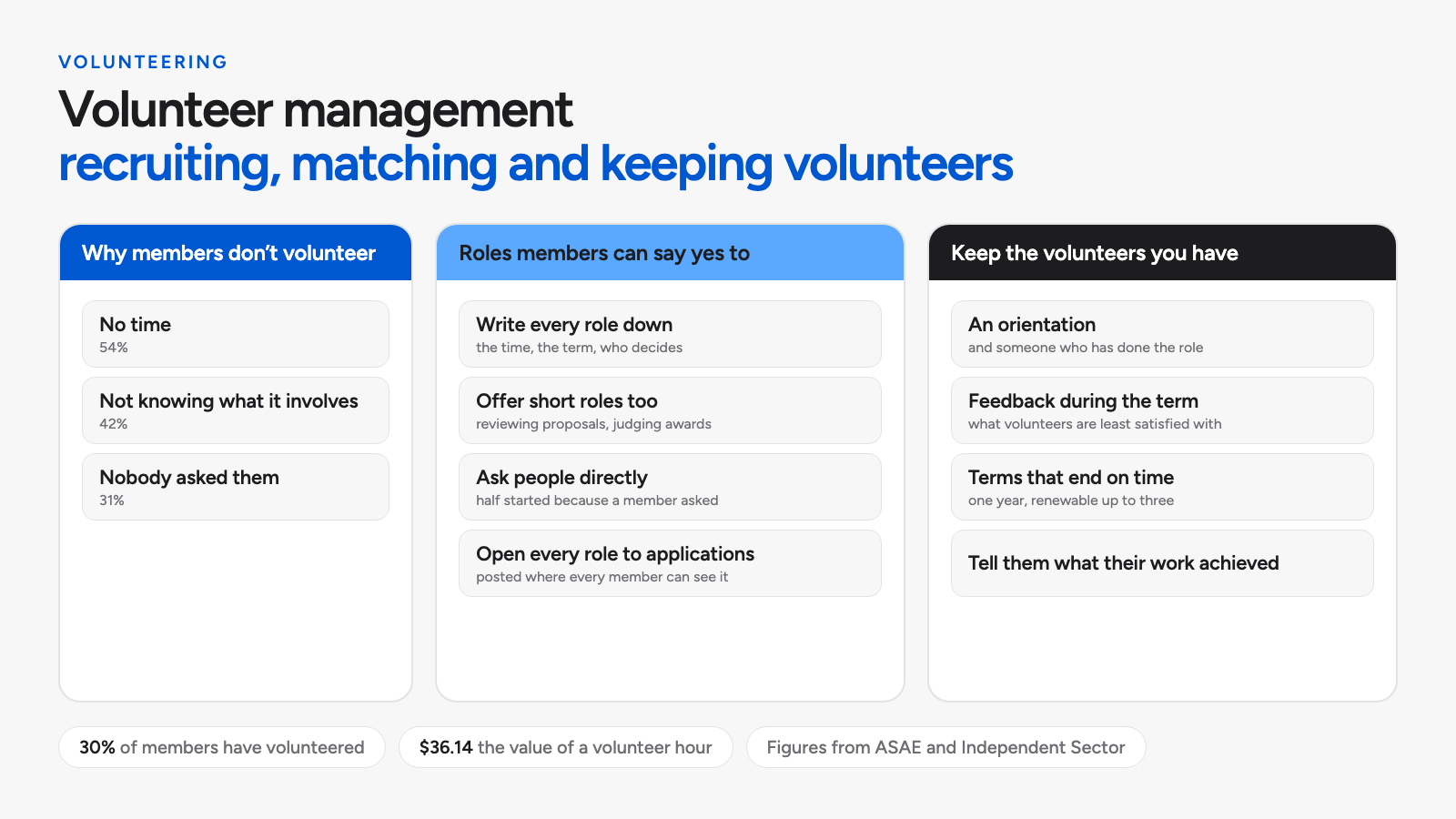
Association staff estimate that about 30% of their members have volunteered, and almost 70% never have. That comes from ASAE’s 2023 study of volunteer management.
The volunteers you have give a lot: a median of 30 hours a year. At $36.14 an hour, Independent Sector’s value of volunteer time for 2025, that is about $1,080 of work a year from a typical volunteer.
Most do it to give back. Giving back to their profession was the top reason volunteers gave (46%), well ahead of building their network (11%).
Why members don’t volunteer
An earlier ASAE study asked members who had never volunteered why not:
- No time (54%).
- Not knowing what volunteering involves (42%).
- Nobody asked them (31%).
Only the first is hard to fix. The other two are about how roles are described and offered.
Write every role down
A member cannot say yes to a role they cannot picture. Susan J. Ellis, who wrote widely on volunteer management, advised a written description for every volunteer job. For each role, write down:
- What the role is for, in a sentence.
- The time it takes each month and in total: “two hours a month for a year”.
- The term, and when it starts and ends.
- Where it happens: online, at chapter meetings, at the annual conference.
- Who it suits: the experience or credentials that help.
- Who decides, and by when.
This is where associations rate themselves lowest. In ASAE’s 2023 study, staff gave their own role descriptions 3.01 out of 5.
Offer short roles too
Not every role needs a year on a committee. Short, one-off tasks, often called micro-volunteering, suit members who have a few hours rather than a few months:
- Reviewing proposals for conference sessions.
- Judging awards.
- Writing one article for the newsletter or journal.
- Photographing a chapter event, or testing a new web page.
- Mentoring a new member for one conversation.
At RAPS, tasks like these take 30 minutes to 2 hours.
Fewer associations offer short roles than committee seats. Of 30 associations interviewed for ASAE’s 2023 study, 18 offered short roles and 28 offered board and committee roles.
Short roles are the easiest first step for a newer member, and they pay off. ASAE research found that even writing one article raised a member’s view of the association’s value.
Ask people, and open the door
Half of volunteers (51%) in ASAE’s earlier study started because another member asked them. ASAE has also found that a personal request works better than a notice on the website.
But if you only ask people you know, the same faces end up on every committee. In ASAE’s 2023 study, only about half of volunteers (52%) said their association keeps the door to leadership roles open to the next generation. Do both:
- Post every role where all members can see it, with an application and a closing date. ASAE itself takes volunteer applications each spring and fall.
- Ask people directly to apply, especially newer members and those whose expertise fits the role.
- Say how people are chosen, and tell every applicant the outcome.
Train them, and tell them how they are doing
Associations know this is a weak spot. In ASAE’s 2023 study, staff most often named training (21%) or orientation (16%) as the biggest weakness in how they manage volunteers. And 40% had no formal way to review volunteers’ work at all.
Volunteers notice. In ASAE’s earlier study, the feedback they got on their work was what they were least happy with.
- Start with an orientation: what the group does, how decisions are made, where the files are, who to ask.
- Pair new volunteers with someone who has done the role before.
- Give feedback during the term, not only at the end: what went well, what to change.
- Tell them what their work achieved: the sessions they chose, the members their chapter reached.
End terms on time
Open-ended roles keep the same people in place and stop new ones getting in. ASAE uses “one-year terms that are renewable for up to three years” for its own volunteers.
- Give every committee and leadership role a term.
- Remind the holder and the chair before it ends, so there is time to ask them to continue or find a successor.
- Have a vice chair or successor learn the role in the final year.
- Thank people when they finish, and offer them a shorter role if they want to stay involved.
What to measure
- Share of members who volunteered this year, in any role, short or long.
- First-time volunteers, and how long they have been members.
- Roles filled by the closing date, and the number of applicants for each.
- Volunteers who would do it again. In ASAE’s earlier study, 70% said they were very likely to.
Where One Roof helps
One Roof’s chapters and committees include volunteering:
- Staff and group leaders post a role with what it involves, the time it takes, how many places there are and when applications close.
- Every open role is listed in one place for all members, and each member sees the roles that fit their expertise marked for them.
- Members apply with a note. Leaders accept or decline, and every applicant is told. Accepted members join the group in that role.
- Roles can have terms. The holder and the chair are reminded before a term ends, and when it is over the role is removed, along with access to the committee’s private space.
For running chapters themselves, see our guide to association chapter management.
Questions about volunteer management
What is volunteer management in an association?
Recruiting members for committees, chapters, boards and short tasks, matching them to the right roles, preparing them, and keeping them involved, from the first ask to the end of their term.
How do associations recruit volunteers?
Write each role down with its time commitment, post every role openly with an application, and ask people directly. Half of association volunteers started because another member asked.
What is micro-volunteering?
A short, one-off task: reviewing conference proposals, judging awards, writing an article, mentoring one new member. It suits members with little time, and is an easy first step for newer members.
How long should committee terms be?
One year, renewable up to three, is the model ASAE uses for its own volunteers. What matters most is that every role has a term, so new members can get in.
How do you keep volunteers?
Give them an orientation, feedback during their term, and a clear account of what their work achieved. Thank them when they finish, and offer a shorter role to those who want to stay involved.

