Chapters
How to manage association chapters, from the agreement to the yearly review
How to manage association chapters: choosing a structure, what goes in a chapter affiliation agreement, tax and money, supporting chapter leaders, and reviewing each chapter.
 Boopesh MahendranCo-founder, One Roof8 min read
Tap the picture to see it at full size.
In this article⌄
Chapters bring an association to where members live and work: a meeting nearby, a local job lead, a leader who knows their name. They are also hard to run from headquarters. Volunteers lead them and change every year or two, and each chapter often keeps its own money and its own member list. This guide is for the staff who look after chapters: how to set them up, what to put in writing, how to support the people who lead them, and how to tell which ones are working.
What the research shows
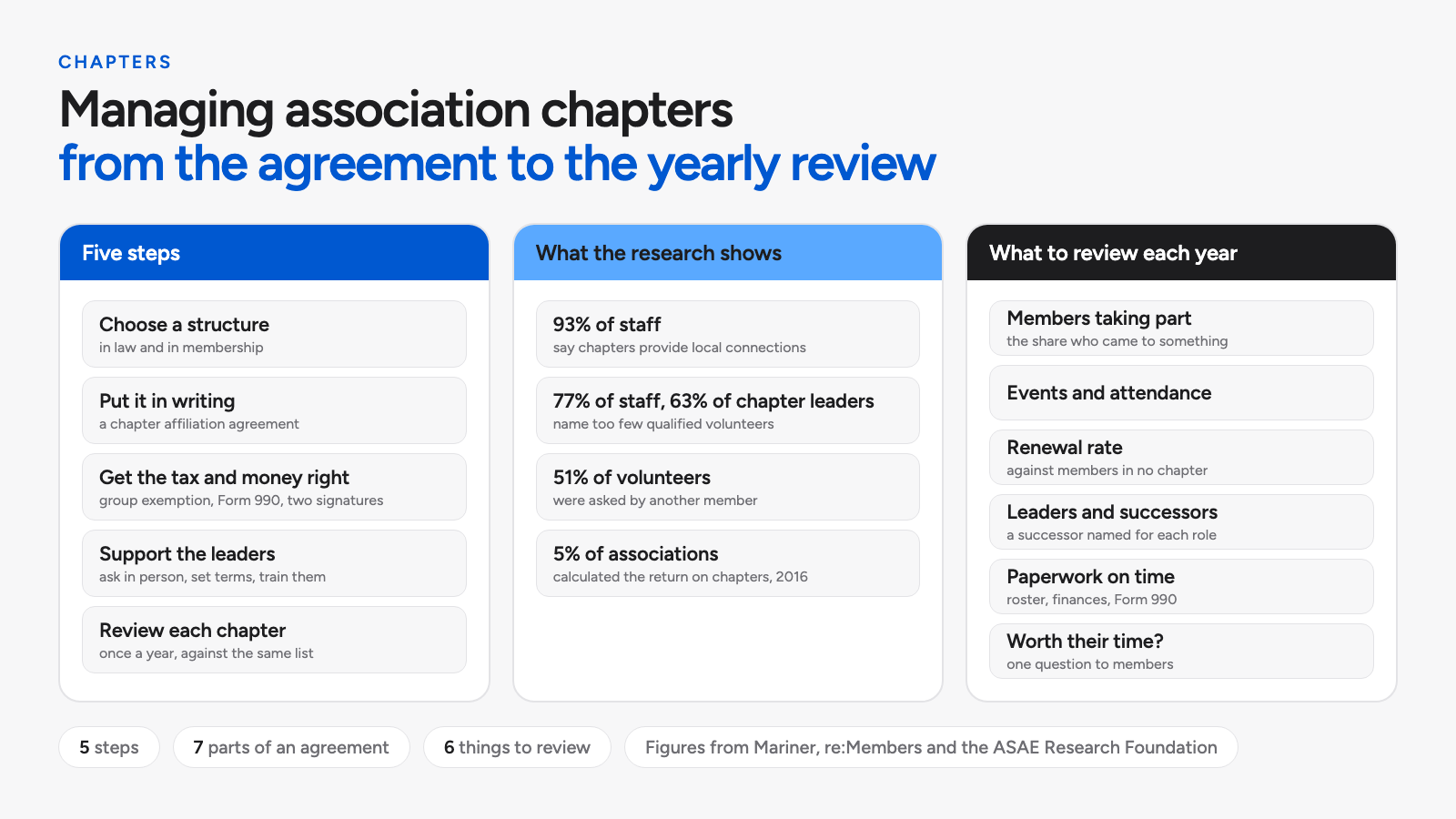
- Staff are more positive than chapter leaders. re:Members and Mariner Management surveyed 250 association leaders and 1,132 chapter leaders in 2025. 93% of association staff said their chapters provide local connections. Chapter leaders gave low marks to their own programming and overall performance.
- The biggest problem is people. In the same survey, 77% of staff and 63% of chapter leaders named “insufficient qualified volunteers” as their biggest chapter-related challenge.
- Few associations measure chapters. In a 2016 Mariner study of 162 associations, 5% worked out the return on investment of their chapters. In a 2019 study of 177 associations, 29% tracked chapter performance with a formal assessment tool.
- Chapters help recruit. In Marketing General Incorporated’s 2024 benchmarking report, 30% of associations used chapters to recruit members. Associations whose renewal rates were rising were “significantly more likely” to do so.
Step 1: Choose a structure
There are two decisions: how a chapter relates to the association in law, and how chapter membership relates to association membership.
In law. In the 2016 Mariner study:
- 46% of associations used a “separate chartered” model, where each chapter is its own nonprofit but cannot exist apart from the association.
- 29% used a “separate affiliated” model, where chapters could exist on their own.
- 20% used a subsidiary model, where the chapters and the association are one organization.
A separate chapter has its own bank account, board, tax filing and liability. Under a charter, the association can still keep substantial control. A subsidiary chapter is part of the association’s own books, insurance and tax filing. That means more control, and more work for staff.
In membership. In the same study:
- 31% had a unified membership: joining one means joining both.
- 29% required members to join the association before they could join a chapter.
- 20% let members join a chapter without joining the association.
Then decide who collects chapter dues. About two-thirds of associations in the study collected dues for their chapters.
Step 2: Put the relationship in writing
Associations with separate chapters often sign a chapter affiliation agreement, sometimes called a charter agreement. The Association of Fundraising Professionals publishes its agreement for US chapters, which has 21 sections. The American Society of Addiction Medicine publishes one with 27. Between them they cover:
- The name and brand. How the chapter may use the association’s name and logo.
- Tax status. AFP’s agreement says the chapter “agrees to be a member of AFP’s ‘group exemption’” and will file an IRS Form 990 every year.
- Money. Dues, payments between the chapter and the association, and an annual financial report.
- Insurance. The liability cover each chapter must hold.
- The member list. Who holds it and how it is shared. ASAM’s agreement has a section on it.
- Policy positions. ASAM’s agreement asks a chapter to send ASAM a copy of any public policy statement on a topic where ASAM has no national position, before issuing it.
- When a chapter stops working. Probation, termination and dissolution. AFP can place a chapter on probation for up to six months, and either side can end the agreement with at least thirty days’ notice.
Review the agreement every few years. The American Society for Health Care Engineering’s chapter guide advises reviewing chapter bylaws every two years.
Step 3: Get the tax and money right
- Consider a group exemption. The IRS can recognize a group of organizations as tax-exempt when they are affiliated with a central organization, so chapters do not each have to apply. The central organization needs at least five subordinate organizations.
- File every year. Each tax-exempt chapter files a return every year, unless the association files a group return that includes it. A chapter whose gross receipts are normally $50,000 or less can file the short Form 990-N. An organization that does not file for three years in a row loses its exemption automatically, which is how a dormant chapter becomes a problem.
- Protect the money. Use two signatures on payments, and bond every officer who can sign checks. ASHE’s guide gives the reason: “if the financial officer splits for Bermuda with the bucks, the chapter won’t end up out of business.”
- Ask for a report. Each chapter sends a financial report once a year, at the same time as its other paperwork.
Step 4: Support the leaders
- Ask people in person. In an ASAE Research Foundation study, about half of volunteers (51%) “became a volunteer after being asked to serve by another member”. Of members who had not volunteered, 31% gave as one reason that no one had asked them.
- Set terms with an end date. Name a successor, such as a president-elect, a year ahead. Mariner’s 2025 report calls leadership sustainability “a chronic vulnerability”.
- Train every new leader. The Project Management Institute runs online courses and regional meetings for chapter leaders. AFP’s agreement commits each chapter to send its president or president-elect to the AFP Leadership Academy.
- Give them a kit. Templates for an event, a budget and a meeting notice, the brand files, and a handover document for the next leader.
- Offer smaller jobs. Not everyone wants a two-year board seat. Running one event, finding a speaker or calling new members are ways in.
- Let leaders do it themselves. A chair should be able to update the members list or post an event without waiting for staff.
Step 5: Review each chapter once a year
Two real examples:
- AFP’s annual Chapter Accord checklist asks each chapter for its leadership roster, a program schedule, proof that its corporation is active, a financial report and its latest Form 990.
- PMI’s Chapter of the Year scores chapters on five criteria worth 20% each: impact on the community, knowledge sharing, member engagement and satisfaction, PMI’s values, and sustainability and volunteers.
A short list to start with:
- Members in the chapter’s area, and the share who came to something this year
- Events held, and how many attended
- Renewal rate of chapter members, compared with similar members who belong to no chapter
- A leader in every role, and a successor named for each
- Paperwork in on time: the roster, the financial report and the Form 990
- One question to members: was the chapter worth their time?
Treat the renewal comparison with care. Members who join a chapter may have been more likely to renew anyway.
Where chapters go wrong
- The same few people lead for years, then all step down together.
- A chapter goes dormant, and nobody notices until its tax filing lapses.
- The member list lives in a spreadsheet, out of date and invisible to headquarters.
- The brand drifts, with a chapter logo, a chapter website and a chapter mailing list.
- Nobody counts, so nobody can say which chapters are worth the effort.
Where One Roof helps
One Roof includes chapters and committees as part of the member community:
- Each chapter has its own space in the community, with its discussions, events and members list. There is no separate chapter website to run.
- Leaders manage their own chapter’s members list, roles, events and discussions, and nothing outside it.
- Roles can have terms. Leaders and staff are reminded before a term ends, and the role and its access end on the day.
- Volunteer openings are listed in one place, shown first to members whose expertise fits, and members apply with a note.
- Staff see every chapter, its leaders, and applications waiting for a decision.
- Chapter members lists can be kept up to date from your membership system.
Questions about chapter management
What is association chapter management?
It is the work of setting up and supporting an association’s local or regional groups. It covers each chapter’s legal and financial relationship with the association, the agreement between them, support for chapter leaders, and a yearly review of each chapter.
What should a chapter affiliation agreement include?
It should cover the use of the association’s name and brand, tax status, money and dues, insurance, the member list and policy positions. It should also say what happens if a chapter is put on probation, leaves or closes.
Do association chapters need their own tax-exempt status?
A chapter that is its own organization needs tax-exempt status, either on its own or through the association’s group exemption. Either way, a return is filed every year, by the chapter or in the association’s group return. An organization that files nothing for three years in a row loses its exemption.
How do you measure chapter performance?
Review every chapter once a year against the same short list: how many members take part, events and attendance, renewal rates, leaders and successors in place, and paperwork in on time.
How do you find chapter leaders?
Ask members directly. In ASAE research, about half of volunteers started because another member asked them. Offer small jobs first, and name successors a year ahead.
What is the difference between a chapter and a component?
“Component” is the wider term. It covers chapters, which are usually local or regional, and other groups such as sections, special interest groups and councils.

