Mentoring
How to start a mentoring program in an association
How to start a mentoring program for association members: the format, matching mentors and mentees, how long it should last, and how to measure it.
 Boopesh MahendranCo-founder, One Roof7 min read
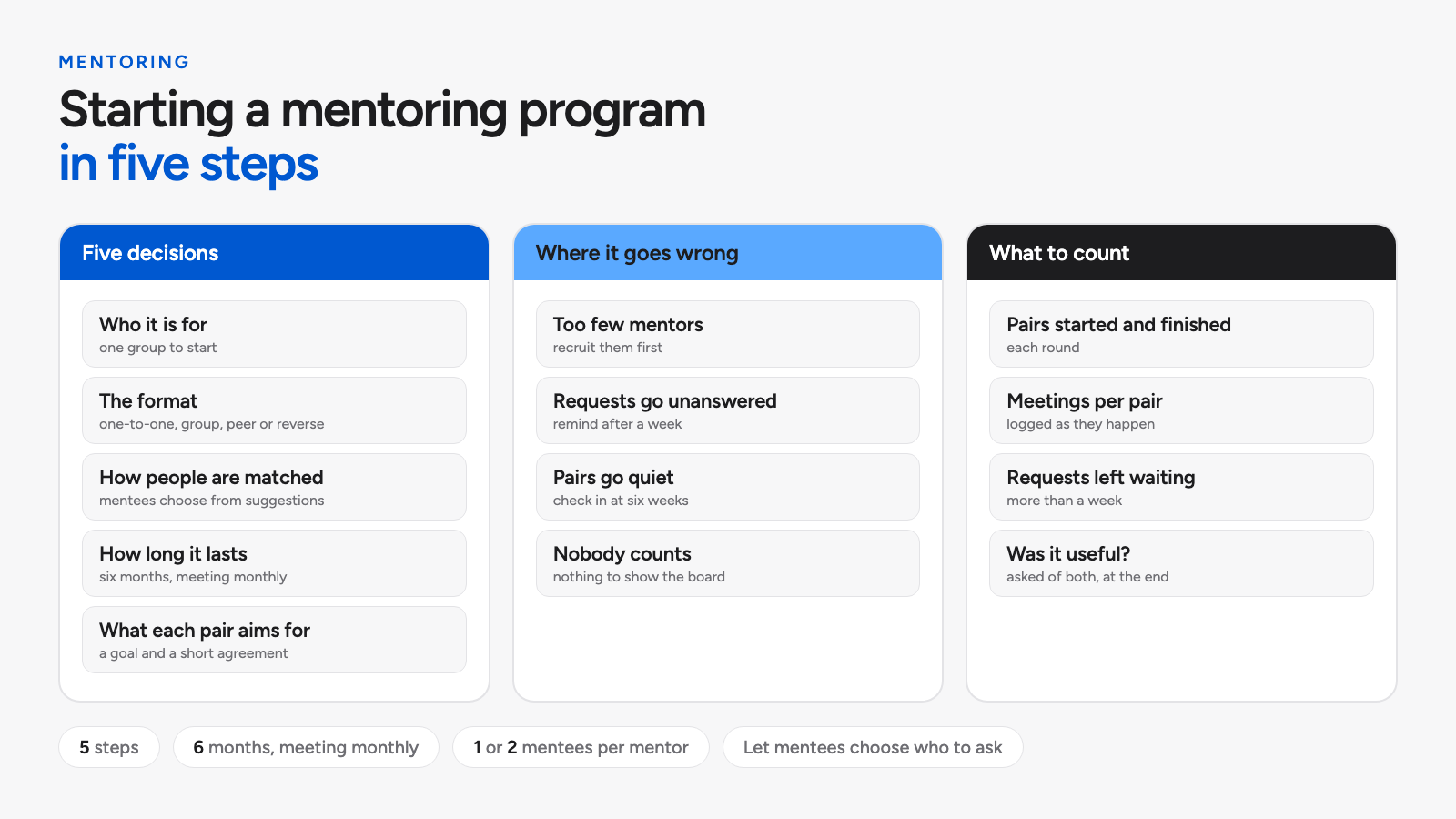
Tap the picture to see it at full size.
In this article⌄
A mentoring program pairs members who have experience with members who want it. This guide covers the decisions you make when starting one: who it is for, the format, how to match people, how long it lasts, and how to tell whether it worked.
Why associations run them
- Members value it. In Momentive Software’s 2025 study of more than 1,000 association members, mentorship came second in the list of activities members valued most, at 79%. First, at 80%, was holding a leadership position in the association.
- It is common. In Naylor’s 2024 benchmarking survey of 297 association staff, 47% said they use mentoring programs to engage younger members.
- The effect is real but modest. A review of 112 studies found mentoring is linked to better outcomes for mentees, but the effect is “generally small”.
We found no study showing that mentoring makes members renew. Run a program because members want it, not as a retention fix.
Step 1: Decide who it is for
A program for everyone is hard to run and hard to explain. Start with one group, for example:
- Early-career members, paired with someone ten or more years ahead.
- New members, in their first year.
- Members working towards a credential.
- Members moving into management.
Write down what a mentee should have at the end, such as a plan for their next role or a first conference talk. That goal decides the format and how long the program runs.
Step 2: Choose a format
- One-to-one. One mentor, one mentee. The most common format, and the most personal.
- Group. One or two mentors with several mentees. The American Geophysical Union’s network links two senior scientists with six mentees. Useful when mentors are scarce.
- Peer. Members at the same stage support each other.
- Reverse. A younger member mentors a senior one, often on technology. The American Staffing Association includes this in its Mentor Match program.
- One conversation. A single meeting on one question. Easy to volunteer for, and a good way to find mentors for longer pairings.
If this is your first program, start with one-to-one.
Step 3: Match mentors and mentees
There are three ways to match people:
- Staff match by hand. Staff read each application and pick the pair. This works for a few dozen pairs. The American Nurses Association found it “too unwieldy” at its size, with 919 mentees and 853 mentors.
- Mentees choose from suggestions. Each mentee sees a few mentors who fit and picks one. The American Speech-Language-Hearing Association matched by hand for 14 years, then switched to this. Its staff said: “A lot of students really valued being able to select a mentor.”
- Software assigns. Fast, but the mentee has no say.
Letting mentees choose usually works best. A study of formal mentoring programs found that when people felt they had input into the match, the results were consistently better.
Three things to settle before you open sign-ups:
- Recruit mentors first. Associations often end up with more mentees than mentors.
- Let each mentor set a limit. The American Nurses Association let mentors choose one mentee or two.
- Invite people, as well as opening a form. The members who need a mentor most often do not ask. A study of new hires at a US call centre found the same: “those who need help most are not seeking help.”
Step 4: Set the length and the rhythm
- Length: six months to a year. A university mentoring adviser quoted by Associations Now aims for at least six months and no more than a year.
- Meetings: about once a month. Stanford Medicine’s mentoring guide suggests monthly meetings for shorter programs, and at least quarterly for a year-long one.
- A fixed end date. It gives each pair a clean finish. Those who want to carry on can.
Step 5: Set up each pair to succeed
- A goal. The mentee writes what they want to learn before the first meeting.
- A short agreement. At the American Bankers Association, pairs sign one setting out their expectations and how often they will meet.
- Training for mentors. Even an hour on what is expected helps. The same study found that good training went with better results.
- A check-in after six weeks. Ask both people how it is going. This is when quiet pairs show up.
Where programs go wrong
Most problems come after the matching:
- Requests go unanswered. A mentee asks and hears nothing, and does not ask again.
- Pairs go quiet. After two meetings, nobody follows up.
- Nobody counts. At the end, staff cannot say what the program achieved. DECA’s chief program officer told Associations Now: “We are struggling with implementation and tracking the data.”
Finding mentors, matching people and training them all take time. The same adviser’s advice: “start small, get big wins, and grow strategically from there.”
How to measure it
Count these at the end of each round:
- Pairs started, and pairs that reached the end date
- Meetings held per pair
- Requests that waited more than a week for an answer
- Whether the mentor and the mentee each found it useful
- The share of mentees and mentors who signed up again
You can also compare renewal rates for mentees with similar members who were not mentored. Treat any difference with care: members who sign up for mentoring may have been more likely to renew anyway.
Where One Roof helps
One Roof includes mentoring as part of the member community:
- Members say what they can offer or want to learn, and mentors set how many mentees they can take.
- A member looking for a mentor sees suggested mentors, with the reason for each. Members can prefer someone outside their own employer.
- A mentor who has not answered a request is reminded after a week, and the request closes after three weeks so the member can ask someone else.
- Each pair logs its meetings, and at the end both say whether it was useful.
- Staff see active pairs, requests that have waited too long, and what both people said at the end.
Questions about mentoring programs
How do you start a mentoring program in an association?
Choose one group to serve, such as early-career members. Pick a format, recruit mentors first, let mentees choose from suggested mentors, and set a length of about six months with monthly meetings.
How long should a mentoring program last?
Six months to a year is typical. Set a fixed end date, and let pairs that want to carry on do so.
How do you match mentors and mentees?
Staff can match by hand, software can assign pairs, or mentees can choose from a few suggested mentors. Research links having a say in the match to better results, so letting mentees choose usually works best.
How many mentees should a mentor have?
One or two for most mentors. Let each mentor set their own limit, and stop suggesting a mentor once they reach it.
How do you measure the success of a mentoring program?
Count pairs started and finished, meetings held, and requests left waiting. At the end, ask both people whether it was useful.
What types of mentoring programs are there?
One-to-one, group, peer, reverse, and single conversations on one question.

