Choosing a platform
How to write an RFP for an association community platform
How to write an RFP for an association community platform: what to put in it, 30 requirements worth asking for, a scoring sheet and an eight-week timeline.
 Boopesh MahendranCo-founder, One Roof9 min read
Tap the picture to see it at full size.
In this article⌄
A request for proposal is supposed to make a decision easier, and most do the opposite. A spreadsheet of two hundred features goes out, every vendor ticks every box, and the choice is made on the demonstration anyway. This article sets out a shorter RFP that produces answers you can compare.
What an RFP for a community platform should contain
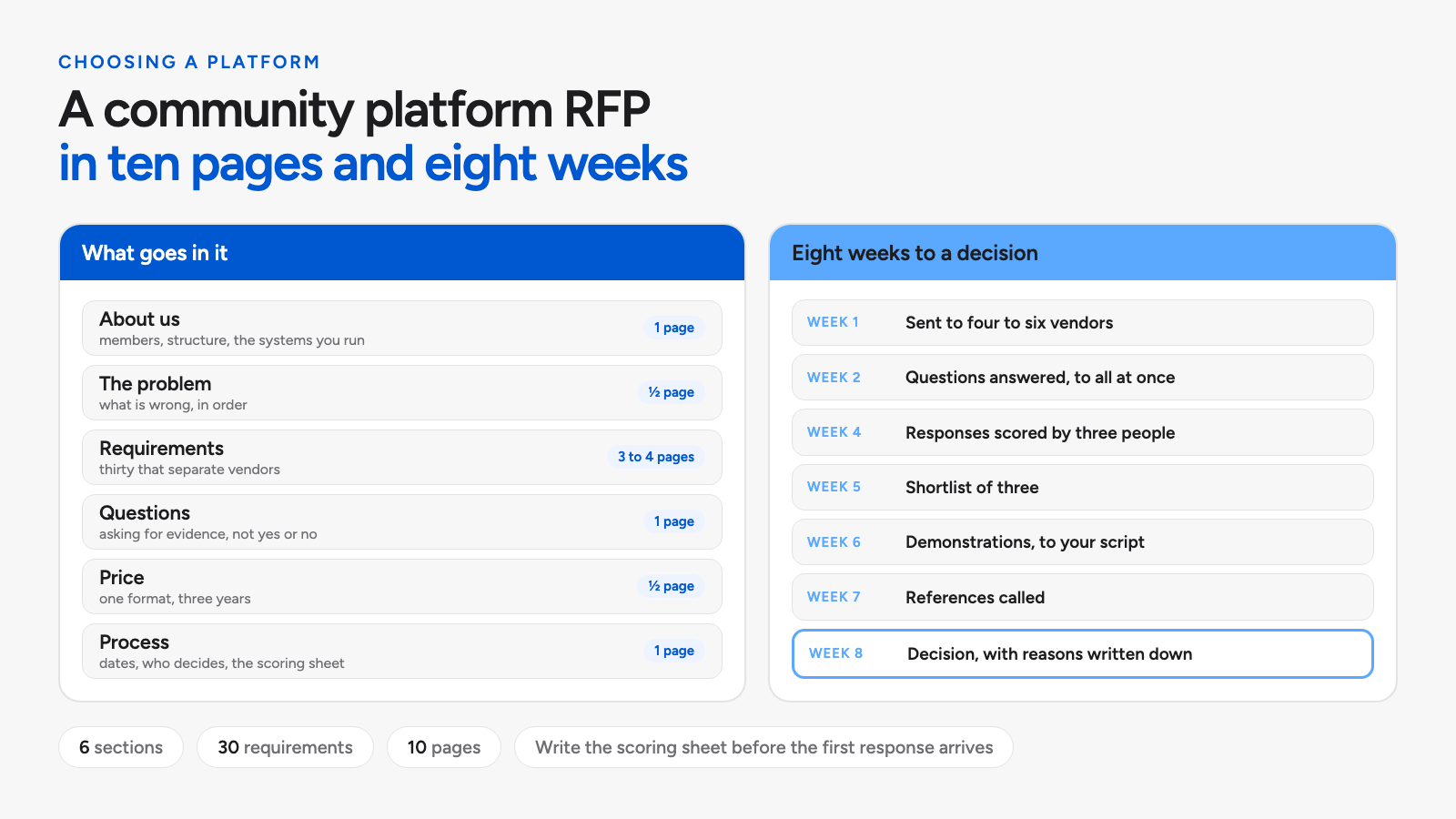
An RFP for an association community platform needs six things: a page about your association and its members, the problem you want solved, your requirements grouped by what matters, the questions each vendor must answer in writing, what a response must include on price, and how and when you will decide. Ten pages is enough.
| Section | What goes in it | Length |
|---|---|---|
| About us | Members, member types, chapters and committees, the systems you run | One page |
| The problem | What is wrong today, in order of importance | Half a page |
| Requirements | Must-haves and should-haves, grouped | Three to four pages |
| Questions | What each vendor answers in their own words | One page |
| Price | The format you want every price in | Half a page |
| Process | Dates, who decides, how responses are scored | One page |
Do you need an RFP at all?
Not always. If your rules do not require one and you can name three plausible vendors, a shorter route works as well. Send all three the same two pages of questions, see each product set up with your structure, and call two customers of each. An RFP is worth the work when procurement rules demand it, when the decision involves several departments, or when you need a record of why you chose as you did.
Start with the problem, not the features
The most useful paragraph in an RFP says what is wrong now. A vendor who knows that members cannot sign in with their association login, or that the board cannot see what the community is worth, can answer that. Given only a feature list, all a vendor can do is tick it.
Rank the problems. Most associations have more than one of these four: the cost is hard to justify against the use, the experience feels dated to members, the community is cut off from events, learning and mentoring, or nobody can report what it achieves. Say which comes first, because no platform is best at all four.
Then describe your membership as a vendor needs to see it: how many members, which member types and what each may see, how many chapters and committees have private spaces, which AMS and sign-in you use, and roughly how much content you would bring with you.
Thirty requirements worth asking for
These are the requirements that separate one platform from another. Mark each as must-have or should-have for your association, and delete any you would not walk away over. For every one, ask the vendor to describe how the product does it. Whether it does is not enough.
Sign-in and membership data
- Members sign in with the login they already have.
- Member type and status come from our AMS, and a lapsed member loses access without anyone acting.
- Committee and chapter rosters come from our AMS.
- Community activity is written back to the member record, or sent to our systems as it happens.
What sits behind these four is in our guide to integrating a community with your AMS.
Who can see what
- Spaces can be open to all, limited to a member type, or private to a named group.
- Staff roles are separate: a moderator is not an administrator.
- Members control what others see of their profile.
Taking part
- Discussions, questions with a marked answer, and file sharing.
- Members can follow a space or a thread and choose daily, weekly or no email.
- Members can reply to a discussion from the email.
- It works fully on a phone, in the browser or an app. Say which.
- Search covers discussions, files and people, and finds things despite a misspelling.
Programmes
- Events with registration, and their discussion in the same place.
- A resource library with permissions per file or folder.
- Mentoring: matching, requests and a record of meetings.
- Continuing education or recertification credit, if you award it.
Looking after it
- Members can report a post, and moderators have a queue.
- Posts can be held for approval by space or by member.
- A record of who changed what in the admin area.
AI
- Any assistant answers only from what the asking member can open, and shows its sources.
- Our content is not used to train a model, stated in the contract.
Reporting
- Active members, answer rate and time to first reply, by period and by space.
- A list of members whose activity has fallen.
- Data can be exported without asking the vendor.
The vendor
- We can export all our content and member data, in a documented format, at any time and when we leave.
- Migration of our existing community is quoted, with the number of test runs included.
- Accessibility: the standard the product is tested against, such as WCAG 2.2 AA, and the latest report.
- Security: independent audits held, such as SOC 2 or ISO 27001, where data is stored, and how a breach is notified.
- Support: hours, response times, and a named contact.
- A way to hear about changes before they reach our members.
If you are bringing an existing community with you, add what our guide to migrating an association community lists under what has to move.
Ask for evidence
A requirement answered “yes” tells you nothing, and the remedy is to change how the question is put.
| Weak | Better |
|---|---|
| Do you integrate with our AMS? | Which of our customers running the same AMS may we speak to? |
| Do you support single sign-on? | Describe what a member sees from clicking “community” on our website to reading a post |
| Is there reporting? | Attach the report that shows active members by quarter |
| Is it accessible? | Attach your most recent accessibility conformance report |
| Do you have an API? | Link to its public documentation |
| Can we export our data? | Describe the export: format, what is left out, cost, and how long it takes |
Ask every vendor the same questions and give a word limit, because a long answer to a simple question is usually a no.
How to ask for the price
Unless you dictate a form, prices arrive in forms you cannot compare. Ask every vendor to fill in the same lines, for three years:
- the licence at your member count, and how the price changes if membership grows or shrinks;
- every add-on you marked as a must-have, priced separately;
- setup, integration and migration, each as a fixed figure or a stated range;
- any percentage taken on payments;
- the increase allowed at renewal, and the notice period to leave.
Add your own figures beside theirs: the systems you would keep, the systems you could retire, and staff time. A licence with a low price is not cheap if it needs a developer to connect it to your AMS.
A scoring sheet you write first
Write the sheet before the first response arrives. Agree the weights with the people who will live with the outcome. If you score after you have seen a favourite demonstration, the favourite wins.
| What you score | Example weight |
|---|---|
| Fit to the problem you ranked first | 25% |
| Sign-in and AMS connection | 20% |
| Member experience, on a phone | 15% |
| Reporting | 10% |
| Three-year cost | 15% |
| The vendor: support, security, references | 15% |
The weights are an illustration, and yours should follow the order of your problems. Score each line from one to five and have three people score separately. Discuss only the lines where they differ by two or more.
Hold must-haves outside the scoring. A vendor who fails one is out however well it scores elsewhere, which is what must-have means.
An eight-week timeline
| Week | What happens |
|---|---|
| 1 | RFP sent to four to six vendors. Questions from vendors accepted in writing |
| 2 | All questions answered, to every vendor at once |
| 4 | Responses due. Scored separately by three people |
| 5 | Shortlist of three. Each given the same script for a demonstration |
| 6 | Demonstrations, set up with your spaces and member types |
| 7 | References called. Contract terms requested |
| 8 | Decision, and the reasons written down |
Give vendors a script for week six: sign in as a member of one type, find an answer, ask a question, open it on a phone, then show the staff view of the same thing. A demonstration on the vendor’s own sample content tells you how the product looks at its best. It does not tell you how it will look with yours.
When you call references, ask what went wrong and how the vendor handled it. Something goes wrong in every project. A reference who says otherwise was chosen for you.
Where RFPs go wrong
- Two hundred requirements. Every vendor says yes and the responses go unread.
- No ranked problem. With nothing else to go on, the decision falls back on who presented best.
- Features copied from the current platform. You end up specifying what you have and buying it again.
- Scoring written after the demonstrations. By then it only records a decision already made.
- Only the buyer in the room. The people who run the community day to day, and the owner of the AMS, see it for the first time after the contract.
- Price left to each vendor’s format. You receive three proposals that cannot be laid side by side.
- Start date set before notice was checked. Read the notice period in your current contract first, or the contract renews while you are still deciding.
How One Roof answers
One Roof would be answering this RFP too. We can answer yes to most of the thirty and show them working, in a demonstration community anyone can walk around today.
| Group | What you would see |
|---|---|
| Who can see what | Spaces open to all, limited to a member type, or private to a chapter or committee. Moderators, community managers and administrators as separate roles |
| Taking part | Discussions, questions with an accepted answer, files and polls. Members follow what they choose and take a daily, weekly or monthly digest. On a phone, members install it to the home screen, where it opens like an app |
| Programmes | Events with registration and waiting lists, a resource library, mentoring with requests and a record of meetings, and recertification credit |
| Looking after it | Reports from members, a moderation queue, posts held for approval, and a record of what staff changed |
| AI | An assistant that answers only from what the member asking can open, and shows the posts each answer came from. More in nine questions to ask about an AI assistant |
| Reporting | Active members, answer rate and members at risk, and a one-page board report for each quarter, ready to print |
| Your other systems | Signed webhooks when a member posts, registers for an event or earns credit |
Two answers worth knowing before you ask:
- A native app (11). Members install One Roof to their phone’s home screen from the browser, where it opens like an app with your name and logo. A branded app for the App Store and Google Play is built with you during onboarding and priced separately, so allow time for it before launch.
- Sign-in and your AMS (1 to 4). We set the connection up for you during onboarding, and it is not a switch you turn on yourself. Ask us what it will carry with your system before you sign.
Then bring the demonstration script from week six, and your own spaces and member types.
Questions about writing the RFP
How long should a community platform RFP be?
About ten pages. One page on your association, half a page on the problem, three or four on requirements, and the rest on questions, price and process. A longer one has features in its requirements list that would not change your decision.
How many vendors should we send it to?
Four to six, to shortlist three. With more than six you will not read the responses carefully, and with fewer than four one weak response leaves you without a real comparison.
What should a community platform RFP include?
Who you are and how your membership is structured, the problem you want solved in order of importance, must-have and should-have requirements, questions that ask for evidence, a fixed format for three-year pricing, and your timeline and scoring method.
How do we compare prices from different vendors?
Make every vendor fill in the same lines for three years: licence, each add-on, setup, integration, migration, payment fees and the renewal increase. Then add your own costs for the systems you keep and the staff time to run it.
Should we tell vendors our budget?
A range helps more than it hurts. Vendors far outside it can say so, which saves you both the time. Those within it will propose the plan that fits and not the largest one.
Who should be on the selection panel?
Whoever runs the community each day, whoever owns the membership system, someone from finance, and one or two members who use the current community. The person who signs should hear from all of them.

