Member retention
How to win back lapsed members: a reinstatement plan for associations
How associations win back lapsed members: why members lapse, sorting former members by reason, how long to keep trying, email and phone calls, what to offer, asking why they left, the rules on email and calls, and what to measure.
 Boopesh MahendranCo-founder, One Roof6 min read
Tap the picture to see it at full size.
In this article⌄
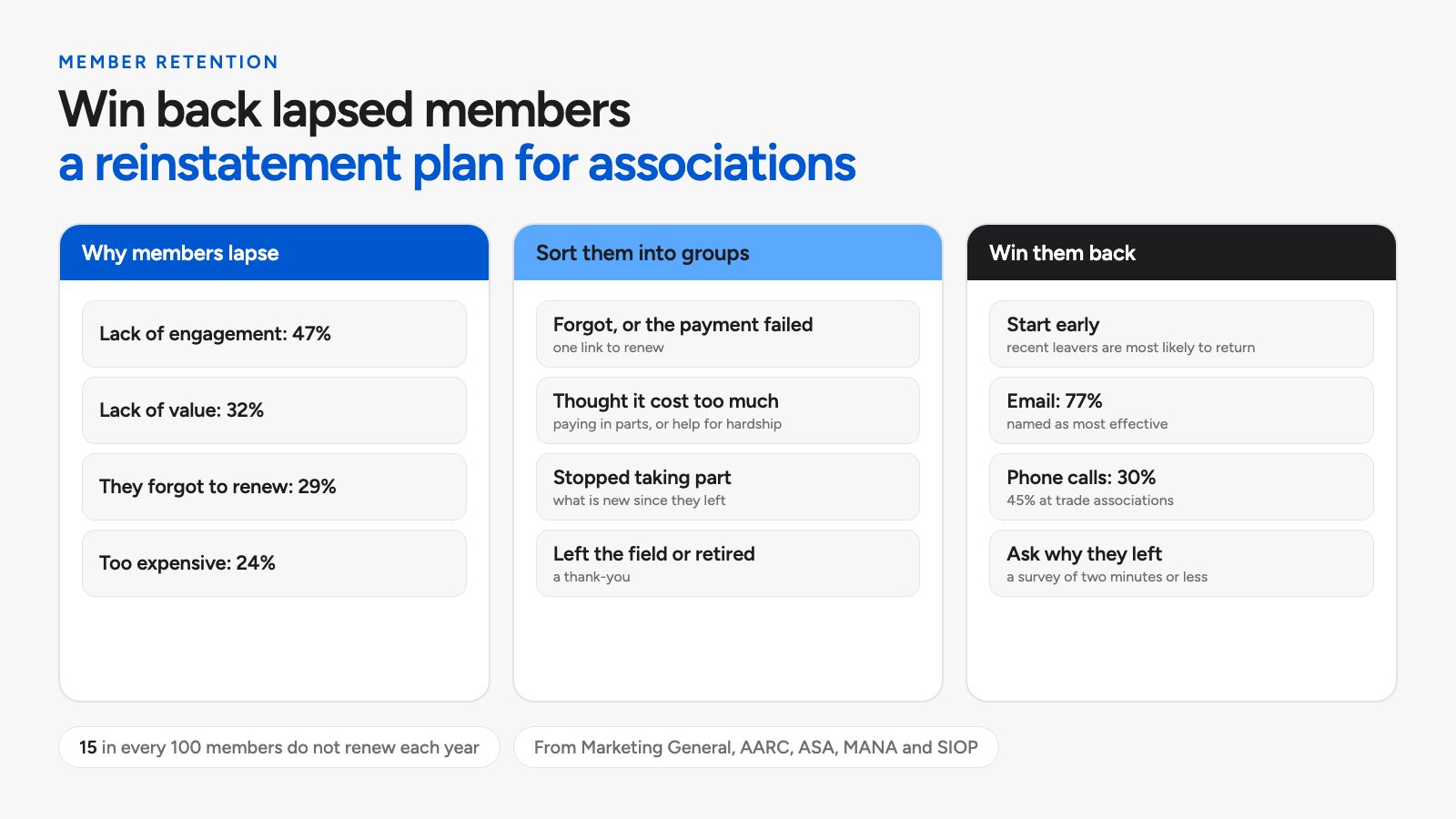
Every association loses members. In Marketing General’s 2024 benchmarking report, the median renewal rate was 85%. So in a typical association, 15 in every 100 members do not renew each year.
Some of them can be won back. This guide covers why members lapse, how to sort them by reason, how long to keep trying, which channels work, what to offer, and what to measure.
Why members lapse
In the same report, associations named the top reasons members do not renew. Each could choose up to three:
- Lack of engagement: 47%.
- Lack of value: 32%.
- They forgot to renew: 29%.
- They left the field: 27%.
- Their employer does not pay: 24%.
- Too expensive: 24%.
Some of these reasons can be fixed and some cannot. A member who simply forgot may need only a reminder. Associations Now calls such members “accidental nonmembers.” A member who retired or left the field is harder to win back.
Sort former members into groups
Send each group a message that fits why they left:
- Forgot, or the payment failed: a short reminder with one link to renew. That is often enough.
- Thought it cost too much: paying in parts, or help for hardship.
- Stopped taking part: what is new since they left, and one thing worth their time now.
- Left the field or retired: a thank-you, and a retired or alumni membership if you have one.
If you do not know why someone left, ask them. The section on asking why they left shows how.
Start early, and keep going
The sooner you ask, the better. Marketing General notes that “the member who is most likely to return to an association is the one who most recently left.”
Many associations let lapsed members keep their benefits for a grace period. In the 2024 report:
- 48% gave two to three months.
- 20% gave one month.
- 19% gave none.
Associations with renewal rates of 80% or more were more likely to give two to three months.
Associations most often stop trying three months after a membership ends (26%). But 22% never stop.
Older lapses are worth a try too. The American Society of Anesthesiologists contacted members who had lapsed as long as five years earlier, mostly by email. Each email led with one useful resource. The society doubled the number of members it usually wins back in a year.
Use email, and pick up the phone
In the 2024 report, associations said how they try to win back lapsed members:
- Email: 95%.
- Phone calls from staff, board members or chapter leaders: 44%.
- Mail: 33%.
Asked which work best, 77% named email and 30% named phone calls. At trade associations, 45% named phone calls. Associations with renewal rates of 80% or more were more likely to say phone calls work very well.
Some examples:
- The American Association for Respiratory Care (AARC) won back almost 800 lapsed members and more than $64,000 in dues. It wrote separate emails for members who had lapsed three to six months earlier and for those who had lapsed seven to 24 months earlier.
- The New York State Bar Association and its telemarketing firm made more than 21,000 renewal calls between February and April, and reported a 450% return on the campaign’s cost.
- The Manufacturers’ Agents National Association (MANA) emailed about 350 former members, offering a year’s membership at whatever price they thought fair. To accept, they called the chief executive and named their price. Between 15 and 20 rejoined, paying $50 to $199 against full dues of $259.
Make coming back easy
- One link that works. It should go straight to payment, with their details filled in and no new account to create.
- Say what changed. New events, new resources, a lower-priced level: anything they did not have when they left.
- Offer ways to pay. In the 2024 report, 33% of associations offered installment payments on renewal and 44% offered help for hardship.
- Make it personal. MANA’s former members rejoined by calling its chief executive, and those conversations told him why they had left.
Ask why they left
A short survey tells you which group a former member belongs in, and what to fix for everyone else:
- Ask early, and keep it short. A marketing director quoted in the AARC article suggests asking for feedback in one of your first messages to lapsed members, with a survey that takes no more than two minutes.
- Ask again later. The Society for Industrial and Organizational Psychology (SIOP) sends an anonymous exit survey 12 months after a membership ends, with a reminder three weeks later. The same article suggests about a dozen questions: why they left, what they liked most and least, what might have kept them, and whether they plan to rejoin.
Our guide to member survey questions has questions you can adapt.
Follow the rules on email and calls
- Email. A message asking a former member to rejoin is likely to count as a commercial email under US law. The Federal Trade Commission’s CAN-SPAM guide warns against assuming that messages to “recipients who participate in a membership program” are transactional messages, which have fewer rules. Include a way to opt out, and honor opt-outs within 10 business days.
- Calls and texts. The Federal Communications Commission requires consent before “an autodialed or prerecorded call or text” to a mobile number. Check the rules before using an automated calling or texting service.
What to measure
- The share of lapsed members who rejoin within 3, 6 and 12 months.
- Rejoins by group: forgot, cost, quiet, left the field.
- Rejoins by channel: email, phone call, mail.
- Whether members who rejoin renew the following year.
Where One Roof helps
One Roof helps you catch members before they lapse, and stay in touch after:
- The members at risk list shows paying members who have gone quiet, with the reason and their renewal date. Staff record each contact, and see who came back afterwards.
- An optional win-back message goes to quiet members. It skips anyone your staff contacted in the last 30 days.
- If you take dues through One Roof, Stripe retries a failed card, and members keep their membership during a grace period. A member whose paid membership ends becomes a free member. They can still read and take part, and rejoin from the membership page.
- Send an announcement to free members, which includes those whose paid membership ended.
To keep members from lapsing in the first place, see our guide to member retention.
Questions about winning back lapsed members
What is a lapsed member?
A member whose membership ended because they did not renew. Many associations let lapsed members keep their benefits for a grace period of one to three months.
How long should you keep trying to win back a lapsed member?
The most common point to stop is three months after a membership ends (26% of associations), but 22% never stop. The most recent leavers are the most likely to return, so start early. Older lapses can still be worth a try.
What is the best way to win back lapsed members?
Most associations name email as the most effective channel. Phone calls work well too, especially for trade associations and for associations with high renewal rates.
Should you offer lapsed members a discount to rejoin?
It can help members who left over cost. First check why they left: a member who simply forgot needs a reminder, not a discount.
How do you find out why members left?
Ask in one of your first messages, with a survey that takes no more than two minutes. Some associations, such as SIOP, also send an exit survey a year after a membership ends.

