Engagement
What to do about a quiet association community
Five reasons an association's online community goes quiet, how to tell which is yours, and a 90-day plan to revive it before you think about changing platform.
 Boopesh MahendranCo-founder, One Roof10 min read
Tap the picture to see it at full size.
In this article⌄
Most association communities fade rather than fail. There is a launch and a busy few months, then the same five people talking to each other while everyone else stops looking. If that is yours, the cause is usually one of a handful of things. Most of them can be fixed in a quarter without replacing anything.
Why association communities go quiet
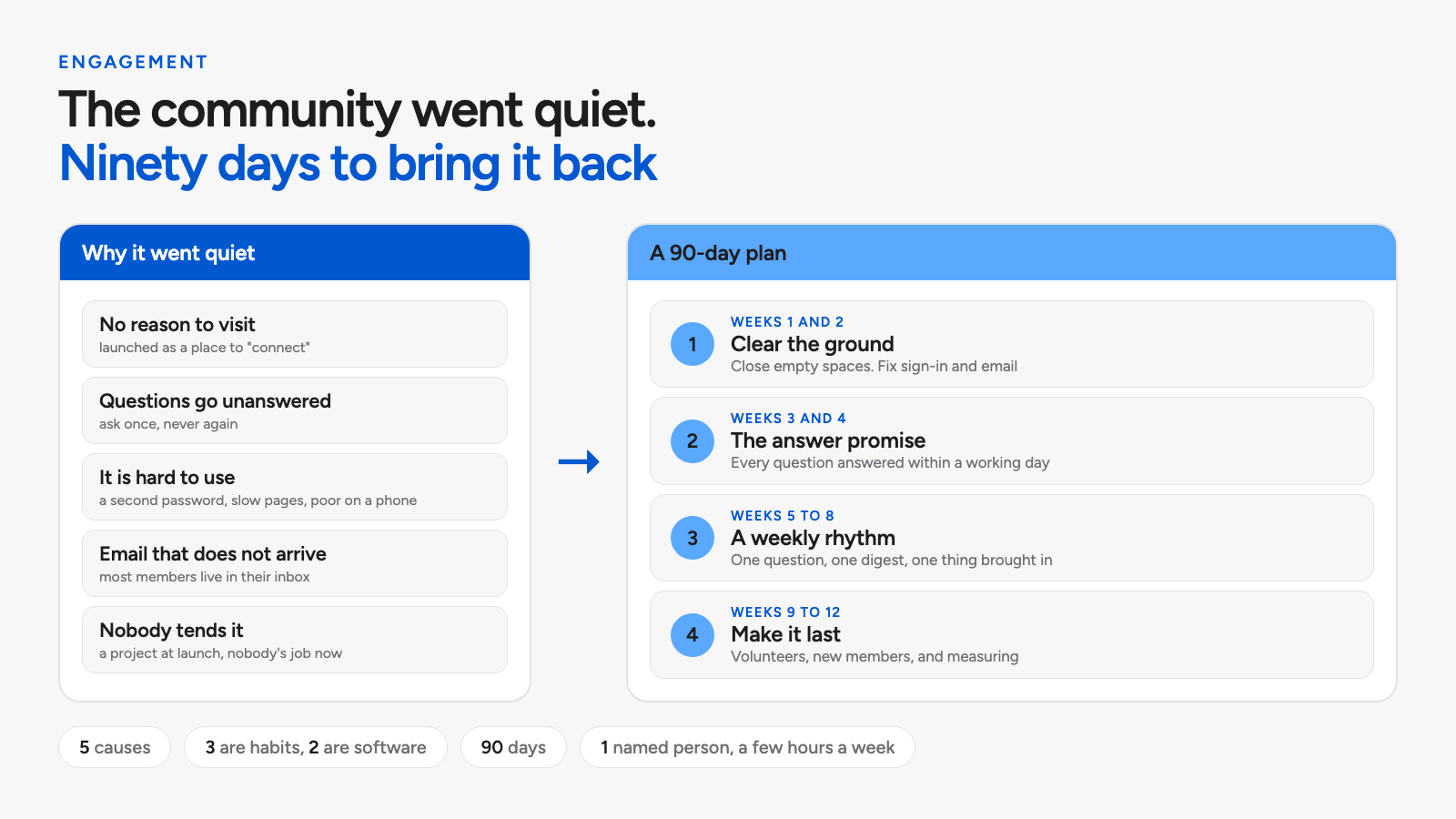
An association community goes quiet for one of five reasons: members have no reason to visit, questions go unanswered, the site is hard to use, email from the community does not reach people, or nobody is responsible for tending it. Three of the five are habits and two are software. The fixes are different, and you need to know which you have.
- No reason to visit. The community was launched as a place to “connect”, but members come for something specific, such as an answer, a document, or a person who has done what they are about to do.
- Questions go unanswered. A member asks, waits a week, hears nothing, and does not ask again. Everybody who read the question learns the same lesson.
- It is hard to use. A separate password, pages that take seconds to appear, a reply box that fights back on a phone. Members compare the community with the apps they use every day and never with other association software. Each small difficulty is a reason to do it later, and later means never.
- Email that does not arrive. Most members will never keep a tab open, and if the digest goes to spam, or a reply needs a login to read, the community is invisible to them.
- Nobody tends it. It was somebody’s project at launch and is now nobody’s job.
It is normal for most members to read and never post. Jakob Nielsen’s 90-9-1 rule describes the pattern in most online communities: the great majority read, a few contribute now and then, and a very few write most of what is there. Few people posting does not make a community quiet. A quiet community is one where few people come at all, or where those who ask get nothing back.
Find out which it is
Each cause leaves a different trace, and the table shows what to look at before deciding what to do.
| What you see | What it usually means |
|---|---|
| Members sign in but questions sit without a reply | Questions go unanswered |
| The same few names on every thread | Nobody new has a reason, or the confidence, to join in |
| Plenty of accounts, few sign-ins | Hard to use, or email that does not arrive |
| Members sign in once and do not return | Hard to use, or nothing there for them |
| Far fewer visits from phones than your website gets | It is poor on a phone |
| Digest emails sent, almost none opened | Email is going to spam, or says nothing worth opening |
| New members never appear at all | Nothing invites them in their first weeks |
| A burst after each event, then silence | Nobody is tending it between events |
| Dozens of spaces, most with no posts this year | Too many rooms for the people in them |
Two checks take ten minutes and settle most cases. Count the questions asked in the last three months and how many received a reply within two days. Then use the community on your own phone, as a member, starting from an email it sent you.
The phone test
Do this on mobile data, not office wifi, and count as you go.
- Tap the link in a community email. Are you reading the post, or looking at a login page?
- Count the seconds until you can read it. More than two or three and many members will have gone.
- Reply to it. Notice whether the keyboard covers the box, the page jumps, or the text is too small to check.
- Search for something you know is there, with one letter wrong.
- Go back to where you were.
If any step made you sigh, it is making your members leave. Staff stop noticing because they use the community every day, signed in and at a desk, while members arrive once a month on a phone and signed out.
A 90-day plan to revive it
Ninety days gives a habit time to change without losing people’s attention. The plan assumes one person with a few hours a week and the authority to ask colleagues for help.
| When | What you do |
|---|---|
| Weeks 1 and 2 | Diagnose, as above. Close or merge empty spaces. Fix sign-in and check that email arrives |
| Weeks 3 and 4 | Start the answer promise. Recruit a founding group of 20 to 30 members |
| Weeks 5 to 8 | Set a weekly rhythm: one good question, one digest, one thing brought in from elsewhere |
| Weeks 9 to 12 | Hand parts of it to volunteers. Bring every new member in during their first week. Measure, and decide what continues |
Weeks 1 and 2: clear the ground
Close the empty rooms. A community with forty spaces and three active ones looks abandoned. Merge the quiet ones into a few broad spaces and archive the rest, because people go where other people are.
Fix the way in, and whatever the phone test found. If members need a password they do not use anywhere else, that is the first thing to change. Take the rest of your notes from the phone test to your vendor as a list, with the seconds you counted. Some of it will be settings you can change this week. Our guide to integrating a community with your AMS explains single sign-on and what to ask your vendors.
Send yourself every email the community sends, to a personal address, and see where each lands and what it asks of you.
Weeks 3 and 4: the answer promise
No other single change does as much. Promise that every question gets a useful reply within one working day, and keep the promise with staff as the backstop.
- Each morning, somebody looks at questions with no reply.
- For each, they find a member who knows and ask them personally, by name, to answer.
- If nobody has by the end of the day, staff answer or say who will.
You will get much further by asking a named member than by waiting. People who would never post unprompted will answer when told “you dealt with this last year, could you take a look?” It is also the kindest way to turn a reader into a contributor.
At the same time, recruit a founding group: 20 to 30 members you ask directly to visit twice a week for a month. Choose people for being generous, whether or not they are senior. Tell them plainly that you are rebuilding it and need them to go first.
Weeks 5 to 8: a weekly rhythm
A community needs something to happen on a schedule, or it depends on luck.
- One good question a week, asked by a real person about a real problem. “How is everyone handling the new reporting rule?” beats “Welcome. Introduce yourself.”
- One digest a week, short, with the two or three threads most worth reading. If your members can reply to it by email, say so in the first line.
- One thing brought in from elsewhere. The question a member emailed to staff, with their permission. The discussion a committee had on a call. The slides from last week’s webinar, with one question about them.
Over time that last habit matters most. Associations already have conversations in inboxes, committees and corridors, and reviving a community is largely moving them to where others can benefit. When a member emails staff a question others would ask too, the best reply is “good question, I have posted it in the community so you get more than my view”.
Weeks 9 to 12: make it last
Hand it over in pieces. Ask two or three founding members to each look after one space: welcome newcomers, nudge an unanswered question. If only staff run a community, it stops when staff are busy.
Bring new members in during their first week. One email, from a person, with one thing to do: a thread to read or a question to answer about themselves. A member who finds something useful in their first month has a reason to come back. You will rarely get a second chance at that.
Measure and decide. Compare the two numbers from your diagnosis, questions answered within two days and members who signed in, with where they were. Whatever moved them is worth keeping, and the rest can stop. When the board asks what came of it, our guide to showing a board what the community is worth sets out what to report.
What not to do
- Do not redesign the homepage and call it done. How it looks matters less than how long it takes to read a post and reply to it.
- Do not start with points and badges. They reward people who are already there and give nobody a reason to arrive.
- Do not post for the sake of it. Staff announcements in an empty space make it look emptier.
- Do not open more spaces. Every new room thins out the people in the others.
- Do not run a contest. It buys a week of posts from people who leave when it ends.
- Do not make it compulsory. Requiring committee members to post produces posts nobody wanted to write or read.
- Do not announce a relaunch before there is something to see. Do the work quietly first. Then invite people to a place that is already alive.
When the platform really is the problem
Sometimes it is. No amount of tending will fix the signs below, and they are the same things to test when you look at any replacement.
- Members cannot sign in with the login they already have, and the vendor cannot change that.
- Email from the community cannot be made to arrive, or members cannot reply to it.
- It is slow, or awkward on a phone, in ways the vendor cannot change. You can tend a community every day and members will still not stay on pages that fight them.
- Search does not find things you know are there.
- You cannot get the numbers in the table above without asking the vendor.
If two or more are true and your vendor has no answer, the platform is holding you back. If you do move, take the content with you, and take the habits from this plan as well. A new platform with nobody tending it goes quiet in the same way. It only takes a little longer.
What One Roof does about a quiet community
Two of the five causes in this article are software, and we have tried to get both right. One Roof is built for the phone first and for speed. On our demonstration community the pages we timed for this article showed their main content in about a second on a phone-sized browser over a fast connection. Run the phone test on it yourself, on your own phone and your own connection, and hold us to what you find.
Several parts of the plan are things One Roof does for you as well. An unanswered question is sent to members whose expertise matches it, with a request to answer. Members get a digest of what they follow and can reply to a discussion from the email itself. New members see a short list of first steps, and staff see answer rate and response time, along with a list of members whose activity has dropped.
No platform cares whether a question was answered. The answer promise, the founding group and the weekly rhythm are work for people. A community comes back when somebody does that work.
Questions about reviving a community
How do you increase engagement in an association community?
Start with the questions that are already being asked and make sure every one gets a useful reply within a working day. Then give members a reason to return each week, in the form of a short digest of the best threads and one good question. Most engagement problems are unanswered questions and email that never arrives, not a shortage of features.
How long does it take to revive an online community?
Allow about 90 days of steady work to see a change in how many questions are answered and how many members sign in. Renewal takes longer to move, because members need to pass through a renewal cycle first.
Should we relaunch the community?
Not with an announcement. Fix sign-in and email, close the empty spaces, get a founding group talking, and invite everyone else once there is something worth seeing.
How many staff hours does a community need?
A few hours a week from one named person is enough for most associations, provided that person can ask colleagues and volunteers for answers. A community with no named owner needs more than it will ever get.
Is it normal that most members never post?
Yes. In most communities the great majority read without contributing, and a member who found an answer by reading still got value. Judge the community by how many members visit and whether questions are answered. How many post is the wrong test.
Does design really affect engagement?
Speed and ease affect it more than appearance does. A member who waits several seconds for a page, or struggles to type a reply on a phone, has a reason to put it off. Run the five-step phone test above before you conclude that members are not interested.
When should we change platform instead?
When members cannot get in with their existing login, email cannot be made to work, or it is slow or awkward on phones, and the vendor cannot fix it.

