Choosing a platform
Thirteen alternatives to Higher Logic, and when to stay put
Compare 13 Higher Logic alternatives for associations: who each was built for, published prices, a three-year cost sheet and seven questions to ask vendors.
 Boopesh MahendranCo-founder, One Roof13 min read
Tap the picture to see it at full size.
In this article⌄
We make One Roof, which is one of the alternatives on this page. Everything here about other companies comes from their own public pages as they stood in October 2026. Prices and features change. Check the linked page before you rely on a figure. Corrections are welcome at hello@joinoneroof.com.
What are the alternatives to Higher Logic?
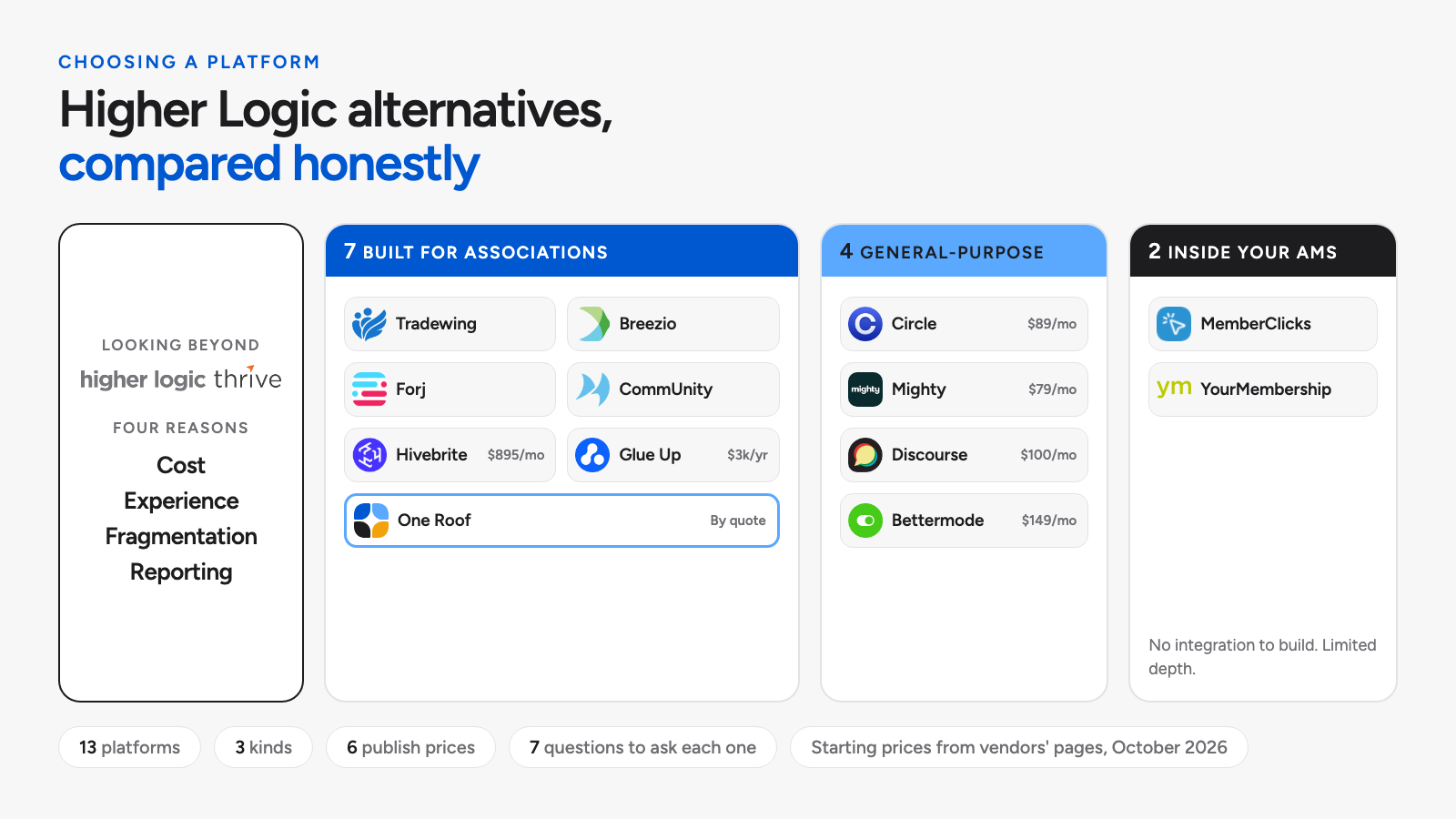
The alternatives to Higher Logic fall into three groups. Platforms built for associations: Tradewing, Breezio, Forj, CommUnity by Momentive, Hivebrite, Glue Up and One Roof. General-purpose community tools: Circle, Mighty Networks, Discourse and Bettermode. And the community module inside an AMS you may already run, such as MemberClicks or YourMembership.
Six of the thirteen publish prices. Hivebrite starts at $895 a month and Glue Up at $3,000 a year, both on annual contracts. Circle starts at $89 a month, Mighty Networks at $79, Discourse at $100 and Bettermode at $149. Higher Logic and the other association platforms, ours included, quote individually.
Start with why you are looking
Most associations that look beyond Higher Logic are not unhappy with the idea of a community. They are unhappy with one of four things:
- Cost against use. The contract renews at a figure that is hard to defend when a few hundred members post.
- The experience. Members and staff compare it with the consumer products they use every day.
- Fragmentation. The community is one system, events another, learning a third and mentoring a spreadsheet.
- Reporting. The board asks what the community is worth and the answer takes a week to assemble.
Which of these is yours decides which alternative makes sense. A cheaper forum does nothing for fragmentation, and an all-in-one suite will not help a community nobody has a reason to visit.
When should an association stay with Higher Logic?
When the platform is not the problem. Higher Logic Thrive is built for associations, and its integrations with association management systems are the most thoroughly documented of any platform here: its support site lists thirteen AMS and CRM systems that community activity can be written back to, among them iMIS, Aptify, Impexium, Personify360, MemberSuite, Fonteva, netFORUM Enterprise, Salesforce and Microsoft Dynamics, and its integrations page names about twenty AMS and CRM products. If your problem is adoption and not the platform, moving will cost months of work and fix nothing.
Match the problem to the kind of platform
| If your problem is | Look first at | Because |
|---|---|---|
| Cost against use | General-purpose tools, or your AMS’s own module | Published prices start under $100 a month, if you can live without what they leave out |
| The experience | General-purpose tools and the newer association platforms | They are built for phones first, and their vendors compete on how they feel to use |
| Fragmentation | Association platforms that include events, learning and mentoring | One system replaces several |
| Reporting | Association platforms with activity written back to your AMS | The membership system is where the board’s question gets answered |
Most associations have two of these at once. Rank them. The platform that fixes the first may make the second worse: the cheapest forum is also the most fragmented answer there is.
Three kinds of alternative
The thirteen alternatives are of three kinds: platforms built for associations, general-purpose community tools, and the community module inside your AMS. They differ less in features than in what they assume about you.
Platforms built for associations
These assume chapters, committees, member tiers and an AMS behind them.






General-purpose community tools
These were built for creators, brands and software companies. They are polished and inexpensive, and they do not advertise the things associations take for granted: an AMS connection, member tiers that come from your membership system, continuing education credit.




These suit an association that wants a discussion space and is content to run events, learning and membership elsewhere. Budget for the integration work yourself: you, or a developer you hire, will be the one connecting it to your membership system.
The community inside your AMS
If you run MemberClicks or YourMembership, you may already have a community module. YourMembership’s product page lists a social feed, group discussion feeds, suggested connections, and surveys and polls. MemberClicks’ help pages describe a social community with connections, private messages and an activity stream, alongside forums and committee spaces. There is no integration to build, because it is the same system. The trade-off is depth. A module inside a membership system is rarely anyone’s main product.
Higher Logic alternatives compared
Higher Logic and the alternatives, as their vendors described them in October 2026:
| Platform | Built for | Publishes pricing | Worth knowing |
|---|---|---|---|
| Higher Logic Thrive | Associations | No | The most documented AMS integrations |
| Tradewing | Associations | No | Community, learning, events and member records in one |
| Breezio | Associations and societies | Not found | Works with your existing AMS and CRM |
| Forj | Associations | No | Community and learning as separate or combined products |
| CommUnity by Momentive | Associations | No | Same owner as several AMS products |
| Hivebrite | Associations, nonprofits, universities, businesses | Yes | Mobile app and mentoring are add-ons |
| Glue Up | Associations and chambers | Yes | Membership system with a community module |
| One Roof | Associations | By quote | Community, events, credit, mentoring and an AI assistant that cites its sources, in one product |
| Circle | Creators and brands | Yes | Transaction fees on payments |
| Mighty Networks | Creators and brands | Yes | Transaction fees on payments |
| Discourse | Anyone | Yes | Open source; a forum only |
| Bettermode | Organisations of any kind | Yes | A branded community you own |
| AMS built-in modules | Existing AMS customers | With the AMS | No integration needed; limited depth |
What it really costs over three years
Higher Logic does not publish prices, and neither do most platforms built for associations, so compare three-year totals and not monthly fees: licence, add-ons, transaction fees, integration, migration, the systems you keep and staff time. The monthly price is the smallest part of the comparison. Once everything else is counted, two platforms a long way apart on the price list can end up close together, and the cheap one is not always cheaper. Build the same sheet for every platform on your shortlist:
| Line | What to put in it |
|---|---|
| Licence | The plan you would need, at your member count, for three years, with the renewal increase the contract allows |
| Add-ons | Mobile app, single sign-on, mentoring, events, learning, API access, extra administrators |
| Transaction fees | A percentage of event and membership payments, if the platform takes them |
| Integration | Building the connection to your AMS, and maintaining it each time either system is upgraded |
| Migration | Moving your existing discussions, files and subscriptions, including a second export from your current vendor |
| Systems you keep | Whatever the new platform does not replace: the events tool, the learning system, the mentoring spreadsheet |
| Systems you retire | A saving, counted only if the contract does end |
| Staff time | Hours a week to run it, and the weeks of launch work |
Where a vendor cannot answer a line, fill it in with your own estimate and mark it as one. A sheet with honest gaps is more use to a board than a single confident number.
The line most often left out is integration with a general-purpose tool. The licence is small because the work of connecting it to your membership system is yours, every year for as long as you run it.
Seven questions that separate them
Ask every vendor the same questions and write the answers down.
- How does a member sign in? With the login they already have, or a new one?
- Where do member status and tier come from? If the answer is a spreadsheet upload, access rules will be out of date within a month.
- What comes back to our AMS? Activity on the member’s record is what lets you connect engagement to renewal. Our guide to integrating a community with your AMS sets out the four connections to ask about.
- What is included in the price? Events, mentoring, a mobile app, single sign-on and the API are each an add-on somewhere.
- Can we get all our data out, and in what form? Ask before you sign.
- Who moves our existing community across, and what does it cost? Ten years of discussions are the asset. Our guide to migrating an association community covers what has to move.
- What does the AI read, and can members see where an answer came from? An assistant that answers from the open internet is a liability in a professional community.
Warning signs in a demonstration
Every vendor has rehearsed its demonstration. These are the moments to watch for.
- The demonstrator never signs in as a member. The administrator’s view is where the features are, but it is the member’s view that your members will see.
- The integration is a slide. Ask to see a member’s tier change in the membership system and their access change in the community.
- Nobody opens it on a phone. Ask them to open it on your phone while you watch.
- Search is skipped. Search for something a member would type, spelling mistake included.
- “That is on the roadmap.” Write down each time you hear it, and ask for the date in the contract.
- Reports are screenshots. Ask for the one report your board wants, built live.
- The sample community is busy and yours will not be. Ask what the platform looks like with twelve posts a week, because that is where most communities start.
Where One Roof fits
One Roof replaces the stack most associations have ended up with: a community on one tool, events on another, mentoring on a form and credit tracked on a spreadsheet. Discussions, events, a resource library, a member directory, mentoring, chapters and committees, recertification credit and sponsorship live in one product. Each part knows what a member has done in the others.
Three things set it apart:
- An AI assistant members can check. It answers only from your own community’s content and shows the posts each answer came from.
- Reporting your board can read. Because everything is in one place, you can see who is active, who is drifting before renewal, and how each sponsor’s placement performed.
- A move that is done for you. We bring across your members, discussions and library files, connect your membership system and sign-in, and let your team try it with real content before anyone else is invited.
It also sends webhooks. Your membership system, CRM or data warehouse hears when a member posts, registers for an event or earns credit.
It is the right choice if you are paying for several tools that do not talk to each other, or if you cannot show your board what the community is worth.
How to decide
Write down which of the four problems at the top you have. Shortlist one platform from each group that addresses it, and ask all three the seven questions in writing. Then ask each for a demonstration set up with your own spaces and your own member tiers, because every platform looks good with its own sample data.
Give the decision a date, because evaluations that run past a renewal deadline end with another year on the current contract, signed in a hurry.
Before you decide
Is it worth leaving Higher Logic at all?
Only if the platform is the problem. If members would not come to any community you ran, because there is no staff time to tend it or no reason to visit, a new platform gives you the same quiet community at a new address. Fix the programme first, which costs less than a migration.
When should we start looking?
Work back from your renewal date. A migration takes around twelve weeks once a contract is signed, and choosing takes about two months before that. Before anything else, find the notice period in your current contract. Some agreements renew automatically unless you give notice months ahead.
Does Higher Logic publish its pricing?
No. Higher Logic quotes each customer individually, as do most platforms built for associations. Of the thirteen alternatives here, six publish prices: Hivebrite, Glue Up, Circle, Mighty Networks, Discourse and Bettermode.
Can a small association use a creator platform such as Circle or Mighty Networks?
Yes, and for a few hundred members with one tier it can be the sensible choice. Once access depends on membership status it stops being sensible, because somebody then has to keep two systems agreeing by hand.
Do we need a native mobile app?
Ask what you would use it for. If the answer is notifications, email and a site that works well on a phone cover most of it. If your members live in apps and your events depend on one, it matters. Rule out any platform without one.
Who should be in the room when we choose?
Whoever runs the community day to day, whoever owns the membership system, and one or two members who use the current community. The person who signs the contract should hear from all three.

