Choosing a platform
What an association community platform costs
What an online community platform costs an association: published prices, what Higher Logic buyers pay, the costs left off the price page, and a three-year example for 5,000 members.
 Boopesh MahendranCo-founder, One Roof8 min read
Tap the picture to see it at full size.
In this article⌄
An online community for an association can cost anything from about $1,000 a year to well over $30,000. Where you land depends less on the platform than on what you need it to connect to. Prices below come from each vendor’s own page as of October 2026, unless a line says otherwise.
What the platforms charge
There are three kinds of platform, and their prices differ by a factor of ten or more.
General-purpose community tools publish their prices. They were built for creators and brands, not associations:
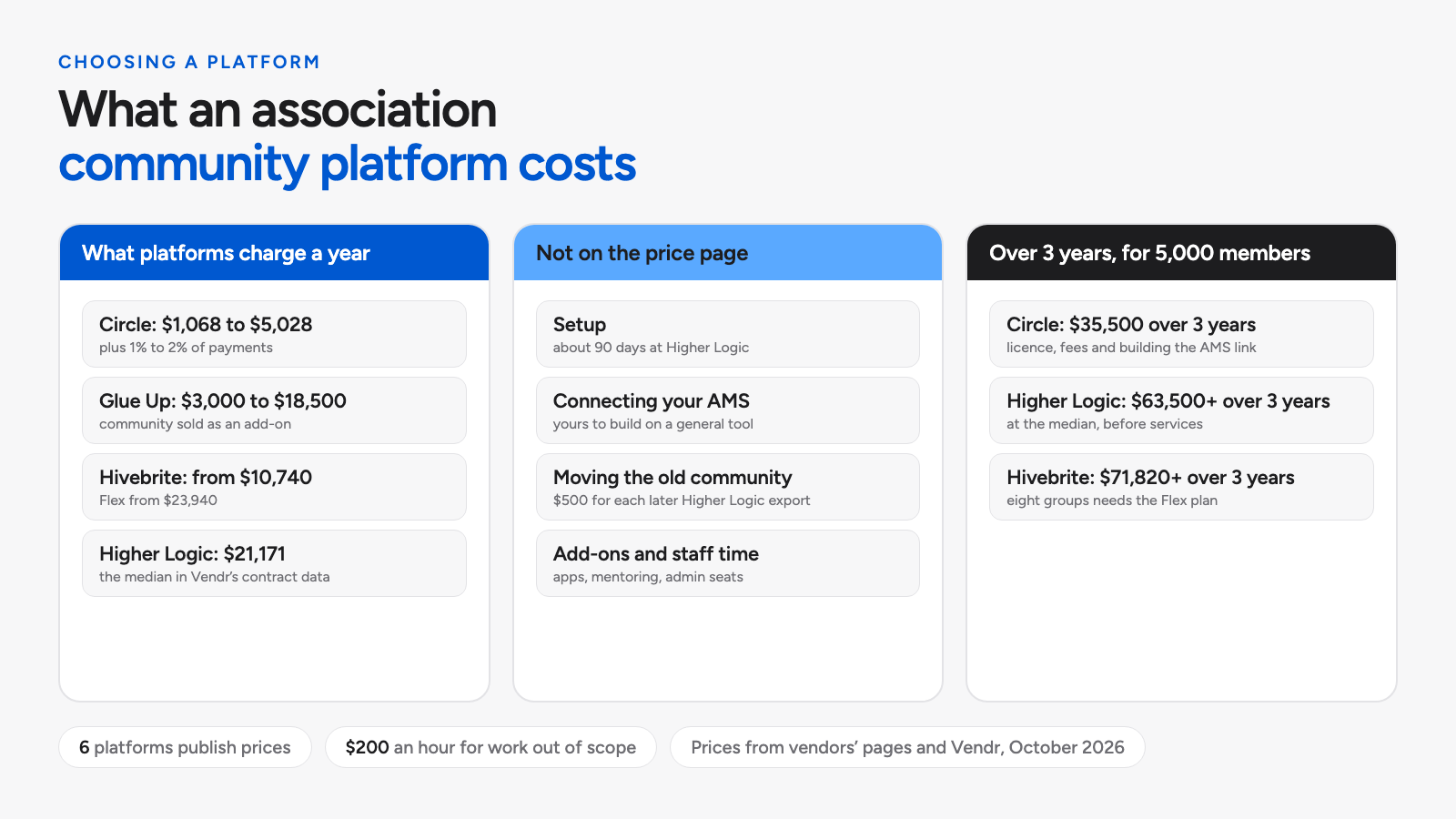
- Circle: $89, $199 or $419 a month on annual billing, or $1,068 to $5,028 a year. It also takes 2% of payments on the lowest plan and 1% on the two above it.
- Mighty Networks: $79 to $354 a month on monthly billing, with a fee of 2% to 0.5% on payments.
- Discourse: $100 a month for Pro or $500 for Business, with 50% off for nonprofits that send proof of their tax exemption.
- Bettermode: $149 or $1,500 a month on annual billing.
Platforms built for associations mostly quote each customer. Two publish prices:
- Hivebrite: Core from $895 a month ($10,740 a year) and Flex from $1,995 a month ($23,940 a year), both billed annually. The two larger plans are quoted.
- Glue Up: $3,000 to $6,500 a year for Professional, and $8,000 to $18,500 for Advanced. Glue Up is a membership system first. Its community is sold as an add-on.
Higher Logic doesn’t publish prices. Vendr, a company that helps businesses negotiate software contracts, has data on what buyers really pay. It reports that the median Higher Logic buyer pays $21,171 a year, with a range of $10,727 to $35,615.
The community module in your AMS, if it has one, is priced with the AMS. It needs no integration, but it is rarely as deep as a dedicated platform.
How vendors set the price
Most quotes are built from one or more of these:
- The number of members. Common among association platforms. Ask whether it counts every member or only active ones, and what happens when you grow.
- A plan with limits. The price is fixed, but the plan caps admin seats, groups or spaces.
- Contacts or emails. Usual where the community comes bundled with email marketing.
- A share of payments. Taken on dues and tickets paid through the platform, on top of the card processor’s own fee.
The limits that push you up a tier
Check the limits before you check the price. They decide which plan you can actually use:
- Hivebrite Core includes 2 admin seats and 5 groups. An association with eight chapters and committees needs Flex, which allows 10 groups.
- Circle allows 3 admins on its lowest plan and charges $10 a month for each extra one. Custom single sign-on, which you need if members are to log in with their association account, starts on the $419 Scale plan. A branded app is only available on its quoted Circle Plus plan.
- Glue Up sells community, single sign-on and certification as separate add-ons.
The costs that aren’t on the price page
The licence is the easy part to compare. These are the lines that make two quotes very different by year three.
Setup
Higher Logic’s standard implementation plans for launch about 90 days after the kickoff call. Connecting your AMS and single sign-on takes about 6 to 8 weeks of that. Anything outside the package is billed at $200 an hour. That includes custom design, custom reports, a data export, and changing the sign-in or integration after launch.
Connecting your AMS
With an association platform, the vendor builds the connection to your membership system, or it is already built. With a general-purpose tool, building it is your job. Someone has to keep member status, tiers and sign-in in step. They also have to fix the connection whenever either system changes. Get a developer’s quote before you compare licences.
Moving the old community
Ten years of discussions and files are worth keeping, and getting them out has a cost. Higher Logic’s export policy makes the first full export free and charges $500 for each one after that. You will want two: one to test with, and one at cut-over. Our guide to migrating an association community covers the rest.
Add-ons
Look for these, each sold separately somewhere:
- a branded mobile app;
- mentoring;
- events and ticketing;
- learning and continuing education credit;
- connectors to your CRM;
- more languages;
- more admin seats.
Hivebrite, for example, lists its mobile app, mentoring, connectors and multi-language as extensions, outside every plan.
Fees on payments
If members pay dues or buy tickets through the platform, a percentage fee adds up. At Circle’s 1%, $80,000 of event tickets a year costs $800 on top of card fees.
Staff time
This is usually the largest line, and the one most often left off. Count the weeks of launch work. Then count the hours a week someone will spend running the community, and multiply by what an hour of their time costs you.
Renewal increases
A low first-year price means little if the contract allows a steep rise at renewal. Ask for a cap in writing, and find the notice period for leaving.
A three-year example for 5,000 members
Take an association with 5,000 members and eight chapters and committees. Members log in through the AMS, and the platform sells $80,000 of event tickets a year. Over three years, using only published prices:
- Circle, Scale plan: $15,084 for the licence, because custom sign-on starts on Scale. Add $2,400 in fees on tickets. Then add a developer to connect the AMS. We assumed 80 hours to build it, 20 hours in each later year to maintain it, and $150 an hour. That comes to $18,000. About $35,500 over three years, before staff time.
- Hivebrite, Flex plan: $71,820 for the licence, because eight groups is more than Core allows. A mobile app or mentoring would be quoted on top. At least $71,820 over three years, before staff time.
- Higher Logic: at the median in Vendr’s data, $63,513 over three years. Implementation may be quoted on top, and out-of-scope work is $200 an hour. About $63,500 and up over three years, before staff time.
The cheapest licence here is not the cheapest platform once the integration is counted. Do the same sum for your shortlist, with your own numbers. If a vendor won’t give a figure, put in your best guess and label it as a guess.
How to keep the cost down
- Buy the tier you need on day one. Check groups, admins and sign-in against your structure before you look at the price.
- Ask for the move to be included. Some vendors cover the cost of switching to win a customer. Hivebrite’s pricing page offers to.
- Trade length for a cap. A two- or three-year term is the usual way to get a lower annual price and a fixed limit on increases.
- Start before the notice period. Find the date by which you must tell your current vendor you are leaving. Miss it and you may pay for another year.
- Count what you can switch off. A new platform may replace your events tool or mentoring software. Count that saving, but only from the day the old contract ends.
For the full list of lines to ask every vendor for, see how to write an RFP for a community platform.
What One Roof costs
One Roof is quoted by the number of members, and every feature is in that price:
- Discussions, events, mentoring, chapters and committees, the member directory, the resource library, recertification credit, sponsorship and the AI assistant are all included. There are no add-on modules.
- Dues and event tickets go through Stripe into your association’s own account. One Roof takes no fee on top of Stripe’s.
- We move your members, discussions and files across with you, and connect your membership system and sign-in.
- On a phone, members add the community to their home screen from the browser in a few taps. It opens like an app, with your name and logo, at no extra cost. Your own app in the App Store and Google Play is the one thing priced separately.
Book a demo for a quote at your member count.
Questions about cost
How much does an online community cost an association?
A general-purpose tool starts at about $1,000 a year. A platform built for associations usually costs $10,000 to $35,000 a year. Setup, integration and staff time come on top. Hivebrite starts at $10,740 a year. The median Higher Logic buyer in Vendr’s data pays $21,171.
Why don’t association platforms publish their prices?
Most price by member count and by the modules you need, so one price list would fit few buyers. Ask any vendor that quotes to break the quote into the same lines as the vendors that publish.
Is a cheap general-purpose tool good enough?
Often, for a small association with one kind of member. If lapsed members must lose access, someone has to keep the tool in step with your membership system, usually a developer. Add that cost before you compare prices.
Should we pay monthly or annually?
Most association platforms bill annually. Where both are offered, annual is cheaper. Circle’s and Bettermode’s published prices are for annual billing.
What should the board see?
A three-year total for each option on the shortlist, built from the same lines, with every guess labelled. Our guide to showing the board what the community is worth covers the other half of that conversation.

