Engagement
Online community engagement ideas: discussion prompts that get replies
Online community engagement ideas for associations: what research says gets a post a reply, 30 discussion prompts members can answer, recurring formats such as introduction threads and ask-me-anything sessions, what works better, and what to measure.
 Boopesh MahendranCo-founder, One Roof7 min read
Tap the picture to see it at full size.
In this article⌄
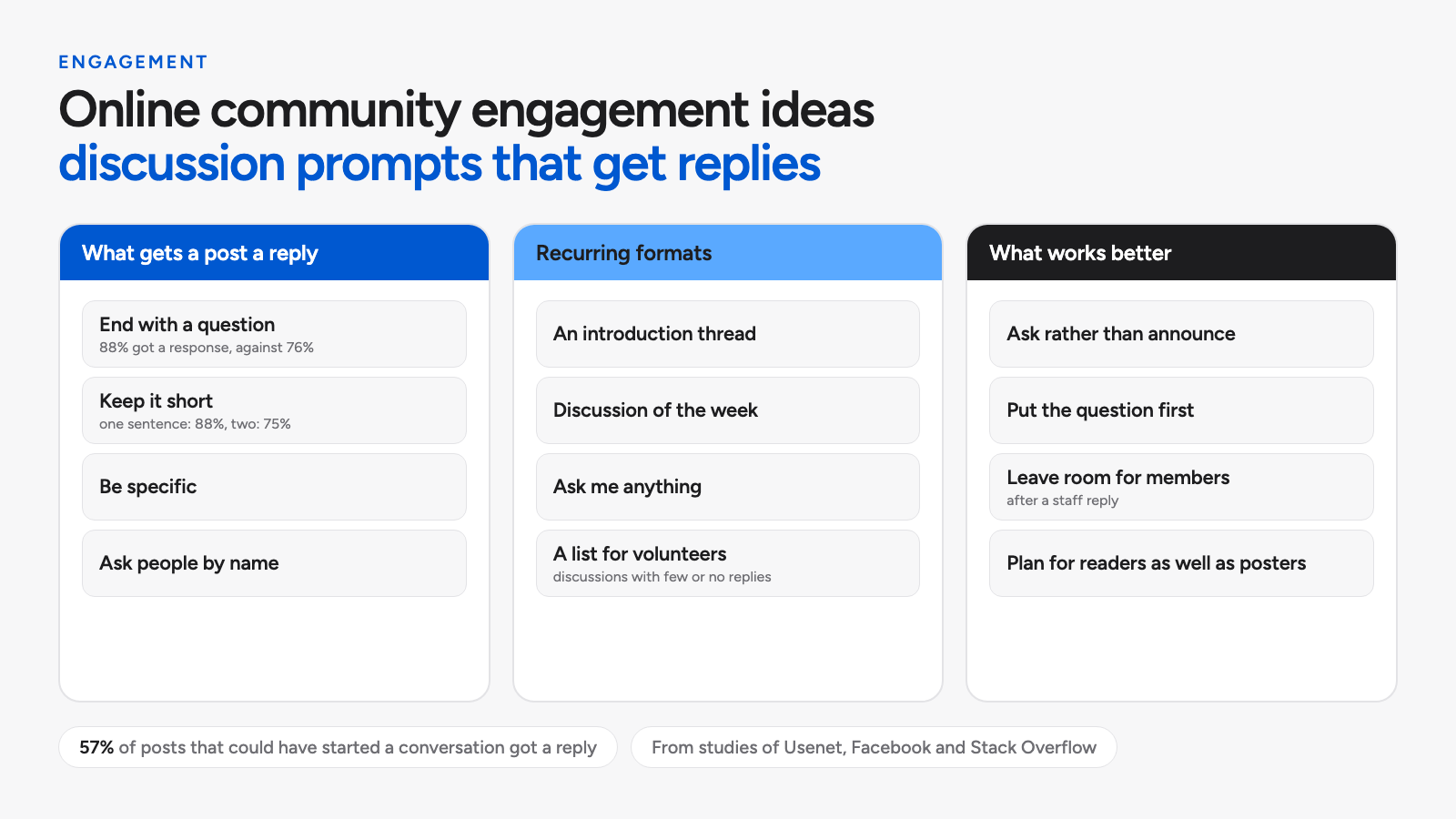
In a study of 40,931 messages in 99 Usenet newsgroups, early online discussion forums, 57% of posts that could have started a conversation got a reply. Research like this also shows which posts do better: short, specific questions that end with a question mark.
This guide covers what research says gets replies, 30 prompts you can use, recurring formats, what works better, and what to measure.
What gets a post a reply
Researchers have studied this in newsgroups, on Facebook and on Stack Overflow, a question-and-answer site for programmers. Most of the findings point the same way:
- End with a question. In a 2011 study by researchers at Microsoft Research and MIT, 282 people posted the same question as their Facebook status. With a question mark, 88% got a response. Phrased as a statement, 76% did.
- Keep it short. In the same study, one-sentence questions got a response 88% of the time, and two-sentence questions 75%. On Stack Overflow, questions under about 200 words were more likely to get an accepted answer than longer ones. One study of newsgroup newcomers found the opposite, so put the question first and add only what people need to answer it.
- Be specific. Robert Kraut and Paul Resnick, in a draft chapter of their book on online communities, report that a specific question, rather than a statement or an open-ended question, made a response about 50% more likely.
- Invite newcomers to say hello. In the Usenet study, the researchers reposted old messages with and without a short introduction. A line saying the poster had been reading the group raised the estimated number of replies per message from 0.42 to 0.81. A line about the poster’s own connection to the topic made no clear difference.
- Ask people by name. Kraut and Resnick, reviewing the research, conclude that asking specific people to contribute works better than broadcasting a request to everyone, and that requests from members with standing in the community, such as leaders and frequent posters, work better than anonymous ones.
Plain subject lines did better too. In the Usenet study, those with more capital letters or dollar signs were less likely to get a reply.
30 discussion prompts
Adapt these to your field. Each is a single question that most members can answer from their own work.
Easy to answer
- What is one tool you rely on every day?
- What is the best piece of advice you got early in your career?
- What does a typical Monday look like for you?
- What is one thing you wish people outside our field understood about it?
- Which conference session or webinar was most useful to you this year, and why?
Asking for experience
- How do you handle a client or stakeholder who keeps changing the brief?
- What is one process you changed this year that saved you time?
- How did you get your first job in this field?
- What do you include in your onboarding for new staff?
- How do you keep up with changes in regulations that affect your work?
Practical sharing
- What template or checklist do you use for [a common task in your field]? Can you share it?
- Which software do you use for [a common task], and would you choose it again?
- What questions do you ask when interviewing a candidate for [a common role]?
- How do you report results to your manager or board?
Opinions
- Is [a recent change in your field] good or bad for people like us?
- Which skill will matter most in our field in five years?
- Should [a common certification or qualification] be required for [a common role]?
- What is one rule in our field you would change?
Career
- What would you tell someone in their first year in this field?
- How did you negotiate your last raise or promotion?
- What made you stay at your current employer, or leave your last one?
- Who in the field do you learn the most from, and why?
News and change
- How is [this month’s news or new rule] affecting your work?
- What surprised you in your work this year?
- What new thing are you planning for next year?
Getting to know each other
- Introduce yourself: where do you work, and what are you working on right now?
- What are you reading or listening to that is useful for your work?
- What is something you are proud of from the past year?
Polls (one click to answer, with an invitation to explain in a reply)
- How many years have you worked in our field? (Under 5, 5 to 10, 10 to 20, over 20)
- Are you working on site, remotely, or a mix? (On site, remote, hybrid)
Recurring formats
A weekly or monthly format gives members something to expect:
- An introduction thread. The Professional Photographers of America started one in its community in June 2013, and it had more than 300 posts by August 2014. Some members became “the unofficial welcome wagon,” its community coordinator said.
- Discussion of the week and member of the week. The same association picked a discussion to feature each week, which usually brought it more activity, and a member who posted often or gave in-depth advice.
- Ask me anything. The American Statistical Association hosts a guest each month in its young professionals group, often a committee chair, volunteer or past president, who answers members’ questions.
- Thanks to top contributors. The American Staffing Association planned to mark its community’s fourth anniversary by highlighting its top 10 contributors, in the community and in its member newsletter.
- A list for volunteers. Each week, ISTE emailed member volunteers a list of discussions with few or no replies. “If the topics fit their area of interest, we ask if they would submit a reply, and they usually do,” said Lauren Kelly, then its director of membership and community.
- A roundup in the newsletter. ISTE also included popular discussions in its monthly newsletter.
Email brings people back. In a study of a nutrition website, people logged on far more often on days they were sent an email, though the effect faded within two days.
What works better
- Ask rather than announce. A post that asks gets more replies than one that tells, as the Facebook study found.
- Put the question first, before any background.
- Leave room for members after a staff reply. In a study of a health community, 46% of threads ended right after a moderator told the member to see their doctor. Of other threads, 28% ended right after a moderator’s first reply. So when staff reply, end with an invitation for members to add their own experience.
- Plan for readers as well as posters. Most members read. In Jakob Nielsen’s 90-9-1 rule, 90% of users “read or observe, but don’t contribute.” In a survey of 219 people who read online community boards without posting, 54% chose “just reading/browsing is enough” as a reason.
Our guide to reviving a quiet association community covers what to do when activity has dropped.
What to measure
- The share of new discussions that get a reply, and how quickly.
- Which prompts and formats draw the most replies.
- How many different members post each month.
- How many members answer a poll compared with how many reply to a discussion.
Where One Roof helps
- Polls take one click to answer, with the results split by member type, region and industry.
- Questions waiting for an answer are sent to members with the right expertise, and have their own Unanswered tab on members’ home page.
- Email digests bring members the discussions they missed, daily, weekly or monthly.
- Recognition gives members points and ribbons, a kind of badge, for helping others.
Questions about online community engagement
How do you get members to reply in an online community?
Ask a short, specific question, and invite particular members by name. Encourage newcomers to introduce themselves. Questions ending in a question mark get more responses than statements.
What are good discussion prompts for an association community?
Questions most members can answer from their own work: a tool they rely on, advice for newcomers, how they handle a common problem, or how a recent change affects them.
Do polls increase community engagement?
They take one click, so more members can take part. To turn votes into discussion, pair each poll with an invitation to explain the answer in a reply.
How often should we post discussion prompts?
Often enough that members expect them, such as one a week, alongside a regular format like a monthly ask-me-anything.
What makes a community post get a reply?
A short, specific question, ideally addressed to people who can answer it. Long, unclear posts and statements get fewer replies. In one study of newsgroups, 57% of posts that could have started a conversation got a reply.

