Engagement
Member engagement scoring for associations: how to build a score and check it works
How to build a member engagement score for an association: what to count and what to leave out, points for each activity, letting old activity fade, tiers, checking the score against renewals, and using it to decide who to call.
 Boopesh MahendranCo-founder, One Roof6 min read
Tap the picture to see it at full size.
In this article⌄
An engagement score adds up what each member does, such as events attended, volunteering and posts, into one number. It helps staff see which members are drifting away while there is still time to reach them. This guide covers what to count, how many points to give, how to let old activity fade, and how to check that the score means something.
Why score engagement
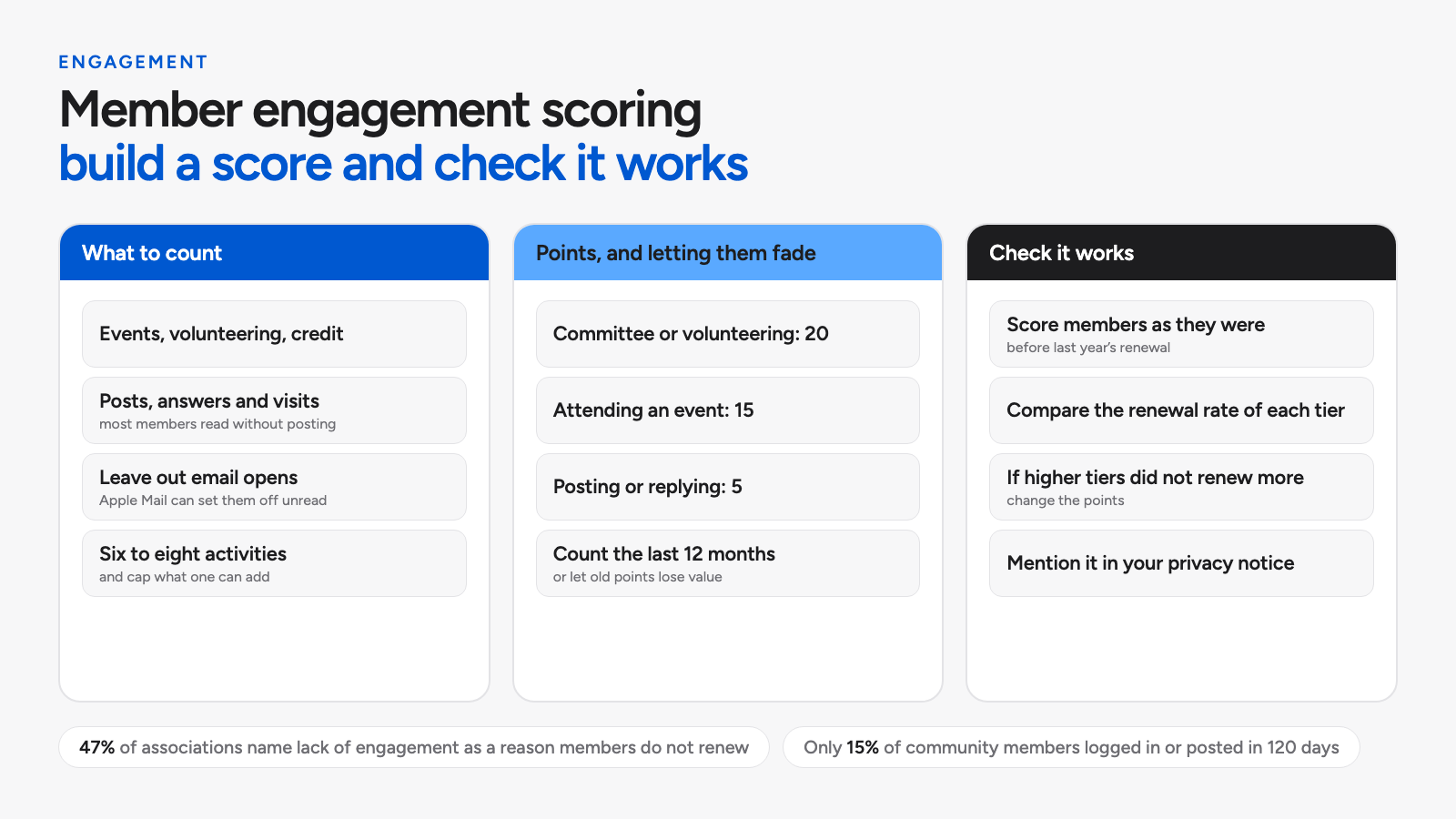
In Marketing General’s 2024 benchmarking report, lack of engagement was the reason staff most often gave for members not renewing: 47% of associations named it, rising to 64% among trade associations.
Most have no plan to raise it. In a GrowthZone survey of 518 association leaders, 75% had no written plan for increasing engagement.
A score turns “engagement” into something you can see for every member. With 5,000 members, nobody can remember who has gone quiet.
What to count
Count things members choose to do:
- Attending an event, in person or online.
- Volunteering, or serving on a committee.
- Earning credit toward a certification.
- Posting, replying or answering a question in the community.
- Visiting the community or the members’ area of your website.
- Downloading a resource.
- Clicking a link in an email, for a few points.
The Pennsylvania Institute of CPAs’ score counted events, purchases, volunteering and social media, and left out passive things such as opening the newsletter.
Leave out email opens
Email opens no longer show whether anyone read the email. When Mail Privacy Protection is on, Apple Mail downloads the content of emails in the background, “regardless of whether you engage with the email”, and the sender’s system logs that as an open. In September 2026, Apple Mail accounted for about three in four of the opens Litmus tracked. Clicks are a better sign, but give them few points: some come from security software checking links, not from people.
Count visits, not only posts
Most members of an online community read without posting. The usual rule of thumb, from Nielsen Norman Group, is that 90% only read, 9% post now and then, and 1% post a lot. In Higher Logic’s 2024 benchmark of about 1,500 associations, only 15% of community members, on average, logged in or posted within 120 days. A score that counts only posts would treat members who read but never post as disengaged.
Gather the data in one place
The activity sits in different systems: your membership database, event registrations, your learning system for credit, and the community. Match each record to the member by member ID, not by name or email, since people change both. Start with the systems you can connect, and add others later.
Give points to each activity
Give more points for what takes more effort, or matters more to renewal. Here is a starting point to adjust:
- Serving on a committee or volunteering: 20 points.
- Attending an event: 15 points.
- Earning credit toward a certification: 10 points.
- Having a reply marked as the answer: 8 points.
- Posting or replying: 5 points.
- Downloading a resource: 3 points.
- Visiting the community: 1 point, up to 10 a month.
- Clicking a link in an email: 1 point, up to 5 a month.
Two rules keep the score honest:
- Cap what one activity can add. Otherwise a member who visits every day would outscore a committee member.
- Keep the list short. Six to eight activities are enough. Each one you add is one more thing to keep accurate.
Let old activity fade
A member who chaired a committee three years ago and has done nothing since is not engaged now. Either:
- Count only the last 12 months, which is simple to explain, or
- Let points lose value over time, for example full points for the last 6 months, half for 6 to 12 months ago, and none after that.
Letting activity fade is the recency part of RFM analysis, which marketers use to rank customers by how recently they bought, how often, and how much.
Group members into tiers
A number on its own is hard to act on. Put members into three or four groups, and decide what each group gets:
- Highly engaged: ask them to volunteer, speak or mentor.
- Somewhat engaged: invite them to the next thing that matches what they already do.
- Barely engaged: a personal call or email before renewal.
- No activity at all: find out why. When the Pennsylvania Institute of CPAs first scored its members, 42% of its 21,000 members scored zero.
The Florida Association of Insurance Agents used three tiers, reviewed every quarter, and aimed its outreach at the two lower ones.
Check that the score works
A score is only useful if it tells you something about renewal. Test it against last year’s renewals:
- Score each member using only the 12 months before their renewal date last year.
- Put members into tiers by that score.
- Compare the renewal rate of each tier.
If the higher tiers renewed more often, the score is doing its job. If not, change the points and test again. With a few thousand members, a statistician can go further with logistic regression, which estimates how each activity relates to the chance of renewing.
A link between taking part and renewing does not prove that taking part causes renewal. For how to report this to a board, see our guide to measuring community value.
Use it to decide who to contact
The score tells staff where to look first, not what to say. Look for:
- First-year members with low scores. First-year members renew less often: a median of 75%, against 85% overall, in the Marketing General report.
- Members whose score dropped, not only those with low scores.
- Members in the lowest tiers who renew in the next 90 days.
Read the member’s record before you call: a score cannot tell you that someone changed jobs, or was unhappy with an event.
Tell members you score them
A score is a kind of profiling. The UK’s data protection regulator, the Information Commissioner’s Office (ICO), says people have the right to object to profiling in some cases, and that you must tell them about that right. Mention the score in your privacy notice, and say what you use it for.
Where One Roof helps
One Roof’s member retention list does part of this work for you, from the community’s own activity:
- Posts, replies, events, messages and visits are checked every day, with nothing for staff to enter.
- Paying members are listed when there is a clear reason: never active, quiet for 90 days or more, short of credit near the end of their cycle, new and not settled in, or unhappy in a post.
- Each member gets a high, medium or low risk level, worked out by fixed rules, with the reasons shown, their renewal date and a suggested next step.
- Staff log each contact, and can see later which contacted members became active again.
- The list downloads as a spreadsheet (CSV), and a separate table shows how many of each employer account’s members are at risk.
For what to do once you know who is drifting, see our guide to member retention.
Questions about engagement scoring
What is a member engagement score?
A number for each member that adds up what they do, such as events, volunteering, credit and community activity, so staff can see who is engaged and who is drifting.
What should an engagement score include?
Things members choose to do: events, volunteering, credit earned, community posts and visits, and downloads. Leave out email opens, which are no longer reliable.
How many points should each activity get?
More for what takes more effort. A committee role might be 20 points, an event 15, a post 5 and a visit 1. Then test the points against last year’s renewals and adjust.
How do you know if an engagement score works?
Work out last year’s scores, group members into tiers, and compare each tier’s renewal rate. If higher tiers renewed more often, the score works.
Does a high engagement score mean a member will renew?
Not for certain. Engaged members tend to renew more often, but a score cannot see everything, such as a member changing jobs. Use it to decide who to contact first.

