Continuing education
Continuing education credit tracking for associations: what to record, certificates and audits
How associations track continuing education credit for members who must recertify: what common credentials require, what to record for every credit, what a certificate should say, checking attendance online, and getting members through an audit.
 Boopesh MahendranCo-founder, One Roof7 min read
Tap the picture to see it at full size.
In this article⌄
Many association members hold a certification they must renew every few years with continuing education credit. The association is often where they earn it, and where they expect to find the record of it. This guide covers what common credentials require, what to record, what a certificate should say, and how to help members through an audit.
Why it matters
In Marketing General’s 2024 benchmarking report, associations named continuing education and professional certification as one of the top reasons members join: 42% overall, and 54% at associations whose members are individuals rather than companies. Only networking ranked higher.
What members need to earn
Requirements differ by credential, which is why one spreadsheet column for “credits” rarely works:
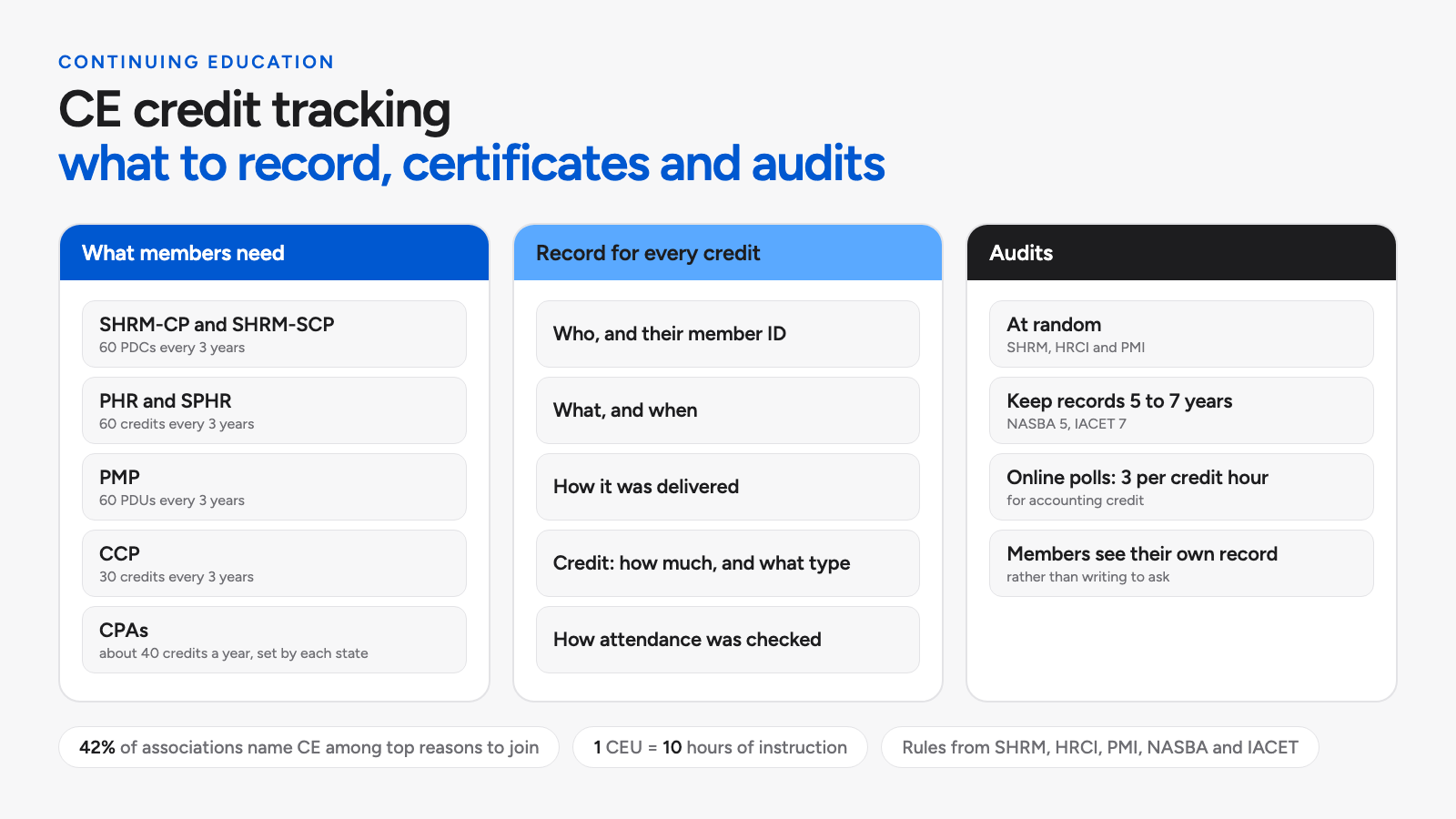
- SHRM-CP and SHRM-SCP: 60 professional development credits (PDCs) every three years (SHRM).
- HRCI’s PHR and SPHR: 60 credits every three years, including one ethics credit (HRCI).
- PMP: 60 professional development units (PDUs) every three years, at least 35 of them from education (PMI).
- WorldatWork’s CCP and other certifications: 30 recertification credits every three years, 20 general and 10 in the certification’s own field (WorldatWork).
- CPAs: set by each state. NASBA’s model rules ask for an average of 40 credits a year (120 over three years), at least 20 in any one year, and 2 a year in ethics.
The units differ too. A CEU is ten hours of instruction, as IACET defines it. A credit for accountants is 50 minutes. SHRM and HRCI count in quarter hours.
What to record for every credit
Whatever the credential, record the same few things for each member and each activity:
- Who: the member’s name and member ID.
- What: the program or session title.
- When: the date, and the start and end times.
- How: in person, live online or on demand.
- Credit: how much, and what type, such as ethics or a field of study.
- Who gave it: your name as the provider, and your provider number if you have one.
- How attendance was checked: a sign-in, a scan, polling answers.
Keep the records for as long as the strictest rule you work under:
- Five years for accounting credit (NASBA).
- Seven years for IACET-accredited providers (IACET).
- At least three years for SHRM’s approved providers.
What a certificate should say
NASBA’s 2026 standards for accounting credit list what a certificate of completion must include. It is a good model for any credential:
- Your name as the provider, and your NASBA sponsor number.
- The participant’s name.
- The course title, and the date it was offered or completed.
- The location, if there was one, and the type of program.
- The credit awarded, by field of study.
- A statement that credit is based on a 50-minute hour, and anything the state board requires.
Send certificates within 60 days. A common mistake, NASBA’s sponsor registry says, is counting credit by the 60-minute hour instead of the 50-minute one.
Check attendance at online sessions
Online credit needs proof that the member was there, not only that they registered. For accounting credit, NASBA’s 2026 standards say a member’s own word is not enough. Ways to check:
- Polls or on-screen prompts. NASBA requires at least three per credit hour, at unpredictable times.
- Codes read out during the session, for members to enter.
- Someone watching who is there, throughout the session.
SHRM’s provider guide also asks providers to have a way of checking who took part in webinars.
Partial credit
Sessions rarely last an exact number of credit hours. Each body counts the extra time its own way:
- NASBA: a full credit is 50 minutes. After the first one, add fifths or halves (1.2, 1.5), and always round down.
- SHRM: in quarters, 0.25 for each 15 minutes.
- HRCI: in quarter hours, such as 1.25, for programs at least 45 minutes long.
Use the same rule for every session in a program.
Help members through an audit
Credentialing bodies check a sample of renewals at random:
- SHRM checks at random, and recommends members keep their records for six months after their cycle ends.
- HRCI audits at random, and accepts a certificate of attendance, a registration form, a receipt or a confirmation email as proof.
- PMI checks at random, and asks members to keep proof for at least 18 months after their cycle ends.
None publishes how many it audits. A member who is selected needs the record quickly, so let them see their own record at any time rather than writing to ask for it.
Become an approved provider
As an approved provider, you award credit yourself, so members do not have to claim it separately.
- A SHRM Recertification Provider can award credit for its programs without asking SHRM first.
- An HRCI Recertification Provider pays $525 a year, or $250 per conference for an organization that only runs conferences.
Each body sets its own rules for what you must record and keep.
Help members renew on time
Members rarely lapse on purpose. They lose track. Show each member how much credit they have against what their credential requires, remind them well before their cycle ends, and point them to the sessions that earn what they still need.
What to measure
- Members with a tracked credential, and how far each is through their cycle.
- Credit earned through your events, by credential.
- Members within six months of their cycle’s end and short of credit.
- Requests for records, and how quickly you answered them.
Where One Roof helps
One Roof’s recertification credit tracking:
- Sets up a program for each credential, with its own cycle length and requirement. Each member’s cycle starts on their own date, such as when they joined.
- When staff mark who attended an event, each attendee gets the credit toward every credential they hold.
- Can also give credit for community help, such as an accepted answer, up to a limit per cycle.
- Shows each member their credit this cycle against their requirement, and what earned each credit and when.
- Lets staff download every member’s credit as a file for your records and for audits.
For running the events that earn credit, see our guide to association event management.
Questions about CE credit tracking
What is continuing education credit tracking?
Recording the education each member completes, with the credit it earned, so members can show they meet their credential’s renewal requirement.
How many contact hours is a CEU?
Ten hours of instruction. That is how IACET, which sets the standard for CEUs, defines one.
How long should CE records be kept?
As long as the strictest rule you work under: five years for NASBA accounting sponsors, seven for IACET-accredited providers, at least three for SHRM providers.
What should a certificate of completion include?
The provider, the participant’s name, the course title, the date, the type of program, the credit awarded by type, and any provider or approval number.
How do you verify attendance at a webinar for CE credit?
With checks during the session, not only a registration. For accounting credit, if you use on-screen prompts or polls, NASBA requires at least three per credit hour, at unpredictable times.

