Events
Event management for associations: registration, waitlists, no-shows and follow-up
How associations run events members come to: pricing for members, easy registration, planning for no-shows, waitlists that move, reminders, hybrid and recordings, accessibility, proof of attendance for credit, and what to measure.
 Boopesh MahendranCo-founder, One Roof7 min read
Tap the picture to see it at full size.
In this article⌄
- Why events matter to members
- Give members a better price
- Make registering easy, and keep it open late
- Plan for no-shows
- Run a waitlist that moves
- Remind people
- Hybrid events and recordings
- Make it accessible
- State prices and refunds up front
- Record attendance for credit
- After the event
- What to measure
- Where One Roof helps
- Questions about association event management
Events are where an association’s members meet. They are also where many members decide whether membership is worth it. This guide covers pricing, registration, no-shows, waitlists, reminders, hybrid events and follow-up, for conferences, chapter meetings and webinars alike.
Why events matter to members
In Marketing General’s 2024 benchmarking report, associations say the top reason members join is “to network with others in their chosen profession” (67%). Continuing education came next (42%). Events deliver both.
Events are also under pressure. In ASAE’s first State of Associations report, in 2026, meetings were the source of income hit hardest, as fewer people attend.
Give members a better price
A member price is one of the clearest benefits an association can show. Marketing General found conference discounts among the offers associations rated best at getting people to join. How much less members pay varies widely. Two examples:
- AMRPA’s 2026 fall conference: $845 for members and $945 for non-members, at the early-bird rate.
- ABA’s 2027 Conference for Community Bankers: $1,595 for members who book early, and $3,495 for non-members, more than double.
Show non-members both prices, so they can see what joining would save them. AMRPA goes a step further: if a non-member’s organization joins before the conference, they pay the member price.
Make registering easy, and keep it open late
People register later than organizers expect. In Livestorm’s 2026 webinar benchmark, “nearly half of all registrations (49.6%) happen in the final seven days before an event, and 15% come on the day of.”
- Keep registration open until the start for online events, and as late as the venue allows for in-person ones.
- Ask only for what you need. A member who is already signed in should not have to type their name and email again.
- Confirm at once, with the date, the time zone, how to join, and a link to add it to their calendar.
Plan for no-shows
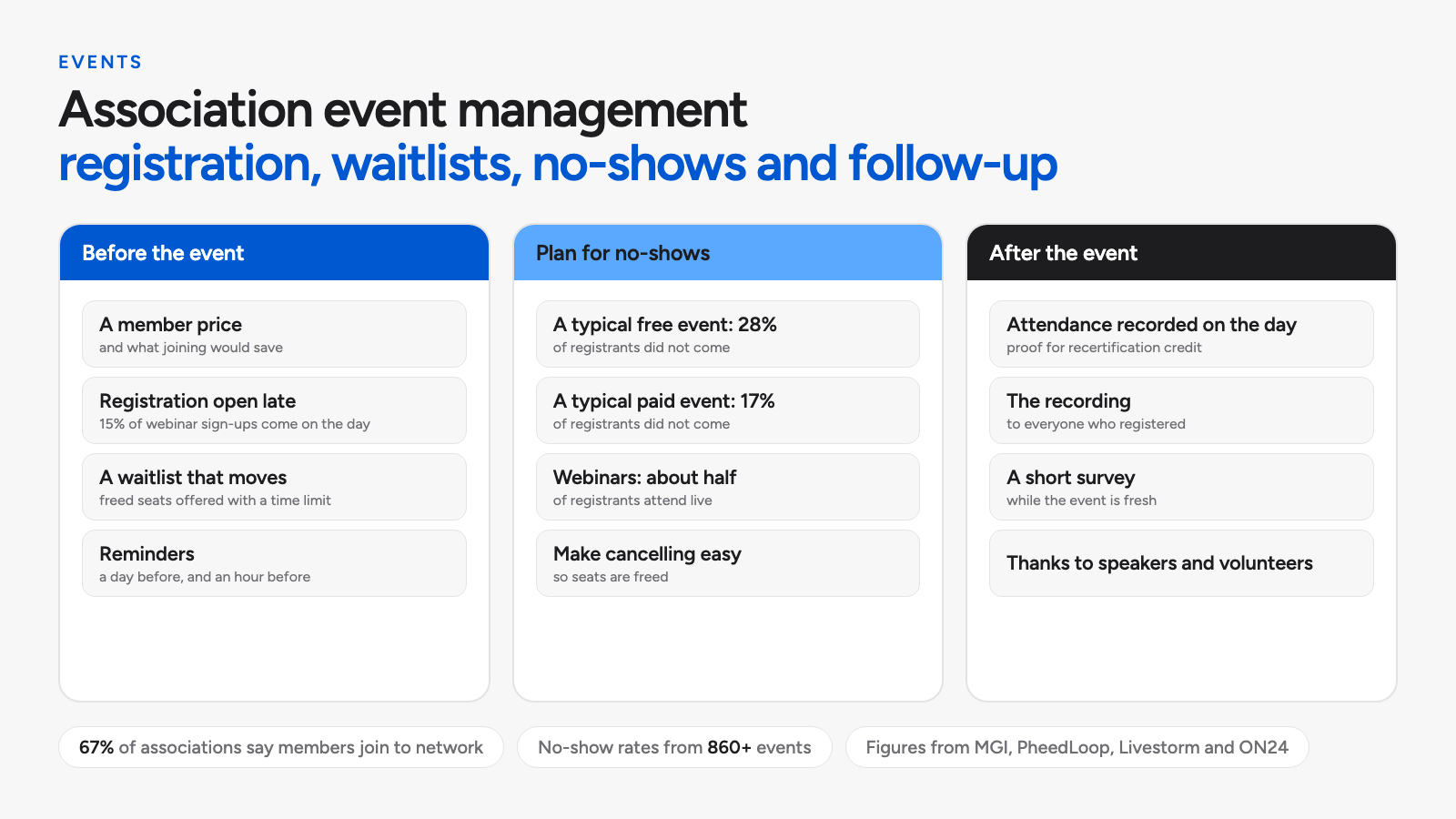
Not everyone who registers comes. PheedLoop, an event software company, measured more than 860 events. At a typical free event, about 28% of the people who registered did not come. At a paid event, about 17% did not. People who have paid tend to come.
Online events lose more. Only about half of the people who register for a webinar turn up live: 47.7% in Livestorm’s 2026 report.
- Allow for it when you set the number of seats and order food.
- Make cancelling easy, so a member who cannot come frees their seat for someone who can.
- Charge a small fee if no-shows at a popular free event keep out members who would come.
Run a waitlist that moves
When an event is full, a waitlist keeps people who would otherwise give up. When a seat frees up:
- Offer it to the next person in line, in the order they joined.
- For a paid event, give them a set time to claim it, then offer it to the next person. Event platforms such as Eventbrite set a “Time to Respond” for exactly this.
- Tell people their place in line. If no seat frees up, tell them before the event starts.
Remind people
Livestorm recommends four messages:
- A confirmation as soon as someone registers.
- A reminder 24 hours before.
- Another an hour before.
- A “starting now” message.
Put the joining link or the venue in every one, so nobody has to search for it.
If anything changes (the time, the room, the link) or the event is cancelled, tell every registrant at once, and say exactly what changed.
Hybrid events and recordings
Many in-person events now have an online part. In PCMA’s 2025 survey of event planners, most of them at associations, 34% stream part of their in-person events live and 21% put it online afterwards. The other 44% run theirs fully in person.
Record what you can. ON24 found that 43% of webinar attendees watched a recording rather than the live session. Send the recording to everyone who registered, including those who did not come.
Make it accessible
Under the Americans with Disabilities Act, nonprofits that serve the public must provide what people with disabilities need to follow an event, such as live captioning. They may not charge extra for it. For online events, the W3C’s accessibility guidelines expect captions on all live audio.
Ask about access needs on the registration form, and plan captions from the start.
State prices and refunds up front
Show the full price, fees included, and the refund deadline before anyone pays. The FTC’s fee rule is written for concerts and similar events, but its advice suits any ticket: show the total price, and avoid vague charges such as “convenience fees”.
Record attendance for credit
Many members attend to earn recertification credit, and their credentialing body may audit them and ask for proof. Record who attended on the day, not weeks later from memory, and give members a record they can show. Our guide to continuing education credit tracking covers what to record and how audits work.
After the event
- Send a short survey while the event is fresh.
- Share the recording and slides with everyone who registered.
- Thank speakers and volunteers by name.
- Carry on the discussion in your online community, with people who came and people who did not.
What to measure
- Registrations from members and from non-members.
- How many of those who registered came, for free and paid events.
- Seats offered from the waitlist, and how many were taken.
- Non-members who joined to get the member price.
- Survey scores, and what attendees asked for next.
Where One Roof helps
One Roof’s events sit inside the member community:
- Events can be online, in person or both, for the whole association or for one chapter or committee.
- Signed-in members register in one click. Paid events take payment at checkout, and members with a paid membership pay the member price.
- When an event is full, members join a waiting list. When a seat frees up, it goes to the next member in line, who is told. For a paid event, the seat is held for them for a day while they pay.
- Registered members get a reminder the day before, and a notice if the time, venue or link changes or the event is cancelled. They can add the event to their calendar in one click.
- A member who cancels before the refund deadline you set gets their money back automatically.
- Staff mark who attended. Members marked as attended get their recertification credit, and every credit can be downloaded for your records.
Questions about association event management
What is association event management?
Planning and running an association’s conferences, chapter meetings, webinars and other events: pricing, registration, communication, attendance and follow-up.
How do you reduce event no-shows?
Charge for events where seats are scarce, remind people the day before and an hour before, make cancelling easy so seats are freed, and keep a waitlist to fill them.
What is a normal no-show rate?
In one study of more than 860 events, the typical free event lost about 28% of registrants and the typical paid one about 17%. For webinars, about half of registrants attend live.
Should members pay less for events?
Yes. A member price is one of the clearest benefits of membership. Show non-members both prices, and what joining would save them.
How should associations record attendance for CE credit?
Record attendance on the day, keep it with the date, time and session, and give members proof they can show if their credentialing body audits them.

