Chapters
Special interest groups in associations: how to start, run and rethink them
How associations run special interest groups and communities of practice: what they are, how associations organize and price them, why some are replacing paid groups with free communities, rules for starting and closing groups, what members use, the volunteer load, and what to measure.
 Boopesh MahendranCo-founder, One Roof7 min read
Tap the picture to see it at full size.
In this article⌄
- What a special interest group is
- How associations organize them
- Why some associations are dropping paid groups
- Rules for starting a group
- Rules for reviewing and closing groups
- What members actually use
- Lighten the volunteer load
- Do not assume groups keep members
- What to measure
- Where One Roof helps
- Questions about association special interest groups
Most associations serve members who share a profession but not a specialty. Special interest groups, or SIGs, give members with a narrower interest a place of their own. Associations call them by different names: sections, round tables, divisions, interest groups or communities.
This guide covers what these groups are, how associations organize and price them, why some are changing their approach, rules for starting and closing groups, what members use, the volunteer load, and what to measure.
What a special interest group is
The Association for Computing Machinery (ACM), which runs dozens of them, defines a SIG as a group “formed by Members with the desire to pursue significant long term activity in a specialty of ACM’s interests.”
A related idea is the community of practice. Etienne Wenger-Trayner, who coined the term with the anthropologist Jean Lave, and Beverly Wenger-Trayner define it as “groups of people who share a concern or a passion for something they do and learn how to do it better as they interact regularly.” They name three things it needs:
- A shared subject, which they call the domain.
- A community: members who discuss, help each other and share information.
- A shared practice: members work in the field, and build up tools, stories and ways of solving problems together.
A group is not a community of practice just because it exists. “A website in itself is not a community of practice,” they write. It becomes one only when its members talk and learn from each other.
How associations organize them
Some examples, with what they cost members:
- ACM runs 37 SIGs, which together organize more than 170 conferences, workshops and symposia. Each SIG sets its own dues, with lower rates for ACM members.
- The American Library Association has 19 round tables. Members pay $15 for each round table they join, or $5 as students.
- The National Association of Social Workers has 11 specialty practice sections, at $40 a year each.
- The Society of American Archivists had 47 sections in 2023, and members may join as many as they like.
Why some associations are dropping paid groups
Two large associations recently replaced their paid groups with new communities.
ASHA, the American Speech-Language-Hearing Association, ended its 20 SIGs on December 31, 2025. Members had paid $45 a year for each SIG, or $10 as students. A task force gave these reasons for the change:
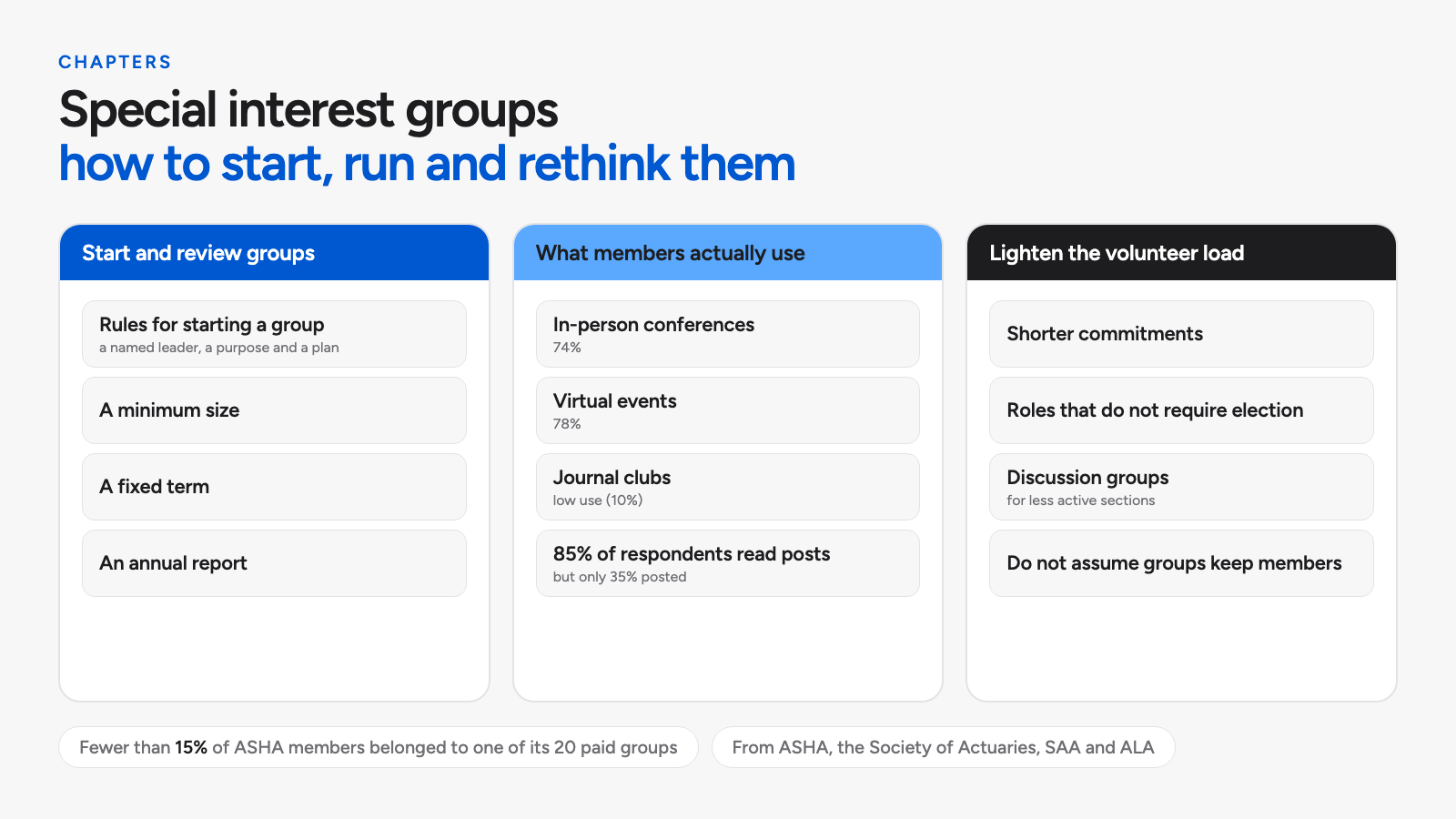
- “Participation declining to its lowest level since 2007, with fewer than 15% of ASHA members choosing to affiliate with a SIG.”
- “Members creating their own communities outside of SIGs.”
- The program had reached the most SIGs that its systems and staff could support.
- “Cost barriers associated with additional membership fees.”
ASHA replaced the SIGs with 20 topic-based communities. Its task force had recommended dropping the extra fees.
The Society of Actuaries merged its sections into seven communities in 2025, after section membership and volunteering had declined, especially among early-career and international members. The communities are free for its members, and $25 a year for others. Each gets a budget “based on need” rather than its own dues.
Charging for each group raises money, but it also keeps members out. If few members join, consider making groups part of membership.
Rules for starting a group
Clear rules stop groups from being created on a whim, and give members a fair way to start one:
- The American Library Association can approve a new round table on a petition from 150 members, with a statement of purpose.
- The Society of American Archivists needs a petition signed by at least 100 members, a statement of the section’s purpose and goals, and an explanation of why a separate section would help.
- The American College of Emergency Physicians needs a petition from 100 members, and a two-thirds vote of its board. A section that does not reach 100 members within a year may lose its official status.
Ask for a named leader, a purpose, and a plan for the first year too.
Rules for reviewing and closing groups
Groups outlive their purpose. Decide in advance how you will review them:
- A minimum size. If an American Library Association round table falls below 150 members, it is offered the options of converting into or merging with another unit, or being dissolved.
- A fixed term. ACRL, the American Library Association’s college and research library division, approves interest groups for three years. They disband unless renewed, and need at least 75 ACRL members to apply for renewal.
- An annual report. Society of American Archivists sections must file a yearly report and leader list. A section that fails to file one within a year is told it will be dissolved, though it may appeal.
In July 2023, after a review of its sections, the Society of American Archivists’ governing council decided to close one section, turn three into discussion groups, and merge others.
What members actually use
Members value meeting each other more than publications:
- In ASHA’s 2024 survey, respondents who had taken part in SIGs rated in-person conferences (74%) and virtual events (78%) most valuable. Journal clubs, where members discuss research articles, showed low use (10%).
- In the Society of American Archivists’ survey, 85% of respondents read posts on their section’s email list, but only 35% posted.
So most members read and few post, as in any community. Give each group a place to talk, a few events a year, and a session at the annual meeting.
Lighten the volunteer load
Every group needs leaders, and they are hard to find. “It can be difficult to find enough people to stand for section elections,” the Society of American Archivists’ review found. In its 2023 survey, which drew 449 responses:
- 86% were open to turning less active sections into discussion groups.
- 18% disliked “the hierarchy/bureaucracy of elections and steering committees.”
Staff time adds up too. ASHA assigned each SIG about a quarter of one staff member’s time.
Both associations looked for lighter roles. ASHA’s task force found that traditional volunteer structures did not fit people who “prefer shorter commitments.” It recommended replacing elected committees with a single advisory group of 8 to 12 members, and curators who look after each topic. The Society of Actuaries added roles that do not require election. Our guide to volunteer management covers short roles.
Do not assume groups keep members
Group members are often an association’s most engaged. That does not mean the groups made them so. ASHA’s task force said: “While SIG affiliates are among ASHA’s most engaged members, it wasn’t clear whether SIGs created engagement or simply attracted already-engaged members.”
What to measure
- The share of members in at least one group.
- How many members in each group post, not only read.
- Events and sessions each group runs, and attendance.
- Groups with no activity in the past six months.
- Leader roles left empty.
Where One Roof helps
- Spaces: each subject or group has its own space for discussions and files. A space can be open to all members, limited to paying members, or private to a group.
- Following: members follow the spaces they care about, for all posts or questions only, and get them in their email digest.
- Group leaders: leaders run their own space, pinning and locking discussions and setting up events, with terms that end on time.
- Reporting: see what members read, searched and asked next to what was written, by topic or for one space, so unanswered questions and quiet groups are easy to spot.
Questions about association special interest groups
What is a special interest group in an association?
A group of members who share a narrower interest within the association’s field. Associations also call them sections, round tables, divisions or communities.
What is the difference between a SIG and a community of practice?
A SIG is a formal unit of the association. A community of practice is any group of practitioners who learn together by interacting regularly. A SIG becomes one when its members actively share and learn.
Should associations charge extra for special interest groups?
Some do, such as the National Association of Social Workers at $40 a year per section. The Society of Actuaries stopped charging its members for its groups in 2025, and ASHA ended its paid groups at the end of 2025, after participation fell.
How many members do you need to start a SIG?
It varies. The American Library Association needs 150 members for a round table, and the Society of American Archivists and the American College of Emergency Physicians each need 100.
How do you close an inactive special interest group?
Set rules in advance: a minimum size, a fixed term with renewal, or a yearly report. The Society of American Archivists tells a section that has not filed its annual report within a year that it will be dissolved, though the section may appeal.

