Non-dues revenue
Association job boards: how to run a career center members use and employers pay for
How to run an association job board: running it yourself or with a vendor, what associations charge employers, extras such as featured jobs and resume access, free postings, services for job seekers, career fairs, pay transparency laws, keeping ads lawful, and tax.
 Boopesh MahendranCo-founder, One Roof7 min read
Tap the picture to see it at full size.
In this article⌄
Many people join an association to help their careers. In Marketing General’s 2024 benchmarking report, 27% of individual membership associations (those whose members are people, not companies) named career advancement among the top three reasons members join. A job board helps with that directly, and employers pay to use it.
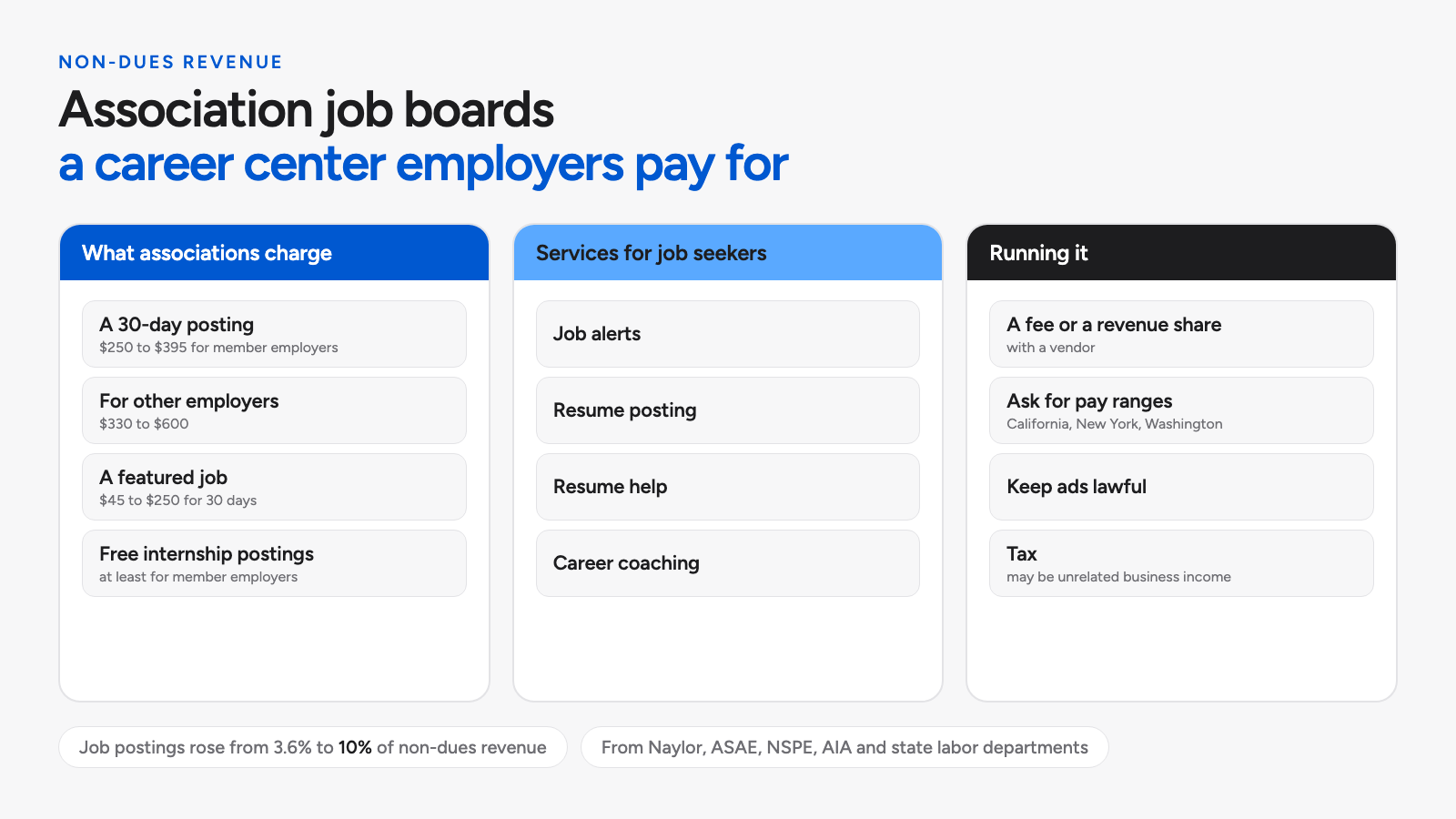
Two surveys suggest employers and job seekers both use them. In Naylor’s 2026 benchmarking report, job posting sales rose from 3.6% to 10% of associations’ non-dues revenue. In a 2025 survey for Momentive Software, 46% of association members said they had used their association’s job board or career center. Both companies sell job board software.
This guide covers how to run a job board, what associations charge, extras, free postings, services for job seekers, career fairs, pay ranges, keeping ads lawful, and tax.
Run it yourself or with a vendor
Many associations use a vendor rather than build their own job board. There are two common arrangements, as Naylor explains:
- A fee. The association pays the vendor to run the board.
- A revenue share. Part of each ad and posting sale goes to the vendor to pay for its services, and the association keeps the rest.
Many vendors also link boards into a network, so a posting can reach job seekers on other associations’ boards. Ask any vendor what share it takes, who owns the job seeker and employer data, and whether the board carries your name and design.
What associations charge
Job boards usually charge employers by the posting, with a lower price for member employers. Prices published in November 2026 for a 30-day posting:
- ASAE’s CareerHQ: $395 for members, $495 for others.
- The National Society of Professional Engineers: $380 and $600.
- The American Institute of Architects: $305 and $480.
- The Institute of Internal Auditors: $250 and $350.
- The National Recreation and Park Association: $275 and $385.
- The Texas Society of CPAs: $275 and $330.
All six boards run on the same vendor’s platform, Naylor’s, so their price lists look alike. A 60-day posting cost about a third to 70% more than a 30-day one.
Extras that employers buy
Beyond single postings, these boards sell some of the following:
- Packages. Several postings at a lower price each. ASAE charges members $2,770 for ten.
- A featured job, shown above the others. A 30-day upgrade costs $45 to $250 on these boards.
- Resume access. Employers search the resumes job seekers have posted. Most of these boards include it with a posting, and ASAE also sells it on its own, at $395 for 30 days for members.
- A featured employer spot. The American Institute of Architects and three of the other boards charge members $525 for 30 days.
- A place in the newsletter. ASAE adds a job to its jobs email for $150, and the National Society of Professional Engineers for $75.
- Shorter postings. ASAE sells a 7-day posting for $150 to members, and the park association one for $165.
Free postings for students and volunteers
Several boards post internships free, at least for member employers. The National Society of Professional Engineers and the Texas Society of CPAs post them free for everyone. The Institute of Internal Auditors and the National Recreation and Park Association post them free for members, and charge others $50 and $35. The park association also posts volunteer roles free for members. Free internship postings can bring students to the board.
Services for job seekers
Employers pay to reach job seekers, so the board has to serve them too. Common services:
- Job alerts, emailed when a matching job is posted.
- Resume posting, so employers can find job seekers.
- Resume help. The Association for Financial Professionals charges members $75 for a resume critique, and others $125.
- Career coaching. ASAE offers a 90-minute introduction to coaching for $359 to members.
- Salary data. ASAE’s job seekers can see median salaries for 75 association jobs, from its 2022 compensation study.
Career fairs
A career fair at the annual meeting brings employers and job seekers together. The Association for Behavior Analysis International ran one at its 2026 convention. Employers paid $2,450 for a recruiting area, three 60-day job postings, resume access and a full-page ad, or $1,350 if they were already exhibiting. An online-only package cost $1,450. The postings in the package run for 60 days, well after the two-day fair.
Ask for pay ranges
At least 17 states and cities have pay transparency laws, according to the American Alliance of Museums’ job board. Several require employers to include pay in job postings, and the rules cover postings on job sites as well as on an employer’s own site:
- California: employers with 15 or more employees must include the pay scale in any job posting. When a third party posts the job, the employer must give it the pay scale, and the third party “must include the pay scale,” the state’s Labor Commissioner says.
- New York: since September 17, 2023, employers with four or more employees must include pay. The law applies to postings by “a third-party on behalf of the employer, such as a recruiter or job listing website.”
- Washington: employers with 15 or more employees must post a wage scale or salary range, and a general description of benefits and other compensation.
Some associations go further. Since November 15, 2022, every job posted to the American Alliance of Museums’ JobHQ must include a salary range. The Minnesota Council of Nonprofits has required pay on its job board since 2020.
Making salary a required field helps the board follow these laws, and helps job seekers decide whether to apply.
Keep ads lawful
The Equal Employment Opportunity Commission says it is illegal for an employer to publish a job ad that “shows a preference for or discourages someone from applying” because of race, color, religion, sex, national origin, age (40 or older), disability or genetic information. Its example is an ad seeking “females” or “recent college graduates,” which may discourage men and people over 40 from applying.
Set posting rules, and remove ads that break them.
Tax
Job posting income may be taxed. The IRS treats ordinary commercial advertising in an association’s journal as unrelated business income, meaning income from a business outside the association’s purpose, even when the ads are aimed at the profession the association serves. Ask your tax adviser how this applies to your job board, since the IRS guidance covers journal advertising.
Our guide to non-dues revenue ideas covers other sources of income, and the US tax rule on advertising.
What to measure
- Postings sold, and revenue, each month.
- The share of employers who post again.
- Member and non-member employers.
- Job seekers who visit, set up alerts or post a resume.
- Applications per posting, if your board tracks them.
Where One Roof helps
One Roof works alongside your job board, with the community around it:
- Sponsor spots: sell an employer a featured spot on the community’s home page, in a space or in the email digest, with views and clicks counted.
- Mentoring: members find a mentor for career advice, with suggestions and the reason for each.
- A careers space: a discussion space where members ask about job hunting, salaries and moving up.
Questions about association job boards
How much should an association charge for a job posting?
On the six association boards we looked at in November 2026, a 30-day posting cost $250 to $395 for member employers, and $330 to $600 for others.
Should an association run its own job board?
Many use a vendor, either for a fee or for a share of each posting sold. Running your own means building, hosting and supporting the site yourself.
Do job postings have to include salary?
In several states, yes, including California, New York and Washington. In California, a job site that posts for an employer must include the pay scale too. Requiring salary on every posting helps the board follow these laws.
Is job board income taxable for an association?
It may be. The IRS treats commercial advertising in an association’s journal as unrelated business income. Ask your tax adviser how that applies to job postings.
How do you get employers to post jobs?
Give member employers a lower price, offer packages, post internships free, and sell postings together with a career fair at the annual meeting.

