Fundraising
Fundraising for associations: taking donations online, and the tax rules that apply
How associations raise money online: why gifts to a 501(c)(6) are not charitable gifts, why associations have foundations, what to say when you ask, receipts, card fees, December and monthly giving, and getting a second gift.
 Boopesh MahendranCo-founder, One Roof6 min read
Tap the picture to see it at full size.
In this article⌄
- Gifts to a 501(c)(6) are not charitable gifts
- Say gifts are not deductible when you ask
- Thank donors in writing
- What taking gifts online costs
- Make the giving page easy
- Plan for December
- Get the second gift
- Guard the page against card testing
- In the UK: Gift Aid
- Where One Roof helps
- Questions about association fundraising
Many associations raise money for something beyond their own running costs: scholarships, research, relief for members after a disaster. This guide covers the tax rules that decide where gifts should go, what to say when you ask, what taking gifts online costs, and how to turn a first gift into a second one.
Gifts to a 501(c)(6) are not charitable gifts
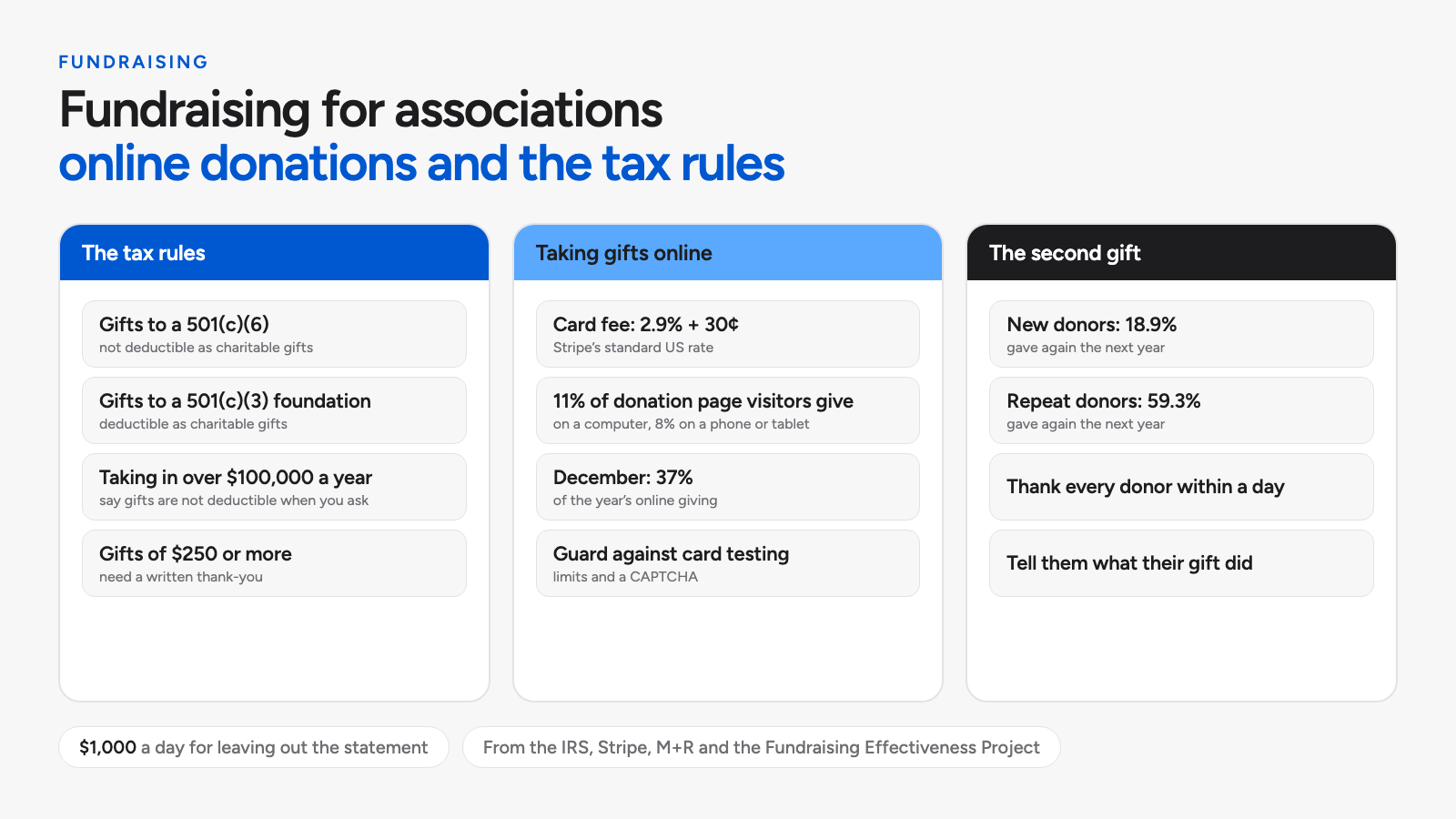
In the US, many trade and professional associations are 501(c)(6) organizations. The IRS is clear: a donor cannot deduct gifts to them as charitable gifts on their tax return. A business that gives may be able to count the gift as a business expense instead, if the gift is a normal cost of running that business.
That is why many associations have a related 501(c)(3) foundation: a separate charity linked to the association. As ASAE explains, a foundation can receive tax-deductible gifts and apply for grants. It pays for charitable and educational work, such as scholarships and research. It must keep its own board, records and accounts. Otherwise the association’s lobbying could count as the foundation’s, and put the foundation’s tax status at risk.
If you have a foundation, gifts for scholarships, research and other charitable work should be made to the foundation, paid into its bank account, with its name on the receipt.
Say gifts are not deductible when you ask
If your association is a 501(c)(6) and its gross receipts (all the money it takes in) normally exceed $100,000 a year, averaged over three years, every request for money must say that gifts are not deductible as charitable contributions. IRS Notice 88-120 explains the rule. The IRS suggests this wording:
Contributions or gifts to [your association] are not deductible as charitable contributions for Federal income tax purposes.
Put this statement on the giving page, in appeal emails, on printed forms, and on dues invoices and renewal notices. Leaving it out costs $1,000 for each day it happens, up to $10,000 a year. If it is left out on purpose, there is no limit.
Thank donors in writing
For gifts to a 501(c)(3), such as your foundation, IRS Publication 1771 sets two rules:
- Gifts of $250 or more: the donor needs a written thank-you to claim the deduction (the IRS calls it an acknowledgment). It must name your organization, give the amount, and say whether anything was given in return. Email counts, and one yearly summary can cover several gifts.
- Payments over $75 where the donor gets something back, such as a gala ticket: you must tell the donor in writing how much of the payment is deductible, with a fair estimate of what they received. The penalty for not doing so is $10 per gift, up to $5,000 per event or mailing.
The simplest way to meet the first rule: send every donor a thank-you straight away that says who you are, the amount, and that nothing was given in return.
What taking gifts online costs
Stripe’s standard US rate is 2.9% plus 30 cents for each card payment, with more for international cards. A $100 gift costs $3.20 to collect.
Two ways to keep more of each gift:
- A nonprofit discount. Stripe offers lower rates to registered nonprofits, but only where at least 80% of the money paid into the account comes from tax-deductible gifts. Dues and tickets do not count. A 501(c)(6) association’s own account cannot qualify, because gifts to it are not tax-deductible. A foundation’s might.
- Asking donors to cover the fee. On the giving forms of GiveCampus, a fundraising platform for schools, 51% of donors chose to cover it, with no clear drop in the share of visitors who gave. In a NextAfter test, though, adding the option cut the share of visitors who gave by more than a third. Test it on your own page before you rely on it.
Make the giving page easy
In the M+R Benchmarks 2026 study, 11% of people who visited a donation page on a computer gave, and 8% of those on a phone or tablet. Most visitors leave without giving, so keep the page short:
- Say what the money pays for, in one or two sentences.
- Show a goal and how close you are to it.
- Offer three or four suggested amounts, and let people type their own.
- Ask only for what you need: amount, name, email and card.
- Let donors give without their name shown publicly.
Plan for December
Giving is not spread evenly across the year. In the M+R study, December brought 37% of nonprofits’ online revenue for the year, and December 31 alone brought 4%. Plan your main appeal for the end of the year, and send a last reminder on the 31st.
Monthly giving matters too: 27% of online revenue in the same study came from monthly donors. A year after signing up, 71% of monthly donors were still giving. So let donors choose to give monthly as well as once, and make a monthly gift as easy to stop as it was to start.
Get the second gift
Most first-time donors do not give again the next year. The Fundraising Effectiveness Project found that only 18.9% of new donors in 2024 gave again in 2025. Repeat donors, who had given in at least two years, did far better: 59.3% gave again.
Four habits help:
- Thank every donor within a day, by name.
- A few months later, tell them what their gift did: the scholarship awarded, the research funded.
- Ask again during the year, not only in December.
- Report each fund’s total so donors can see it grow.
Guard the page against card testing
Fraudsters check whether stolen card numbers work by making small payments. Stripe says donation pages, where anyone can type any amount, are among the most common targets. Stripe’s recommended defenses:
- Use a checkout with built-in limits, such as Stripe Checkout.
- Add a CAPTCHA, and limit how many payments can be tried in a short time.
- Ask donors to sign in where you can.
In the UK: Gift Aid
If your association has a related charity, it can claim Gift Aid: an extra 25p for every £1 given by a UK taxpayer. The donor must make a Gift Aid declaration, and have paid at least as much tax that year as the charity claims. Ask for the declaration on the giving page, when the donor is already there.
Where One Roof helps
One Roof’s donations let members give inside the community they already use:
- Open a fund for each cause, with a goal and up to six suggested amounts.
- Members can give once or every month. Stripe takes a monthly gift on the same day each month until the member stops it from the fund’s page, where they can also change their card.
- Keep a fund to members, or open it to anyone with the link.
- Members can give without their name shown on the fund’s page. Your staff still see who gave.
- Each giver gets a thank-you email once Stripe confirms the gift. You can add your own note to it, such as your tax status and that nothing was given in return.
- Gifts go straight into your own Stripe account, through Stripe Checkout, with no fee from One Roof.
- Visitors who are not members give once, and must give at least 5 in the fund’s currency, such as $5. To stop card testing, only a set number of visitor checkouts can open in a short time.
- Refund a gift in one step, and download every gift as a spreadsheet (CSV).
For other ways to raise money beyond dues, see our guide to non-dues revenue ideas.
Questions about association fundraising
Are donations to a 501(c)(6) tax deductible?
Not as charitable gifts. A business that gives may be able to count the gift as a business expense instead, if the gift is a normal cost of running that business. Gifts to a 501(c)(3) foundation are deductible as charitable gifts.
Does a 501(c)(6) have to say gifts are not deductible?
Yes, if its gross receipts normally exceed $100,000 a year. Every request for money must say that gifts are not deductible as charitable contributions.
Why do associations have foundations?
So that people can give to the association’s charitable work, such as scholarships and research, and deduct the gift. A foundation can also apply for the many grants open only to charities.
What must a donation receipt say?
For a gift of $250 or more to a 501(c)(3): your organization’s name, the amount, and whether anything was given in return. If something was, describe it and estimate what it was worth.
Should donors pay the card fee?
Many will if you offer it, but in one test the option cut the share of visitors who gave. Try it on your own page and compare.

