Community management
The association community manager: the role, skills to hire for, and a weekly routine
What an association community manager does, why most members only read, how community teams are staffed and where they report, the skills and pay in association job postings, a weekly routine, working with member volunteers, and what to measure.
 Boopesh MahendranCo-founder, One Roof6 min read
Tap the picture to see it at full size.
In this article⌄
An online community does not run itself. Someone has to welcome new members, make sure questions get answers, keep discussions civil, and show the board what the community is worth. In many associations, that is a community manager’s job, though often it is one part of someone’s wider role.
This guide covers what the role does, how community teams are staffed, the skills and pay in association job postings, a weekly routine, working with member volunteers, and what to measure.
What a community manager does
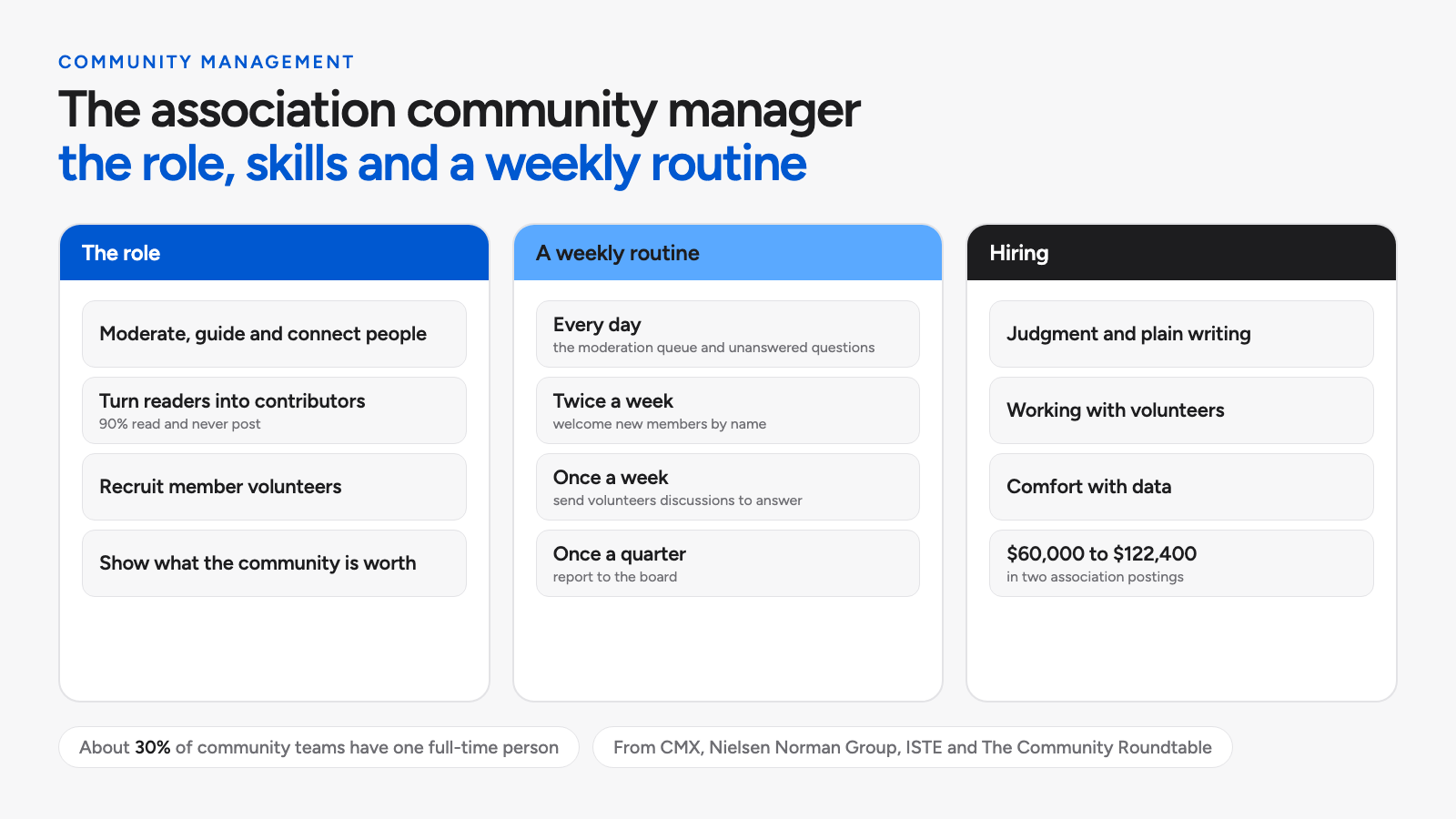
John Nawn put it simply in an article on ASAE’s site: “Community managers moderate, guide, and connect people.” In practice, the job covers:
- Strategy and growth: what the community is for, and getting members to use it.
- Engagement: starting discussions, making sure questions get answers, and introducing members to each other.
- Moderation: applying the community guidelines, fairly and quickly.
- Volunteers: recruiting and supporting members who help run the community.
- Reporting: showing staff and the board what the community does for members.
- Selling it inside the association: getting other staff to use the community and send members to it.
The last one is easy to miss. In a 2015 Associations Now article, Jim Storer of The Community Roundtable said community managers are often surprised by how much time one part of the job takes: “It’s almost always evangelism and coaching.” That means promoting the community to colleagues, and teaching them to use it.
Why so much of the job is getting people to post
Most members read and never post. Jakob Nielsen’s 90-9-1 rule, from 2006, describes it: “90% of users are lurkers (i.e., read or observe, but don’t contribute). 9% of users contribute from time to time… 1% of users participate a lot and account for most contributions.”
A 2014 study of four online health communities found the same pattern. Fewer than 25% of members posted at all, and the most active 1% wrote 74.7% of the posts. The authors concluded that keeping those members “is imperative for long-term success.”
So much of a community manager’s week goes to two groups: readers who could be persuaded to post, and the few members who post a lot and need to be thanked and kept.
How community teams are staffed
The most detailed recent figures come from CMX’s 2025 Community Industry Trends Report, a survey of 589 community professionals, 44% of them in technology. CMX is run by Bevy, which sells community software. In the survey:
- About 30% of community teams had one full-time person.
- 34% had two to five people, the most common size.
- 17% had no one working on community full time.
- 20% of respondents did community work as part of a broader role.
Marketing housed 31% of community teams, customer success 19%, and a separate community department 17%. In associations, the role may sit in membership or communications instead. The American College of Gastroenterology posting below, for example, supported the vice president of communications.
Having someone in the role helps you show its value. In preliminary results from a 2014 survey by The Community Roundtable, 51% of respondents with at least one dedicated community manager said they could measure their community’s value. Of those with no dedicated full-time community manager, 6% said so.
Skills to hire for, and what it pays
Two association job postings from 2026 show what employers look for:
- The American College of Gastroenterology advertised a social media and community manager at $60,000 to $75,000. The community duties included growing the community, recruiting and onboarding its expert panel members, working with the technology vendor, and reporting on analytics. It asked for an “excellent sense of judgement and discretion in communications.”
- The American Association for the Study of Liver Diseases advertised a senior manager for member communities and committee engagement, running its committees and member groups, at $81,600 to $122,400. It asked for the “ability to build and maintain strong relationships with volunteers and staff.”
Both asked for five to seven years of experience. The skills they stress:
- Judgment, for moderation and for knowing when to step in.
- Writing, clear and friendly.
- Working with volunteers, who give their time and need a reason to keep giving it.
- Comfort with data, to report what the community does.
Pay at nonprofits tends to be lower. The Community Roundtable found that community managers at nonprofits earned 40% to 49% less, depending on the role, than their peers at technology, telecom and software firms.
A weekly routine
A routine keeps the important work from being crowded out:
- Every day: check the moderation queue, and answer or route questions that have no reply.
- Twice a week: welcome new members by name, and introduce one or two to someone with shared interests.
- Once a week: send volunteers a list of discussions that need a reply (see below), and start one discussion with a question members care about.
- Once a month: report what happened, and thank the members who helped most, in public.
- Once a quarter: review the guidelines and the spaces, and report to the board.
Recruit member volunteers
One person cannot answer everything. Some ways to put member volunteers to work:
- Answering questions. In 2023, ISTE emailed member volunteers once a week with a list of discussions that had few or no replies. “If the topics fit their area of interest, we ask if they would submit a reply, and they usually do,” said Lauren Kelly, then its director of membership and community. ISTE, the education technology association, is now called the International Society for Transforming Education.
- Moderating. Moderation teams are small: in CMX’s 2025 survey, 60% of communities with 1,000 to 9,999 members had two to four moderators. Volunteers can fill out the team.
- Leading their own groups. Chapter and committee leaders can look after their group’s space, so staff are not the only moderators.
Thank volunteers in public, and give them something in return: recognition in the community, early access, or a line for their résumé.
What to measure
In CMX’s 2025 survey, 24% of respondents said they could confidently put a financial figure on their community’s value. Start by tracking:
- The share of members who visited, and who posted, each month.
- Questions answered, and how quickly.
- New members who posted in their first month.
- Searches that found nothing, which show what members need.
- Renewal rates of members who take part, against those who do not.
Our guide to measuring community value covers reporting this to your board.
Where One Roof helps
One Roof gives a community manager the tools for each part of the week:
- Questions waiting for an answer are shown on members’ home page, so they get answered, and discussions can have an accepted answer.
- Moderation: AI checks each new post, and reports and held posts go to one queue. A person makes every decision, with a reason recorded.
- Volunteers: chapter leaders and committee chairs moderate their own group’s space.
- Recognition: points and ribbons for members who help others.
- Reporting: searches that found nothing, who the community reaches, and a quarterly board report.
For bringing a quiet community back to life, see our guide to reviving a quiet association community.
Questions about association community managers
What does an association community manager do?
They run the association’s online community: welcoming members, getting questions answered, moderating, supporting member volunteers, and reporting what the community does for members.
Does an association need a full-time community manager?
It depends on the size of the community. Many are run by one person, sometimes as part of a broader role. In a 2014 survey, organizations with a dedicated community manager were far more likely to say they could measure their community’s value.
What skills should a community manager have?
Good judgment, clear and friendly writing, experience working with volunteers, and comfort reporting with data.
How much does an association community manager earn?
It depends on seniority. Two association postings in 2026 offered $60,000 to $75,000 for a mid-level role and $81,600 to $122,400 for a senior one. Pay at nonprofits tends to be lower than at technology companies.
Who should the community manager report to?
There is no single answer. In CMX’s survey, marketing was the most common home. In associations, the role may sit in membership or communications.

