Committees
Association committee management: charters, meetings and keeping committees on track
How to manage association committees: standing committee or task force, what a committee charter should say, the liaison's role, running meetings and writing minutes, antitrust rules for trade associations, terms, and reviewing committees.
 Boopesh MahendranCo-founder, One Roof6 min read
Tap the picture to see it at full size.
In this article⌄
- Why committees need managing
- Standing committee or task force
- Write a charter for each committee
- The chair and the liaison
- Run meetings that decide things
- Write minutes that record decisions
- In a trade association, mind antitrust rules
- Set terms, and end them on time
- Report to the board
- Review your committees
- What to measure
- Where One Roof helps
- Questions about committee management
Committees do much of an association’s work: they plan the conference, set standards, review awards and advise the board. Left alone, they multiply and lose sight of why they started. This guide covers when to use a committee or a task force, what a charter should say, how the chair and the liaison share the work, running meetings, antitrust rules, terms, and reviewing committees.
Why committees need managing
Committees are easy to start and hard to stop. The Louisiana Society of Association Executives describes an association that built up 75 committees over decades.
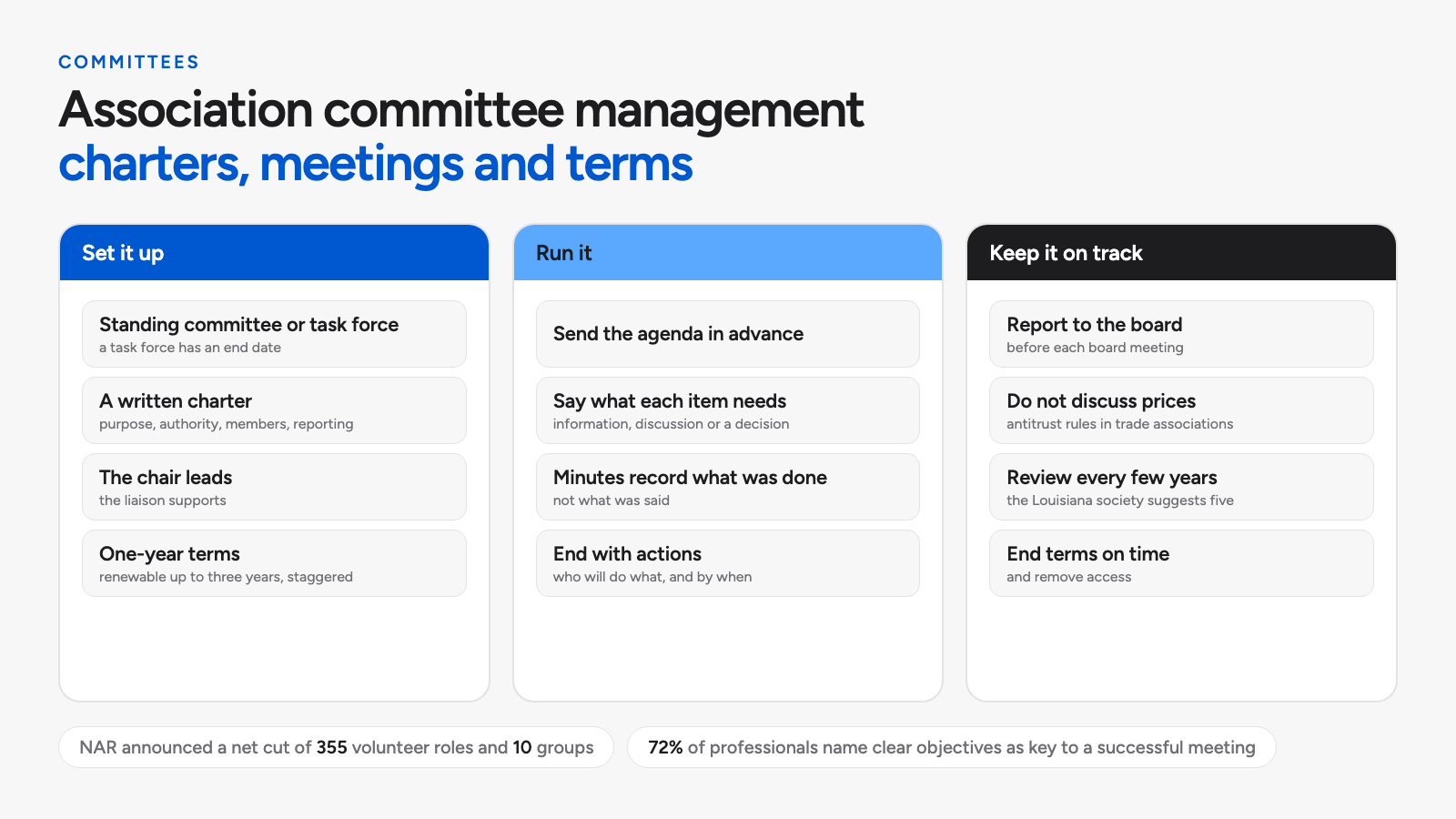
Many associations are now reviewing their committees. In April 2026, the National Association of REALTORS reported on an audit of its more than 95 committees, forums, councils and advisory groups, which found “declining confidence in committee effectiveness”. By June it had announced a net cut of 10 groups and 355 volunteer roles, most taking effect in December. One 89-member committee is being replaced by forum discussions, and a 21-member technology board by working groups formed for each issue.
Standing committee or task force
Decide first whether the work ever ends:
- A standing committee handles work that continues every year, such as finance, membership or the annual conference.
- A task force handles one job, such as reviewing the bylaws or choosing a new platform. Give it a deadline, and close it when the job is done. BoardSource, which advises nonprofit boards, says in its book Nonprofit Board Committees that a task force’s description should include “deadlines and the time frame to complete the work”.
When in doubt, start with a task force. It is easier to make a task force permanent than to close a committee.
Write a charter for each committee
BoardSource also says every committee and task force “should have a written charter that defines its role, goals, and accountability”. Its book lists what to include:
- Purpose: why the committee exists, in a sentence or two.
- Type: a standing committee, or a task force with its end date.
- Responsibilities: what it is expected to do.
- Authority: what it can decide on its own, and what goes to the board.
- Membership: how many members, whether people who are not on the board can serve, who votes, and term limits.
- The chair: who chooses them, and for how long.
- Meetings: how often it meets.
Also say how and when it reports to the board, and add a date to review the charter. Committees should not act for the board unless the charter says so. The Louisiana society’s guide puts it plainly: committees “shall not usurp the authority of the board nor sign contracts”.
The chair and the liaison
Most committees have a volunteer chair and a liaison from the staff or the board. Agree who does what:
- The chair leads. The Louisiana society’s guidance says liaisons “do not replace the authority of a committee chair”.
- The liaison supports. They prepare agendas, reports and minutes, and keep track of what was agreed.
- Plan the year together. Tecker International suggests that staff work with the chair on an annual written work plan, with timelines.
- Start early. An article on ASAE’s site suggests starting the partnership with the chair-elect, and checking in halfway through the chair’s term.
Run meetings that decide things
In Doodle’s 2019 State of Meetings report, 72% of professionals named clear objectives and 67% a clear agenda as keys to a successful meeting. For each committee meeting:
- Send the agenda and papers in advance, at least a week before.
- Say what each item needs: information, discussion or a decision.
- End with actions: who will do what, and by when.
- Plan for people joining online. In Doodle’s 2023 report, 42% of North American meetings scheduled with Doodle were online only, and 38% were hybrid, with some people in the room and some online.
If nothing needs deciding, share the update in writing and skip the meeting.
Write minutes that record decisions
Robert’s Rules of Order is clear: “Minutes are a record of what was done at a meeting, not a record of what was said.” Record:
- Who attended, and whether there was a quorum.
- Each decision, and each vote.
- Each action, with who owns it and the date it is due.
Robert’s Rules also sets two defaults, which your bylaws can change: a quorum is a majority of the members, and a committee chair may vote and join the discussion like any other member.
In a trade association, mind antitrust rules
When competitors sit on the same committee, discussing some topics can break antitrust law. The Federal Trade Commission (FTC) says: “It is illegal to use a trade association to control or suggest prices of members.” The FTC also says most association activity is legal. A model antitrust policy from the law firm Venable, published by ASAE, sets rules for all association meetings, committees included:
- Do not discuss prices, fees or rates.
- Do not agree to divide customers, markets or territories.
- Send agendas in advance, and keep minutes that accurately reflect the actions taken.
- Leave any meeting where improper subjects are being discussed.
Venable also says it can help to have antitrust counsel at association meetings.
Set terms, and end them on time
Fixed terms bring in new people and give long-serving members a natural point to step down:
- ASAE appoints its own committee volunteers for one-year terms, renewable for up to three years.
- Chairs usually serve for a year, the Louisiana society notes.
- Stagger terms, so the whole committee does not change at once.
When a term ends, remove the person’s access to the committee’s private papers and discussions, and thank them.
Report to the board
The board needs to know what each committee did, without reading every set of minutes:
- A short report before each board meeting. The Louisiana society’s sample report form asks committees to send it to their liaison 10 days before the board meeting.
- What was decided, what is in progress, and anything the board needs to approve.
- Whether the committee is on track with its work plan.
Review your committees
Every few years, ask these questions about each committee:
- Does it still serve the association’s purpose?
- What does it cost in money, staff time and volunteer time?
- Could the work be done by a task force, a working group or a discussion open to all members?
The Louisiana society suggests reviewing the whole committee structure every five years. In ASAE’s 2016 study of volunteer involvement, 79% of associations had recently added, removed or changed a committee’s mission.
What to measure
- The share of committees with a current charter.
- The share of meetings with an agenda sent in advance.
- The share of actions completed by their due date.
- The share of terms that ended on time.
- New members brought onto committees each year.
Where One Roof helps
With One Roof’s chapters and committees, each committee gets its own place in the community:
- A space for the committee, open or private to its members, with its own discussions and events.
- A members list with each role and when each term ends.
- Leaders and staff are reminded before a term ends. When the term ends, the role and the access that came with it are removed.
- Chairs can pin notices, set up meetings and manage the members list of their own committee, without asking staff.
- A committee can post an opening. Members apply, and its leaders decide.
- Staff see every committee, its leaders, and applications waiting for a decision.
For finding and keeping the volunteers who serve on committees, see our guide to volunteer management.
Questions about committee management
What is committee management in an association?
The work of setting up committees, giving each one a clear purpose and authority, supporting its meetings, keeping track of members and terms, and reviewing whether it is still needed.
What should a committee charter include?
Its purpose, whether it is a standing committee or a task force, its responsibilities, what it can decide on its own, who serves and for how long, who chooses the chair, how often it meets, and how it reports to the board.
What is the difference between a committee and a task force?
A standing committee does work that continues every year. A task force does one job, has a deadline, and closes when the job is done.
What should committee minutes include?
Who attended, whether there was a quorum, each decision and vote, and each action with its owner and due date. Minutes record what was done, not what was said.
Should committee terms be staggered?
Yes. If terms end at different times, the committee keeps people who know its work while new members join.

