Continuing education
How to start an association certification program
How to start an association certification program: certification vs certificate, keeping it independent of membership and training, the job analysis, writing and scoring the exam, accreditation by NCCA or ANAB, fees and examples from ASAE, SHRM, AHIMA and CFRE, recertification, and the legal rules.
 Boopesh MahendranCo-founder, One Roof7 min read
Tap the picture to see it at full size.
In this article⌄
ASAE’s Certified Association Executive (CAE) credential has existed since 1960, and 4,474 people held it in April 2025. Building a certification like it takes years, and it has to be run at arm’s length from the association that sponsors it.
This guide covers what a certification is, keeping it independent, the steps to build the exam, accreditation, fees and examples, recertification, the legal rules, and common mistakes.
Certification, certificate or license?
The Institute for Credentialing Excellence (ICE), a US association for credentialing organizations that runs NCCA accreditation, defines them like this:
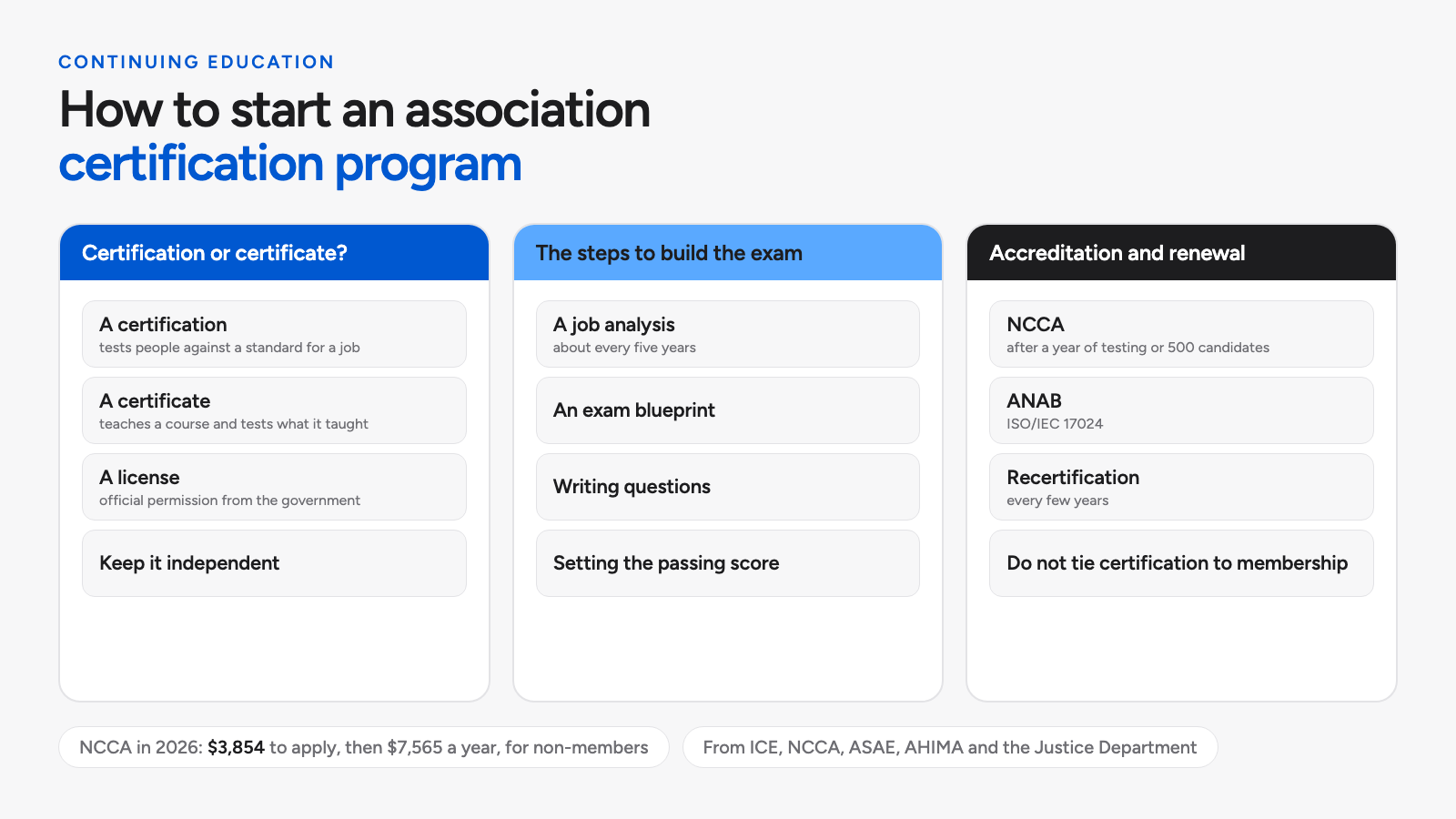
- Certification “is a voluntary process that measures whether someone meets set standards of knowledge and skills.” It lasts for a set period, and holders must show they are keeping up to renew it. The exam is “not tied to any single class, course, or training provider.”
- A certificate is “a non-degree program that teaches specific knowledge or skills.” If it ends with a test of what was taught, ICE calls it an assessment-based certificate program.
- A license is “official permission from the government to work in a certain job.”
So if you want to teach a course and test what it covered, build a certificate program. If you want to say that someone is competent in a role, whatever course they took, build a certification.
Keep it independent
The 2021 standards of the National Commission for Certifying Agencies (NCCA), ICE’s accrediting arm, require a certification board with “autonomy in decision-making” over who is eligible, the exam, passing standards, and discipline of holders who break its rules. The board must include at least one voting member who represents the public.
The standards, quoted here from their final public draft, say that protecting the board from outside pressure “is especially important when a certification program is sponsored by a professional membership association.”
They also require a separation, often called a firewall, between certification and any training:
- Exam prep courses must not be described as the best or only way to prepare.
- Buying them “must be optional.”
- Those who take them must get no unfair advantage.
ASAE’s CAE is run by the CAE Commission, “an independent certifying body of ASAE,” which does not help candidates prepare, “believing it to be a conflict of interest.”
Some go further and set the certification up as a separate organization. CFRE International, which awards a fundraising credential, became an independent nonprofit in 2001. HRCI, which offers the PHR, began in 1973 as an institute of the association now called SHRM.
The steps to build the exam
A certification exam is built and checked by psychometricians, specialists in the design of tests, working with experienced practitioners, known as subject-matter experts. The main steps:
- A job analysis. A study of what people in the role actually do, usually through expert panels and a survey of practitioners. NCCA suggests repeating it about every five years, more often in fast-changing fields.
- An exam blueprint. A plan of what the exam covers, and how much weight each area gets, based on the job analysis.
- Writing questions. Experts write and review the questions, often called items. ASAE’s CAE questions are written by a committee of CAE holders.
- A pilot. New questions are tried out before they count. NCCPA, which certifies physician assistants, includes unscored pre-test questions in its supervised exams, and candidates cannot tell which ones they are.
- Setting the passing score. Experts judge how a minimally competent candidate would do on each question. ASAE uses a method called “modified Angoff,” which it compares to “par on a golf course.”
- Keeping exams equal. NCCA requires a statistical adjustment, called equating, or another sound method, so that candidates on every version of the exam face the same standard.
The American Health Information Management Association (AHIMA) publishes this cycle for its exams. For the RHIA’s latest update, the job analysis began in the last quarter of 2022 and the pilot exam ran in October 2023, about a year later.
Accreditation
Accreditation is an outside review that shows a certification meets recognized standards. There are two main routes in the US:
- NCCA. More than 300 programs are accredited. A new program may apply only after one year of testing or once 500 candidates have taken the exam, whichever comes first. The review takes up to five months, applications are accepted three times a year, and accreditation lasts five years.
- ANAB, the ANSI National Accreditation Board, accredits certification bodies against ISO/IEC 17024, the international standard for organizations that certify people. In 2022, ANSI said it had accredited more than 225 programs since 2003. A new edition of the standard, ISO/IEC 17024:2026, replaced the 2012 one in March 2026.
NCCA’s 2026 fees for an organization that is not an ICE member are $3,854 to apply for one program, then $7,565 a year for up to two programs. ICE members pay $2,892 and $6,870, plus their ICE membership dues.
Fees and examples
What some well-known certifications charge and require:
- ASAE’s CAE: $500 to apply for ASAE members, $750 for others. About 60% of candidates pass. Holders renew every three years with 40 credits.
- SHRM-CP and SHRM-SCP: $399 for members and $499 for others at the standard rate in 2026, or $350 and $450 if booked early. Holders renew every three years with 60 credits.
- AHIMA’s RHIA: $229 for members and $299 for others. 13,848 people held it at the end of 2025, and 67% of first-time candidates passed in 2025.
- CFRE, for fundraisers: $875, or $700 for members of participating organizations. It has more than 8,200 holders, and is accredited by ANAB.
Most charge non-members more. A lawyer at Venable advises that this can be fair, to reflect the share of membership dues that pays for the program, but that the certification itself should be open to members and non-members on the same terms.
Recertification
A certification must be renewed every few years, by earning continuing education credit or retaking the exam: every two years for AHIMA’s RHIA, and every three for the CAE and SHRM credentials. Renewal also gives the association a reason to stay in touch with holders. In 2023, 83% of CAE holders due to renew did so.
Make the rules simple to follow, and show holders their progress. Our guide to continuing education credit tracking covers keeping those records.
The legal rules
- Disability accommodations. The Americans with Disabilities Act covers organizations that offer certification exams. The Justice Department’s guidance, which explains the ADA rules for testing, says testing organizations must respond to accommodation requests “in a timely manner,” and that any documentation they ask for must be “reasonable and limited” to the need. Proof of the same accommodations on similar past tests “is generally sufficient.”
- Do not tie certification to membership. In 2018, a court approved an $84 million settlement of an antitrust class action against the American Osteopathic Association, over a policy requiring physicians seeking its board certification to buy membership. The settlement ended the policy.
- Keep standards to what competence requires. Venable also advises that certification standards be “no more stringent or rigid than necessary to ensure the minimum competency,” and that commercial considerations play no role.
- Protect the exam. Keep question banks secure, and replace questions often enough that candidates cannot learn them in advance.
Common mistakes
- Calling a course a certification. If it tests only what a course taught, it is a certificate.
- Letting the association run it directly, without an independent certification board.
- Making the association’s prep course the obvious way to pass.
- Requiring membership to sit the exam.
- Skipping the job analysis, so the exam tests what experts think matters rather than what the job requires.
- Underestimating the time, from the first job analysis to accreditation.
Where One Roof helps
One Roof does not build or deliver exams. It helps once people hold the credential:
- Recertification credit: a program for each credential, with its own cycle and requirement. Members marked as attending an event get its credit automatically, and each member sees their progress.
- A clear record: every credit has a reason and a date, and the whole record downloads as a file for audits.
- Reminders: ready-made reminders about recertification credit. Each is off until you switch it on, and you can edit its subject and opening line.
- A community for holders: a discussion space for credential holders, where taking part, such as an answer the asker accepts, can earn credit, up to a limit each cycle.
Questions about association certification programs
What is the difference between a certification and a certificate?
A certification tests whether someone meets a standard for a job, independently of any course, and must be renewed. A certificate program teaches a course and tests what it taught.
How long does it take to start a certification program?
Expect at least a year to build the exam, starting with a job analysis. NCCA accreditation can only be sought after a year of testing or 500 candidates, and the review takes up to five months.
How much does NCCA accreditation cost?
In 2026, $3,854 to apply for one program and $7,565 a year (for up to two programs) for organizations that are not ICE members, or $2,892 and $6,870 for members, who also pay ICE dues.
Can an association require membership for its certification?
It should not. In 2018, a court approved a settlement that ended the American Osteopathic Association’s policy of requiring membership for its board certification. Non-members can be charged more, but the exam should be open to all.
How often should a certification exam be updated?
NCCA suggests a new job analysis about every five years, and new versions of the exam often enough to keep the content current and the questions secure.

