Advocacy
Grassroots advocacy for associations: how to get members to take action
How associations run grassroots advocacy: what influences an undecided lawmaker, why personal messages beat form emails, key contact programs, fly-ins, training advocates, the US lobbying and tax rules, and what to measure.
 Boopesh MahendranCo-founder, One Roof7 min read
Tap the picture to see it at full size.
In this article⌄
Advocacy is one of the main reasons people join some associations. In Marketing General’s 2024 benchmarking report, 27% of associations named supporting advocacy among the top three reasons members join. At trade associations, it was 39%.
But many advocacy programs rely on the tactic congressional staff rate lowest. In a 2018 poll by the Congressional Management Foundation (CMF), 79% of grassroots organizers said mass email campaigns were their “primary” way to contact Congress. Yet only 3% of congressional staff said such campaigns have “a lot” of influence on an undecided lawmaker, CMF reported in 2021.
This guide covers what influences lawmakers, writing messages that count, building relationships, fly-ins, training advocates, the US rules, and what to measure.
What influences an undecided lawmaker
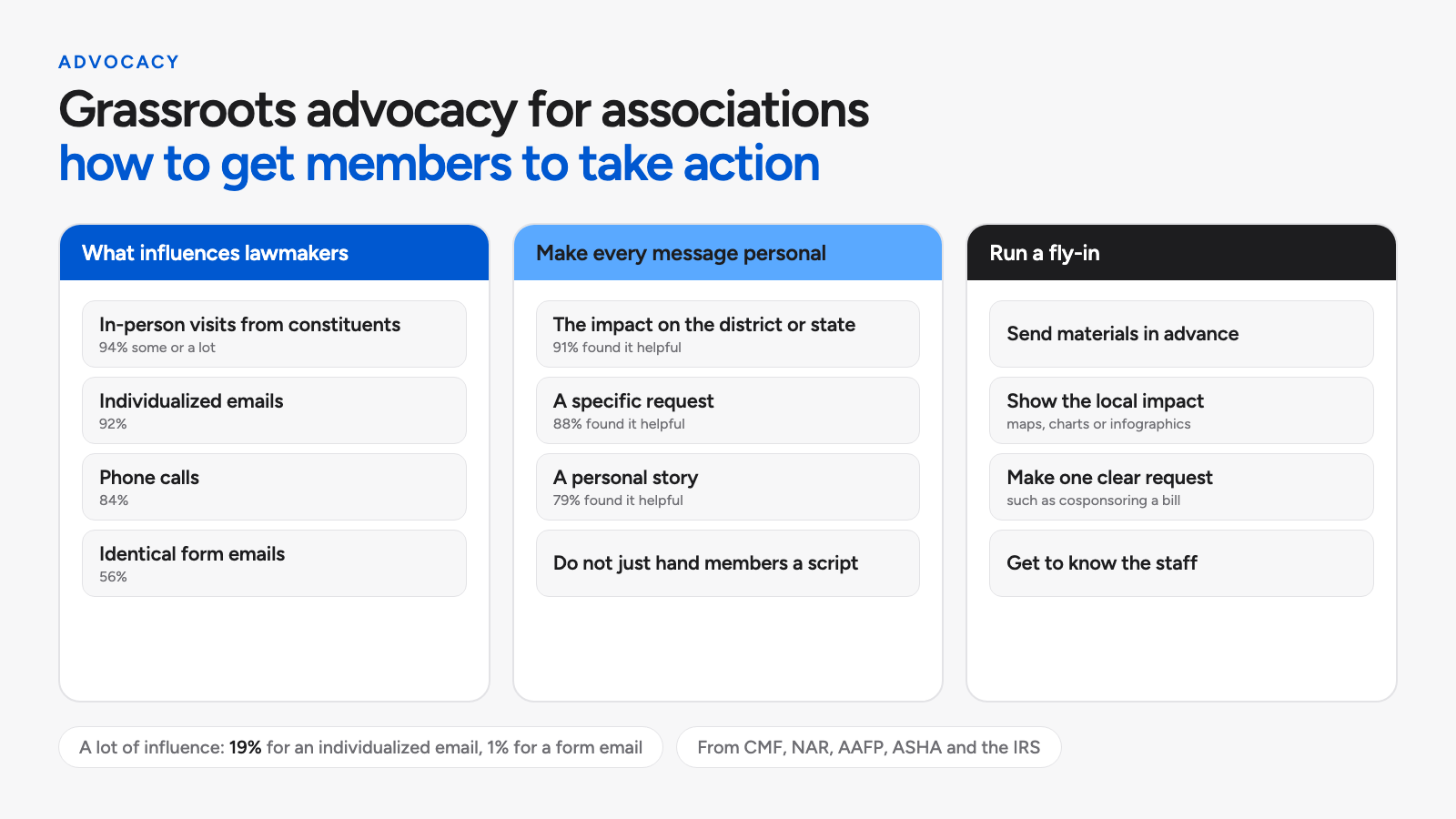
CMF, a nonpartisan nonprofit, has surveyed congressional staff about citizen advocacy since 2004. In its 2015 survey, staff were asked how much influence each tactic might have on a lawmaker who had not yet decided. The share saying some or a lot:
- In-person visits from constituents: 94%.
- Individualized emails: 92%.
- Phone calls: 84%.
- A visit from a lobbyist: 83%.
- Identical form emails: 56%.
The gap is wider when you ask which tactics have a lot of influence. In CMF’s 2010 survey, 46% of staff said an in-person visit from constituents would. For an individualized email it was 19%, and for a form email 1%.
Make every message personal
“What matters most is the content, not the vehicle,” CMF concluded. An email can carry as much weight as a letter, as long as the member writes it in their own words. In the 2010 survey, more than half of staff (53%) agreed that most campaigns of identical form messages are sent without constituents’ knowledge or approval.
Staff in the 2015 survey also said which parts of a message help them most, and how often messages include them:
- The impact on the district or state: 91% found it helpful, but only 9% said messages often include it.
- The writer’s reasons for supporting or opposing: 90% found it helpful, and 50% said messages often include it.
- A specific request: 88% found it helpful, and 59% said messages often include it.
- A personal story: 79% found it helpful, but only 18% said messages often include it.
So in an action alert, do not just hand members a script. Give them the local facts, ask them to add a line about their own work, and say exactly what you want the lawmaker to do.
Build relationships, not only alerts
A lawmaker who knows a member personally is more likely to listen. Many associations match members with lawmakers in a key contact program:
- The National Association of REALTORS (NAR) has 535 Federal Political Coordinators, one for each member of Congress. Each should have “a minimum of four personal contacts” with their lawmaker or staff a year, and all must complete training.
- The American Academy of Family Physicians (AAFP) pairs family physicians with lawmakers through its Advocacy Ambassadors program. In July 2026 it had 1,000 members in 49 states.
Meetings back home count too. In CMF’s 2010 survey, 94% of staff said constituent visits to the district or state office had some or a lot of influence. In 2018, the Auto Care Association launched a program to help members meet lawmakers in their home districts. Staff prepared the agenda, so members only had to give an hour on the day.
Run a fly-in
A fly-in, or Hill day, brings members to Washington, or to their state capital, to meet their lawmakers. Some examples:
- The American Speech-Language-Hearing Association (ASHA): in 2025, 301 participants from 49 states held 262 meetings. ASHA says nine new cosponsors joined bills it supports within days.
- AAFP: in 2026, more than 350 advocates held more than 240 meetings with congressional offices during its Family Medicine Advocacy Summit.
- SHAPE America: 215 members from 45 states took part in its 2017 advocacy day. It offers scholarships to help with travel costs.
To make the meetings count:
- Send materials in advance. In the 2015 survey, 76% of staff said groups should send materials before meetings more often.
- Show the local impact. 85% wanted more materials, such as maps, charts or infographics, showing an issue’s impact on the district or state.
- Make one clear request, such as cosponsoring a bill.
- Get to know the staff. 79% said groups should do more to get to know the legislative assistant who handles their issue.
Train your advocates
Few constituents arrive well prepared. CMF and Feeding America trained food bank staff in their Advocacy Academy, with more than 40 hours of training, coaching and role-playing. 97% of the congressional staff who met the trained advocates said they were “very prepared.” By contrast, only 12% of congressional staff say the typical constituent they meet is very prepared.
Training does not have to take 40 hours:
- ASHA’s 2026 advocates spent a day preparing with advocacy experts before their meetings.
- ASAE’s American Associations Day included education sessions on how to succeed in congressional meetings, whether or not attendees had experience in government relations.
- AAFP gives its Advocacy Ambassadors training modules, action alerts and discussion points.
Know the rules
In the US, associations can lobby, but the rules depend on their tax status:
- 501(c)(6) trade and professional associations may lobby on issues related to their purpose. But they must tell members what share of their dues went to lobbying, because that share is not tax-deductible. An association that does not send this notice pays a proxy tax instead. Some are exempt, such as associations where 90% or more of members cannot deduct their dues anyway.
- 501(c)(3) charities may lobby, but not as a substantial part of their activities. A charity can elect a spending limit instead. The limit is 20% of the first $500,000 it spends on its exempt purposes, with smaller shares above that, up to $1,000,000 a year.
- Registration. Under the federal Lobbying Disclosure Act, an association with an in-house lobbyist must register when its lobbying expenses exceed $16,000 in a quarter. That threshold applies from January 1, 2025.
What to measure
Grassroots programs are often measured by just two things, CMF notes: “How many messages did we send to Capitol Hill?” and “Did we pass or block a bill?” It suggests also tracking relationships:
- How many members are in regular contact with key lawmakers.
- How often members meet or write to their lawmakers.
- How many trained advocates you have in key districts and states.
- Whether a key lawmaker has visited a site that matters to your cause, such as a member’s workplace, or attended one of your events.
Also count meetings held, first-time advocates, and new cosponsors after a fly-in, as ASHA and AAFP report.
Where One Roof helps
One Roof does not send messages to lawmakers. It helps you organize the members who do:
- Chapters and committees give your advocates or government affairs committee their own space, private if you wish, where they can discuss issue briefs and share stories from their meetings.
- Volunteer openings let you recruit key contacts. Members apply with a note, and see the openings that fit their expertise first.
- Announcements reach all members, or only the followers of your advocacy space, when you need them to act.
- Polls ask members where they stand on an issue, with the answers split by member type, region and industry.
- Events handle registration for a fly-in or a training session.
Questions about grassroots advocacy
What is grassroots advocacy for associations?
Getting members to contact their own lawmakers about issues that affect their profession or industry, by email, by phone or in person.
Do form emails to Congress work?
Not well on their own. In CMF’s 2010 survey, 1% of congressional staff said identical form emails would have a lot of influence on an undecided lawmaker. For individualized emails, it was 19%.
What is a key contact program?
A program that pairs individual members with lawmakers, so each lawmaker hears regularly from someone they know. NAR has one volunteer for each of the 535 members of Congress.
What is an association fly-in?
An event where members travel to Washington, or to their state capital, to meet their lawmakers and their staff, often after a day of briefings or training.
Can associations lobby?
Yes. In the US, 501(c)(6) associations may lobby on issues related to their purpose, but must tell members what share of their dues went to lobbying, or pay a proxy tax. 501(c)(3) charities may lobby only within limits.

