Moderation
Community guidelines for an association, with a template to copy
How to write online community guidelines for an association: what to include, how long they should be, a template to copy, and what to do when someone breaks them.
 Boopesh MahendranCo-founder, One Roof8 min read
Tap the picture to see it at full size.
In this article⌄
Community guidelines tell members what the community is for and what is not allowed in it. Most templates online are written for brand communities and creators. An association’s community needs more: members are competitors, colleagues and clients of each other, and some of what they discuss is confidential or regulated. This guide covers what to include, a template you can copy, and how real associations enforce theirs.
Why write them down
- Members follow rules they can see. A 2019 study looked at a science discussion forum with 13 million subscribers. Where the rules were not posted, a first-time commenter had a 52.5% chance of following them. Posting the rules raised that by 8.4 percentage points, and raised newcomers’ participation by 70% on average.
- Explaining removals helps. A study of 32 million Reddit posts found that telling members why a post was removed “reduces the odds of future post removals”.
- Members break rules they do not know. The American Society of Civil Engineers says in its violation policy: “Most violations to date are a result of a member not knowing they were in violation.”
What association guidelines include
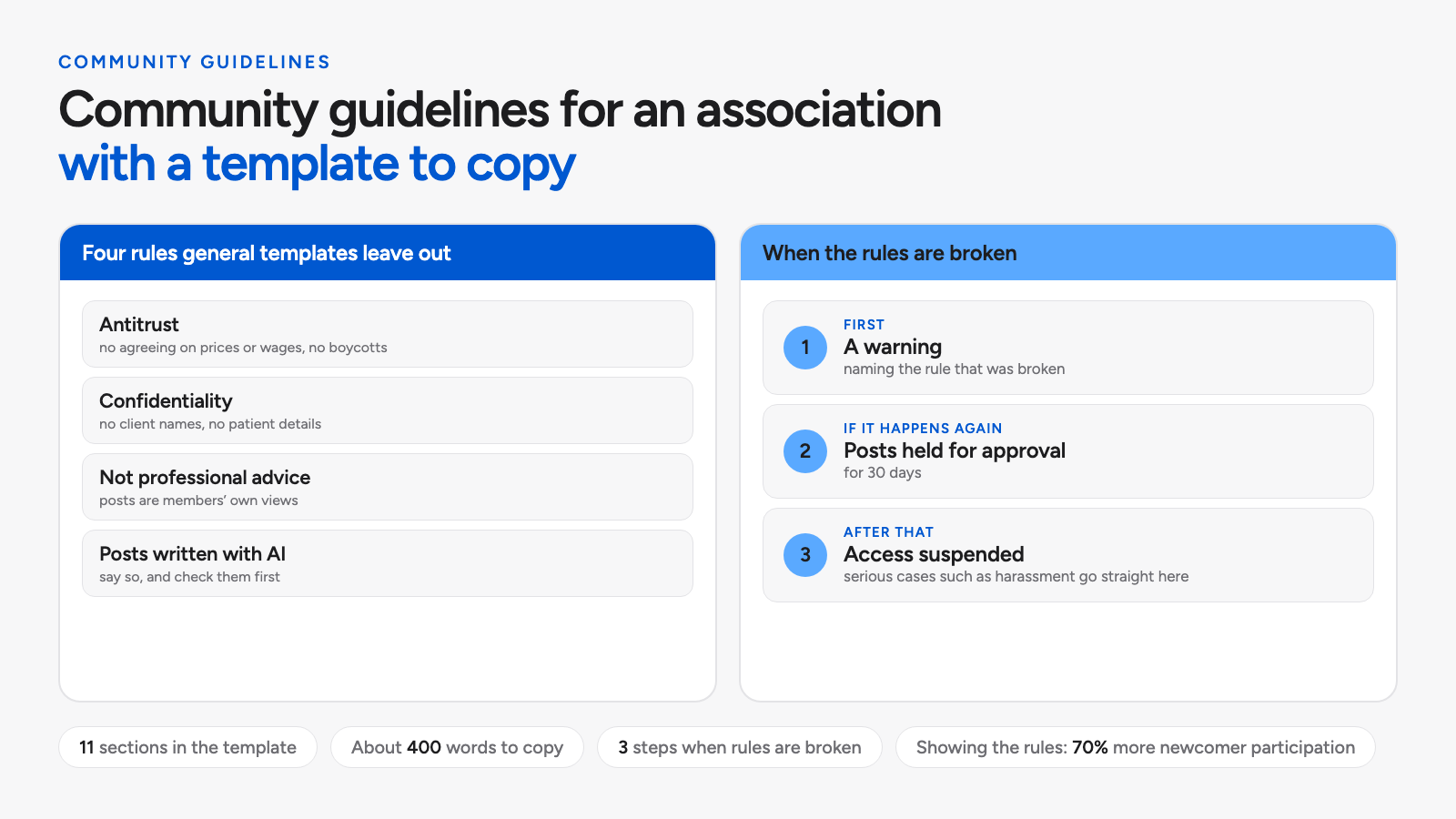
Like most templates, association guidelines usually ban selling. ASAE’s rules say: “Promotional messages are not permitted in Collaborate.” They also have four rules that general templates leave out:
- Antitrust. Members who compete must not use the community to agree on prices. The American Society of Anesthesiologists’ terms say: “Do not discuss pricing, profit margins, wage information, boycotts or other information of a competitive nature.” The FTC’s guidance for trade associations says the same law applies through an association: “it is illegal to use a trade association to control or suggest prices of members.”
- Confidentiality. ASCE asks members not to name clients. The American Association of Endodontists forbids posting any identifiable patient’s health information without the patient’s written authorization. ASHA’s guidelines ask that client details be “de-identified”.
- Not professional advice. AICPA & CIMA’s terms say that what is posted “is not intended to be professional advice”.
- Posts written with AI. The same terms say anything generated with AI “must be clearly identified and attributed with the source”.
How long they should be
YourMembership advises a single page, “no more than about 500 words”. The association pages above run from under 1,000 to about 3,000 words, because most mix the rules with legal terms.
Split them. Keep the rules short enough that members read them, and put the legal terms (liability, copyright, privacy) on a separate page. ASAE already puts its violation policy on a page of its own.
A template to copy
Replace the words in brackets, and remove any rule that does not apply to you. It comes to about 400 words.
What this community is for. [Community name] is where [Association] members ask questions, share what they know and help each other in their work. Ask anything about [profession]. If you know the answer to someone’s question, reply.
Be professional. Disagree with ideas, not people. No personal attacks, harassment or discrimination. Write as you would at a meeting with colleagues you respect.
Keep confidential things out. Do not name clients, patients or employers’ confidential information. Remove details that identify anyone before you share a case or a document. Do not repost a private message without permission.
No selling. Do not promote products, services or events you have a financial interest in. Vendors may answer questions about their products when asked, and say who they work for. Job openings go [where they belong].
Competition law. Do not discuss or agree with competitors on prices, fees, wages or other terms you offer, and do not call for a boycott of any business. Share published or combined survey data, not your organization’s current figures.
Not professional advice. Posts are members’ own views. They are not legal, medical, financial or other professional advice, and they are not the official position of [Association].
Respect others’ work. Share only what you have the right to share. Link to an article and do not paste it whole.
Posts written with AI. Say so when a post is mostly written by AI, and check it before you post.
Stay on topic. Post in the space that fits. Moderators may move a discussion to a better place.
What happens if the rules are broken. Moderators may edit, hide or move a post, and will tell you why. If it happens again, your posts may be held for approval for 30 days. After that, your access may be suspended. Serious cases, such as harassment, can lead straight to suspension.
Reporting a problem. If you see a post that breaks these rules, report it [how]. Questions go to [name or address].
How real associations enforce theirs
Each of these uses a ladder of three or four steps:
- ASHA: a written warning, then the member’s posts are held for moderation, then access is disabled for six months.
- ASAE: contact from staff, then posts held for 30 days, then three months held, then a formal letter and possible removal.
- The American Association of Endodontists: a warning email, then 30 days of monitored posts, then removal for a set period or for good.
- ASCE: two rounds of contact, the second from a member of its editorial board, then a 30-day suspension, then a formal letter and a possible bar. Members can appeal.
AICPA & CIMA says that in most cases it will not suspend anyone for a single violation. Write down which cases skip the ladder, such as harassment or posting a patient’s records.
The legal parts
- Section 230 protects the host. In the US, Section 230 means a host is not treated as the publisher of what its users post. It also protects removing material “in good faith”. The EFF notes it does not cover intellectual property claims or federal crimes.
- Register a copyright agent. To qualify for the DMCA safe harbor, a service that lets users post material must designate an agent with the US Copyright Office. It costs $6 and expires after three years unless renewed.
- Have your lawyer read the competition section. Venable, a law firm that advises associations, warns that “online listserves and chat rooms” give rivals a place to “talk about matters that they perhaps should not discuss.”
Putting them in place
- Ask members to accept them when they join. A 2021 antitrust training for an association advises that forum rules be “agreed to (click-and-accept)” before joining and “sent out to all forum participants each year”.
- Show them where people post, especially to first-time posters.
- Link to the rule when you act. Each warning or removal names the rule it is about.
- Review them once a year, and add rules only for problems that have happened.
Where One Roof helps
One Roof includes community guidelines and moderation built for professional communities:
- Staff publish the community guidelines, and each member accepts them with their first post. When staff change them, they can ask every member to accept them again.
- Each space can have a few rules of its own beside its discussions, set by staff or by the space’s own moderators.
- AI checks each new post for spam, abuse, personal details and confidential material. A doubtful new discussion is held for a moderator, and nothing is removed automatically.
- Members can report a post, a file or a private message, with a reason.
- A member’s first discussion in a space can be held for approval.
- Moderators can warn a member or suspend them for a set number of days. Each needs a written reason, the author is told, and the decision is kept on record.
- A removed post is hidden, not deleted, and can be restored.
- Members can block each other.
Questions about community guidelines
What should online community guidelines include?
What the community is for, how to treat other members, what must stay confidential, and a ban on selling. An association should add a competition law rule and a line that posts are not professional advice. End with what happens when the rules are broken.
How long should community guidelines be?
About one page, or 500 words, for the rules members read. Put the legal terms on a separate page.
What is the difference between community guidelines and terms of use?
Guidelines say how members should behave, in plain words. Terms of use are the legal agreement: liability, copyright, privacy and the right to remove content.
Why do associations include antitrust rules in their community guidelines?
Many members are competitors, and antitrust law applies to their discussions online as it does at a meeting. Using an association to agree on prices is illegal, and sharing current prices can raise antitrust concerns.
How do you enforce community guidelines?
With a ladder: a warning, then posts held for approval, then a suspension. Tell the member which rule they broke each time. Serious cases such as harassment can go straight to suspension.
Should members have to accept the guidelines?
Yes. Ask members to accept them when they join, and remind everyone of them once a year.

